
Deciphering the Emotional Impact of 3D Visual Discomfort: A Machine Learning Approach
Modelling effects of S3D visual discomfort in human emotional state using data mining techniques
The paper presents a machine learning-based model for estimating human emotional states (Arousal and Valence) during stereoscopic 3D (S3D) video consumption. Utilizing a feedforward Multilayer Perceptron (MLP), the study integrates multi-modal psychophysiological signals—ECG, EDA, and EEG—to achieve high-precision emotional state estimation, effectively linking visual discomfort to Quality of Experience (QoE).
TL;DR
Researchers have developed a highly accurate model to "read" your emotions while you watch 3D videos. By combining heart rate (ECG), skin conductance (EDA), and brain waves (EEG), the study uses a Multilayer Perceptron (MLP) to predict Arousal and Valence with near-perfect correlation (up to 0.999). This breakthrough shifts QoE assessment from subjective surveys to objective, real-time biological monitoring.
Context & Motivation: The "QoE" Challenge
In the world of stereoscopic 3D (S3D), visual discomfort (caused by Gaussian blur or vergence-accommodation conflict) is a notorious "experience killer." Traditional methods for measuring this impact—like the Self-Assessment Manikin (SAM)—require users to pause and self-reflect, which breaks immersion and introduces subjective bias.
The authors argue that for S3D to succeed in automotive infotainment or healthcare, we need non-personalized, objective models that can detect emotional shifts purely from biological signals.
Methodology: The Multi-Modal Neural Engine
The core innovation lies in how the authors modeled the problem using "noisy" biological data.
1. Data Collection & Pre-processing
18 participants watched 9 S3D sequences varying in "Action/Tension" and "Visual Quality." The system recorded:
- ECG (Heart Rate): Captures sympathetic activation.
- EDA (Skin Conductance): The "Gold Standard" for measuring Arousal.
- EEG (Brain Activity): Specifically monitoring Alpha, Beta, Gamma, and Theta waves across frontal, parietal, and occipital regions.
2. Architecture: Why MLP?
While Deep Learning is trendy, the authors chose a feedforward Multilayer Perceptron (MLP). Their reasoning? A simpler architecture reduces additional "fuzziness" when dealing with already delicate, non-stationary physiological inputs.
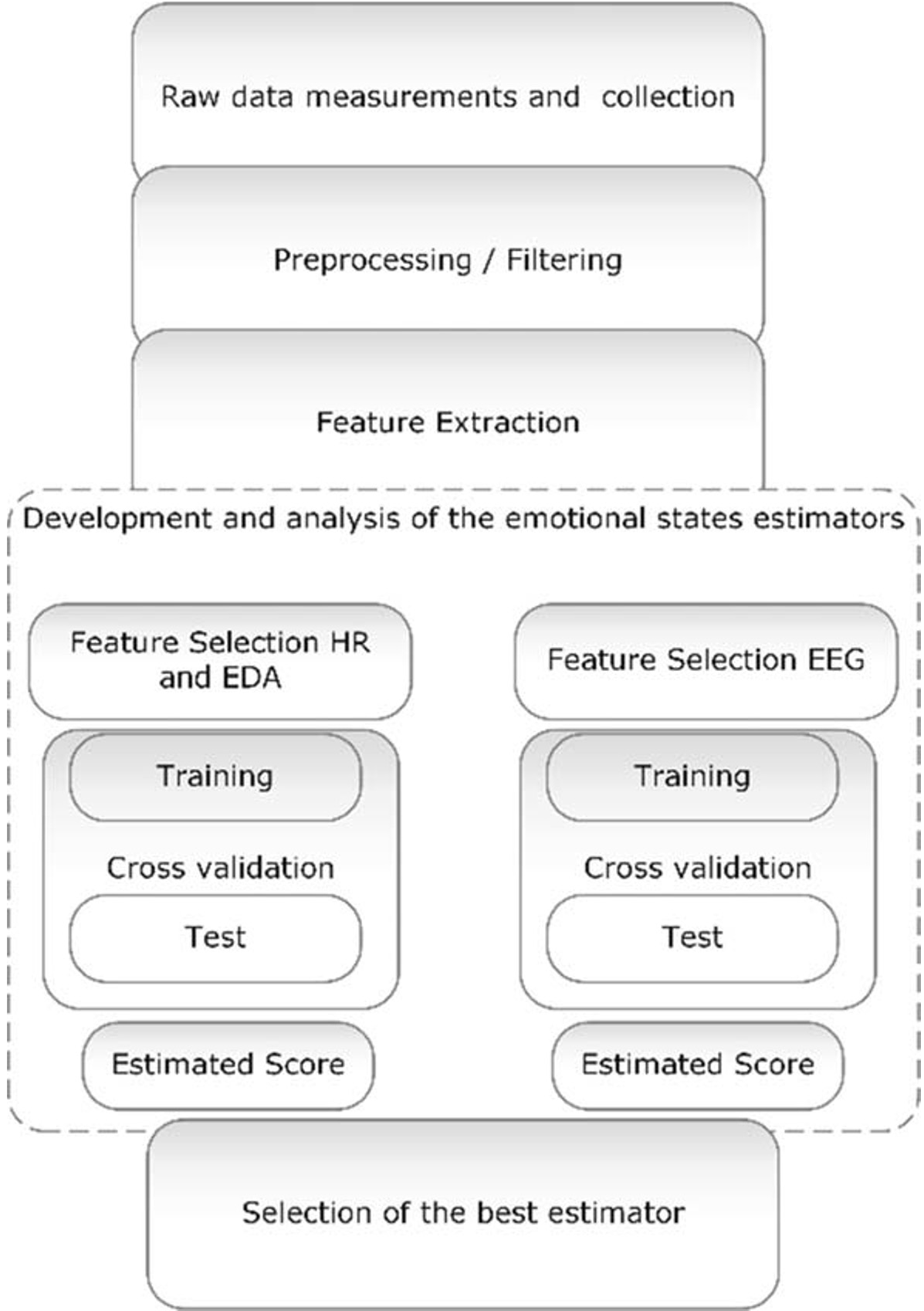 Figure 1: The proposed workflow from raw signal collection to emotional state estimation.
Key Insights: Brain vs. Body
One of the most striking findings is the "division of labor" among biological signals:
- Arousal (Excitement): Best predicted by EDA (Skin Conductance) and Heart Rate. These are direct proxies for the autonomic nervous system.
- Valence (Positive/Negative sentiment): Best predicted by EEG. Specifically, the Occipital region—the brain's visual processing hub—was found to be the most relevant area for S3D discomfort.
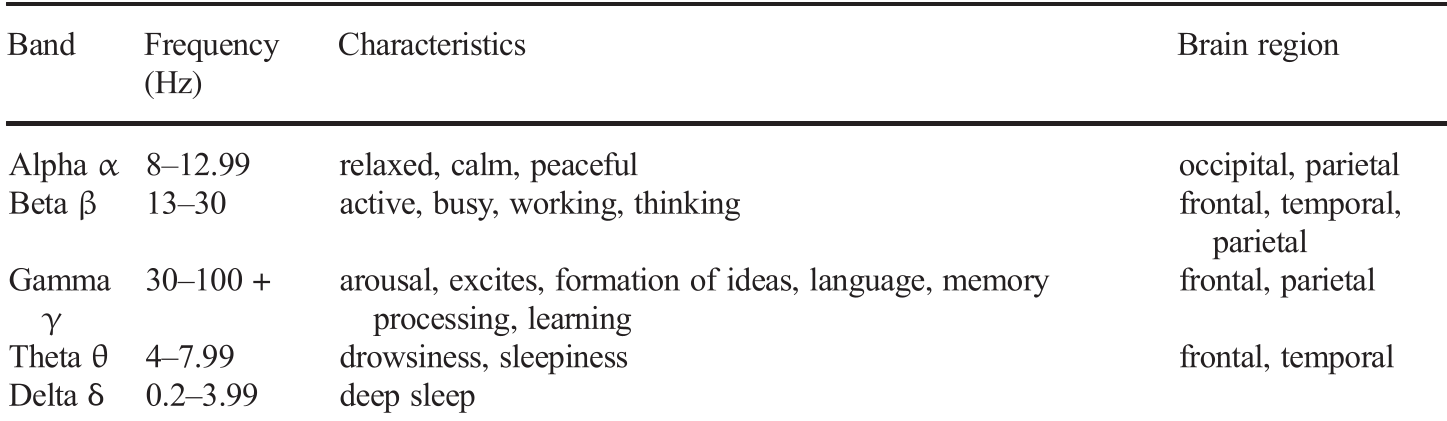 Table 1: Frequency bands and their associated mental states used as EEG features.
Results & Performance
The MLP outperformed other techniques like Support Vector Regression (SVR) and General Regression Neural Networks (GRNN).
- Arousal Performance: RMSE reached as low as 0.050 using the combined HR/EDA model.
- Valence Performance: RMSE was even lower at 0.024 in some configurations.
- The "Occipital" Factor: Models using only Occipital EEG data performed significantly better than those using Frontal or Parietal data, proving that visual discomfort is fundamentally a visual-processing stressor.
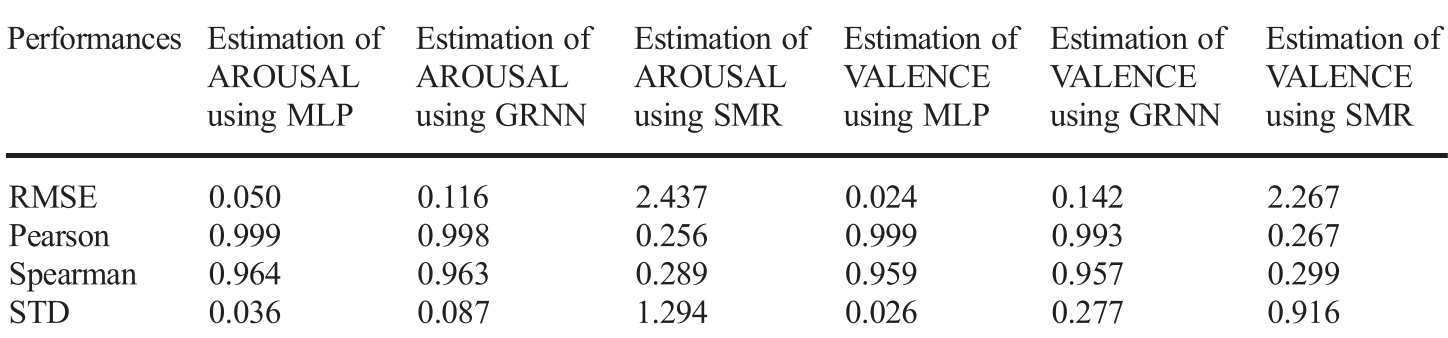 Table 7: Performance comparison between MLP, GRNN, and SVR for emotional state estimation.
Conclusion: Toward Emotion-Aware Systems
This research proves that a generalized, non-personalized model can accurately estimate human emotions in real-time.
Future Implications:
- Smart TV: Content recommendation engines that block distressing content or suggest "calm" videos if high stress is detected.
- Automotive: Detecting driver irritation or fatigue before it leads to an accident.
- Limitations: The study was conducted in a controlled lab. Real-world "noise" (movement, lighting) remains the next frontier for this technology.
As we move toward more immersive media, the measure of success won't just be "resolution" or "bitrate," but how well the system understands the human heart and brain.