
SA-Min: Orchestrating Simulated Annealing to Combat Malicious Rumors in Social Networks
SA-min: An Efficient Algorithm for Minimizing the Spread of Influence in a Social Network
The paper introduces SA-min, a Simulated Annealing-based algorithm designed to minimize influence spread (e.g., viruses or rumors) in social networks by identifying and blocking the top-k optimal links. To handle the computational bottleneck of evaluating influence, the authors also propose ML_CS, a multi-level heuristic that approximates influence spread within m-hops, significantly outperforming traditional Greedy and Monte Carlo approaches.
TL;DR
In the battle against digital viruses and malicious rumors, the "SA-min" algorithm emerges as a high-performance alternative to traditional greedy methods. By combining the stochastic optimization of Simulated Annealing with a localized influence estimation heuristic called ML_CS, the authors achieve a 24x to 30x speedup over existing SOTA methods, enabling influence minimization on networks with tens of thousands of nodes where previous methods failed.
Background: The Price of Precision
Information diffusion in social networks is a double-edged sword. While it facilitates rapid communication, it also enables the spread of "contamination"—be it malware or misinformation. The research community has long focused on Influence Maximization (finding seed nodes to spread a message), but the inverse—Contamination Minimization—is equally vital.
The core challenge lies in selection. If you can only block connections (edges), which ones will most effectively "quarantine" the network? Prior work relied on Greedy-min, which picks the best edge one by one. However, calculating the "value" of an edge requires thousands of Monte Carlo (MC) simulations, creating a massive computational wall for any network larger than a few hundred nodes.
Methodology: Two Pillars of Efficiency
1. The Optimization Shift: Simulated Annealing
Instead of the "short-sighted" greedy approach, SA-min treats the problem as an energy minimization task. It starts with a random set of edges to block and iteratively swaps them.
- Logical Intuition: By allowing the algorithm to occasionally accept "worse" solutions at high "temperatures," it avoids getting stuck in local optima—a common pitfall for greedy algorithms.
- Complexity Gain: The time complexity drops from being dependent on the total number of edges to a fixed number of iterations , making the runtime predictable and significantly faster.
2. The Calculation Shortcut: ML_CS
The second pillar is ML_CS (Multi-Level Calculation Strategy). The authors observed that in the Independent Cascade (IC) model, nodes far away from the source have a negligible probability of being activated when propagation probabilities are small.
- The Heuristic: Instead of simulating the whole network, ML_CS only looks -hops away.
- Mathematical Insight: It approximates the activation probability of a node using the number of -hop paths: .
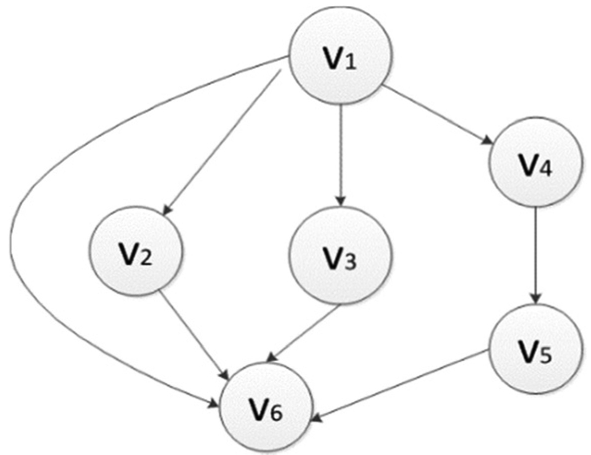 Figure 1: Visualizing how ML_CS calculates path-based influence for a specific node.
Experiments: Performance Without Compromise
The authors tested SA-min on real-world datasets, including Amazon product networks and Epinions trust graphs.
Scaling to the Real World
The most striking result is the scalability. When the network grows to 10,000 nodes, the Greedy-min approach becomes virtually unusable, dragging on for 12 hours. SA-min, powered by ML_CS, finishes the same task in roughly 30 minutes.
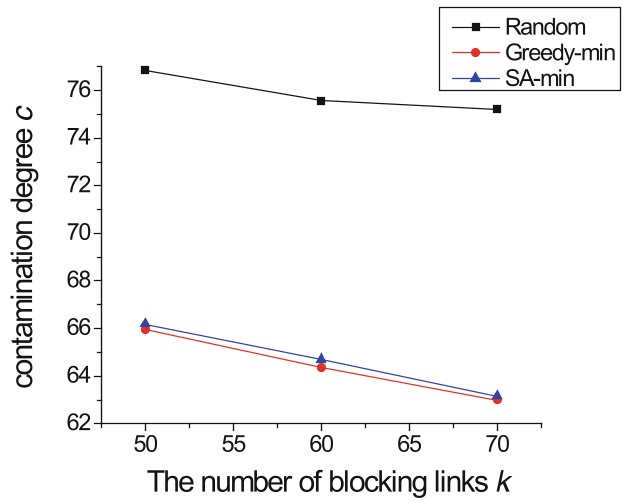 Figure 2: Running time comparison on the Amazon dataset. Note the sharp linear increase for Greedy-min versus the stable efficiency of SA-min.
Effectiveness
Does speed come at the cost of accuracy? Surprisingly, no. SA-min's results for "contamination degree" (the average number of nodes infected) were nearly identical to Greedy-min, and in some cases (e.g., when ), SA-min actually found a better set of edges to block, outperforming the greedy baseline by a small margin.
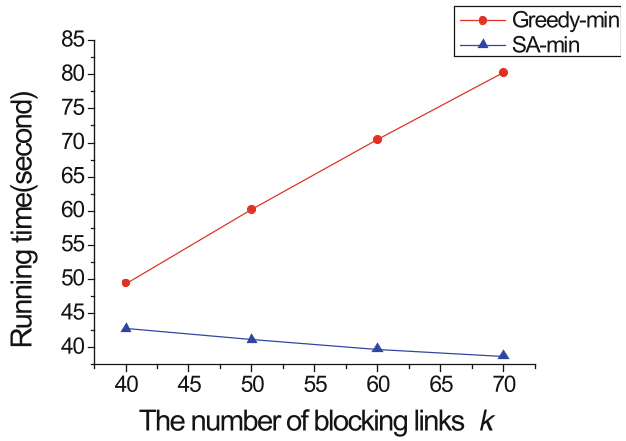 Figure 3: Lower is better. SA-min tracks the Greedy-min performance closely, proving that the stochastic approach is robust.
Critical Analysis & Conclusion
The value of SA-min lies in its scalability. By recognizing that influence is effectively a local phenomenon in many social graph contexts, and by applying a classical meta-heuristic (SA), the authors moved the needle from "theoretical curiosity" to "practical tool."
Limitations:
- The effectiveness of the ML_CS heuristic relies on a relatively low propagation probability (). In "highly infectious" scenarios where is large, the -hop approximation might lose accuracy.
- The paper focuses on the Independent Cascade model; further research is needed to see if these gains hold under the Linear Threshold (LT) model.
Takeaway: SA-min proves that for complex combinatorial problems on graphs, we don't always need complex new math—sometimes, the combination of a well-tuned classical algorithm (SA) and a smart, physics-adjacent heuristic (ML_CS) is enough to break previous SOTA barriers.