
Sada Vehra: Empowering Linguistic Diversity through Crowdsourced Subtitling
Sada Vehra: a framework for crowdsourcing Punjabi language content
This paper introduces Sada Vehra, a specialized crowdsourcing framework designed to generate Punjabi language content and English translations for multimedia artifacts. By leveraging an integrated workflow based on the Amara and Drupal platforms, it enables bilingual volunteers to contribute subtitling and translation services for cultural preservation.
TL;DR
The Punjabi language, spoken by over 100 million people, faces a "digital desert" problem due to the dominance of colonial languages online. Sada Vehra is a prototype framework that tackles this by crowdsourcing English-Punjabi translations for multimedia. By breaking the complex task of subtitling into manageable micro-tasks (syncing, drafting, reviewing), it allows a community of non-experts to preserve their cultural heritage globally.
Problem & Motivation: The Digital Representation Gap
While the "Global South" is rapidly coming online, their linguistic nuances often stay behind. For Punjabi speakers, the internet is predominantly an English-centric space. The authors identify three major hurdles:
- Nuance & Standardization: Punjabi exists across different regions (India vs. Pakistan) and scripts, making "one-size-fits-all" translation impossible.
- Infrastructure Barriers: High-bandwidth video editing is difficult in regions with metered data or poor connectivity.
- The "Elite" Bias: Most online Punjabi speakers are bilingual and default to English, leaving non-English speakers with limited high-quality resources.
Methodology: High-Scaffolded Translation
The core innovation of Sada Vehra is the use of scaffolding. Instead of asking one person to translate an entire video, the system utilizes the Amara Framework to segment the workflow.
The Workflow Architecture
- Drafting: Non-experts provide the initial transcript or translation.
- Syncing (Timing): Users align text with audio—a task requiring technical attention rather than high linguistic skill.
- Reviewing & Editing: Experts or native speakers verify idioms, honorifics, and kinship terms.
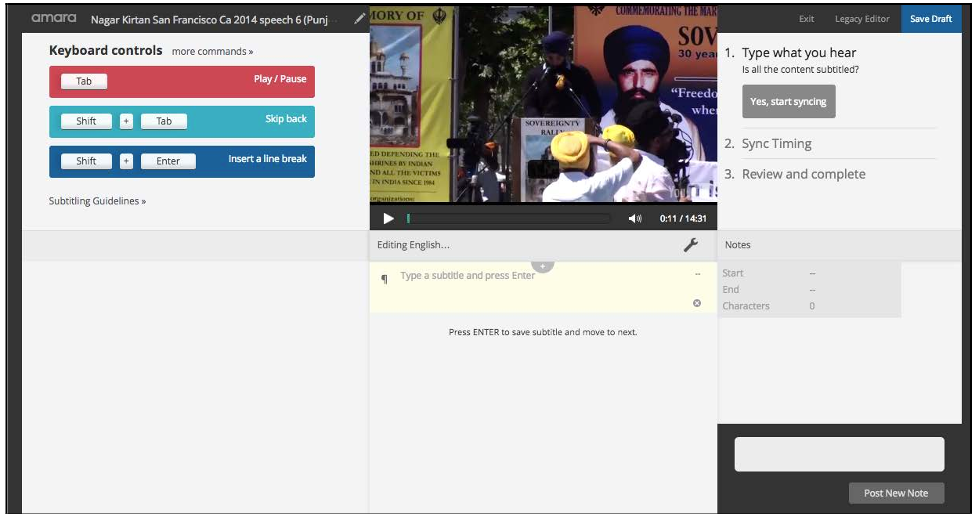 Figure 1: The Amara editor utilized by Sada Vehra to facilitate collaborative time-stamped subtitling.
Experiments & Results: Insights from the Field
Through interviews with translation experts and the Punjabi community, the authors discovered that Redundancy is the best defense against error.
- Linguistic Redundancy: Community forums allow users to discuss "untranslatable" Punjabi idioms, ensuring that meaning isn't lost in literal translation.
- Community Ownership: By allowing users to submit their own YouTube content (music, folk stories, poetry), the platform shifts from a static archive to a living cultural hub.
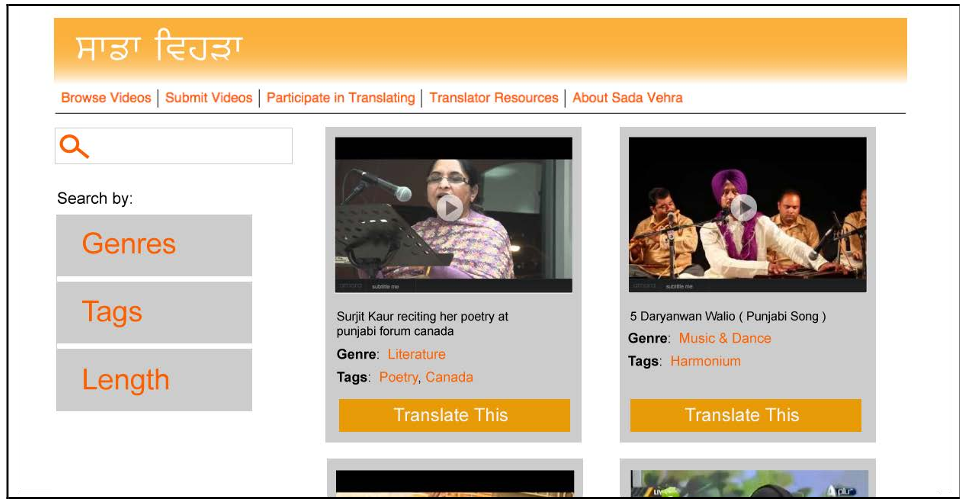 Figure 2: The platform interface organizes videos by genre and translation status, encouraging targeted volunteer contributions.
Critical Analysis & Conclusion
Takeaway
Sada Vehra proves that the barrier to digital linguistic preservation isn't just "lack of interest," but lack of infrastructure. By providing a tool that bridges the gap between casual bilingual speakers and professional subtitlers, we can document oral traditions (poetry, folk tales) that would otherwise disappear.
Limitations & Future Work
The study acknowledges that Bandwidth remains a significant bottleneck for users in the Punjab region. Furthermore, while the crowd can handle "casual" translations, complex religious or legal terminologies still require a "Commonly Agreed Schema" that the current system lacks. Future iterations aim to automate metadata tracking and track "handoff efficiency" to see how quickly a video moves from raw audio to fully subtitled content.