
SAE: Leveraging Social Network Intuition for Efficient Data Stream Classification
SAE: Social Adaptive Ensemble classifier for data streams
The paper introduces Social Adaptive Ensemble (SAE), a novel ensemble classifier for data stream mining that leverages Social Network abstractions to manage concept drift. By modeling individual classifiers as nodes in a social network and using predictive similarity as weighted edges, SAE achieves efficient drift adaptation and resource management, rivaling SOTA methods like ADWIN Bagging while maintaining lower computational overhead.
TL;DR
The Social Adaptive Ensemble (SAE) is a new framework that treats an ensemble of classifiers as a dynamic social network. By measuring how "similar" experts are in their predictions, it identifies redundant models and forms subnetworks to improve classification during concept drifts. It matches the accuracy of heavyweight SOTA methods while being significantly faster and more resource-efficient.
The Challenge: Drift and Redundancy
In the world of data stream mining, data is infinite, fast-paced, and—most importantly—unstable. This instability, known as Concept Drift, requires models to forget old patterns and learn new ones instantly.
While ensemble methods are the "gold standard" for accuracy, they face a double-edged sword:
- Resource Exhaustion: Keeping too many experts consumes massive CPU and memory.
- Redundancy: Over time, different experts may start predicting the same things, providing no "diversity" and failing to help during a drift.
Methodology: The "Social" Architecture
The core innovation of SAE is using Relational Data. Instead of just looking at how accurate an expert is, SAE asks: "Who else is predicting like this expert?"
1. Similarity and Connectivity
SAE calculates a Similarity Coefficient () between experts and based on their agreement over a sliding window of instances.
- If two experts are too similar (), the older one is pruned as redundant.
- If they are somewhat similar (), a "social connection" is formed.
2. Subnetwork-Based Prediction
Instead of a simple majority vote, SAE identifies subnetworks (connected components of similar experts).
- Intra-group: Predictions are first combined within these similar groups.
- Inter-group: Group results are then combined for the final output.
This helps the ensemble give a "louder voice" to new, diverse experts that appear during a concept drift, as they typically form their own independent subnetworks.
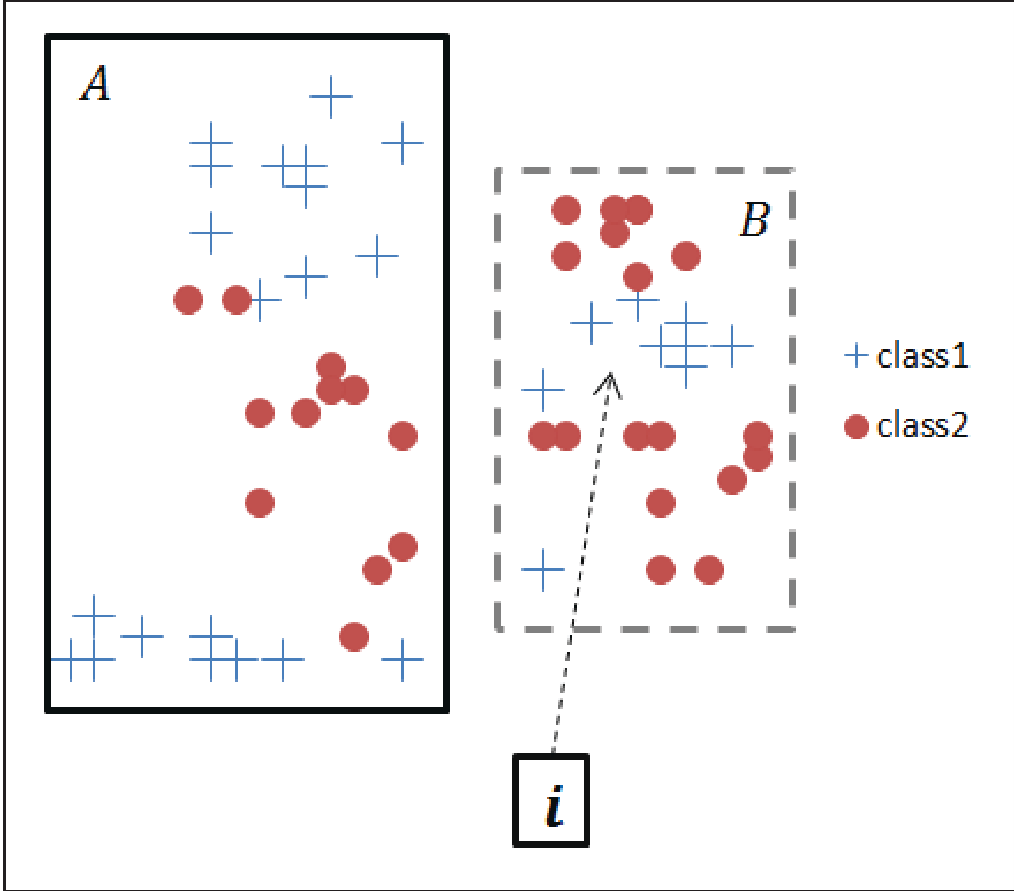 Figure: The structural logic of SAE—Relational properties define how experts are grouped and pruned.
Experiments: Performance vs. Speed
The authors tested SAE against heavy-hitters like ADWIN Bagging and DWM using the MOA (Massive Online Analysis) framework.
Key Findings:
- Efficiency: In the SEA-1 benchmark, SAE processed the stream in 19.63s, while ADWIN Bagging took 82.45s.
- Minimalism: SAE maintained high accuracy with a variable ensemble size that averaged only 3 experts, compared to the fixed 10 used by ASHT and ADWIN Bagging.
- Drift Recovery: As seen in Figure 9, SAE shows a remarkable ability to recover from gradual drifts, often adapting faster than DWM.
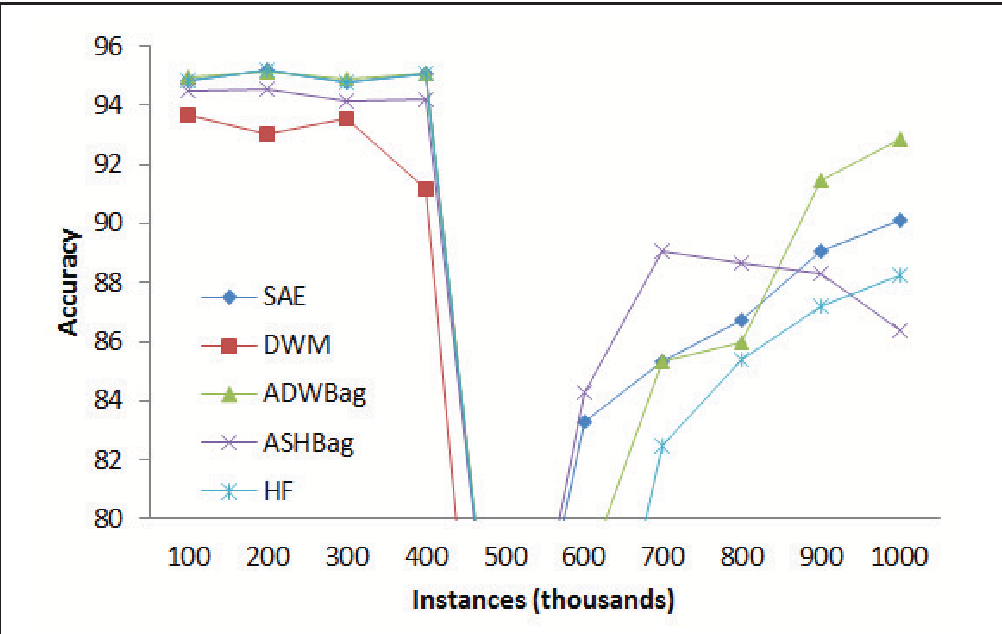 Figure: Accuracy over time on the AGRAWAL-3 dataset (Gradual Drift), showing SAE's competitive adaptation curve.
Critical Insight: Why it Works
The "Social" metaphor isn't just window dressing. It addresses the Minimum Description Length (MDL) principle. By removing redundant experts, SAE keeps the "network" slim. During a concept drift, the existing network's accuracy drops, triggering the addition of a new expert trained specifically on recent errors. Because this new expert is dissimilar to the "old guard," the social structure naturally segments it, allowing its new knowledge to influence the final prediction without being drowned out by the outdated majority.
Conclusion & Future Directions
SAE proves that how experts relate to each other is just as important as how accurate they are individually. While it has some hyperparameter sensitivity (like the period size ), it is a superior choice for real-time systems where CPU cycles are at a premium.
Future work looks into using more complex social metrics, like centrality or clustering coefficients, to determine which experts are the most influential "thought leaders" in the ensemble.
Keywords: Data Stream Mining, Concept Drift, Ensemble Learning, Social Network Analysis, Online Bagging.