
SAE: Bridging Micro-Ties and Macro-Trends in Large-Scale Social Analytic Engines
SAE: Social Analytic Engine for Large Networks
SAE (Social Analytic Engine) is a comprehensive system designed for multi-level mining of large-scale social networks. It integrates a distributed graph database with specialized components for network integration, social influence analysis, and topic evolution, achieving high efficacy in tasks like cross-network entity linking and expert ranking.
TL;DR
The Social Analytic Engine (SAE), developed by researchers at Tsinghua University, is a robust framework designed to solve the complexity of modern social networks. It doesn't just look at "who is connected to whom"; it analyzes social influence, entity integration across platforms, and the evolution of topics over time. By combining distributed graph databases with factor graph models, SAE provides a holistic view of social dynamics from individual interactions to global trends.
Problem & Motivation: Beyond Static Graphs
Most existing graph tools (like SNAP or GraphChi) focus on the mathematical properties of static graphs—density, diameter, or raw computation speed. However, social networks are "living" entities driven by human behavior. The authors identified three major gaps:
- Identity Fragmentation: Users exist across multiple platforms (Twitter, LinkedIn, AMiner), making it hard to find a "complete" profile.
- Invisible Forces: Factors like Social Influence and Structural Holes (users who bridge different communities) are often ignored in standard algorithms.
- Temporal Dynamics: Topics aren't static; they merge, split, and evolve.
Methodology: The Architecture of SAE
The engine is built on a four-tier architecture designed for scalability and deep insight.
1. The Distributed Core
At its base, SAE uses a Distributed Graph Database for storage and indexing. This supports a distributed machine learning component that allows complex models (like Factor Graphs) to run on massive datasets.
2. Cross-Network Entity Integration
How do you know "User A" on Google Scholar is "User B" on LinkedIn? SAE uses a Pairwise Factor Graph Model. It looks at "social circles"—if two accounts share similar neighbors and attributes, they are likely the same person.
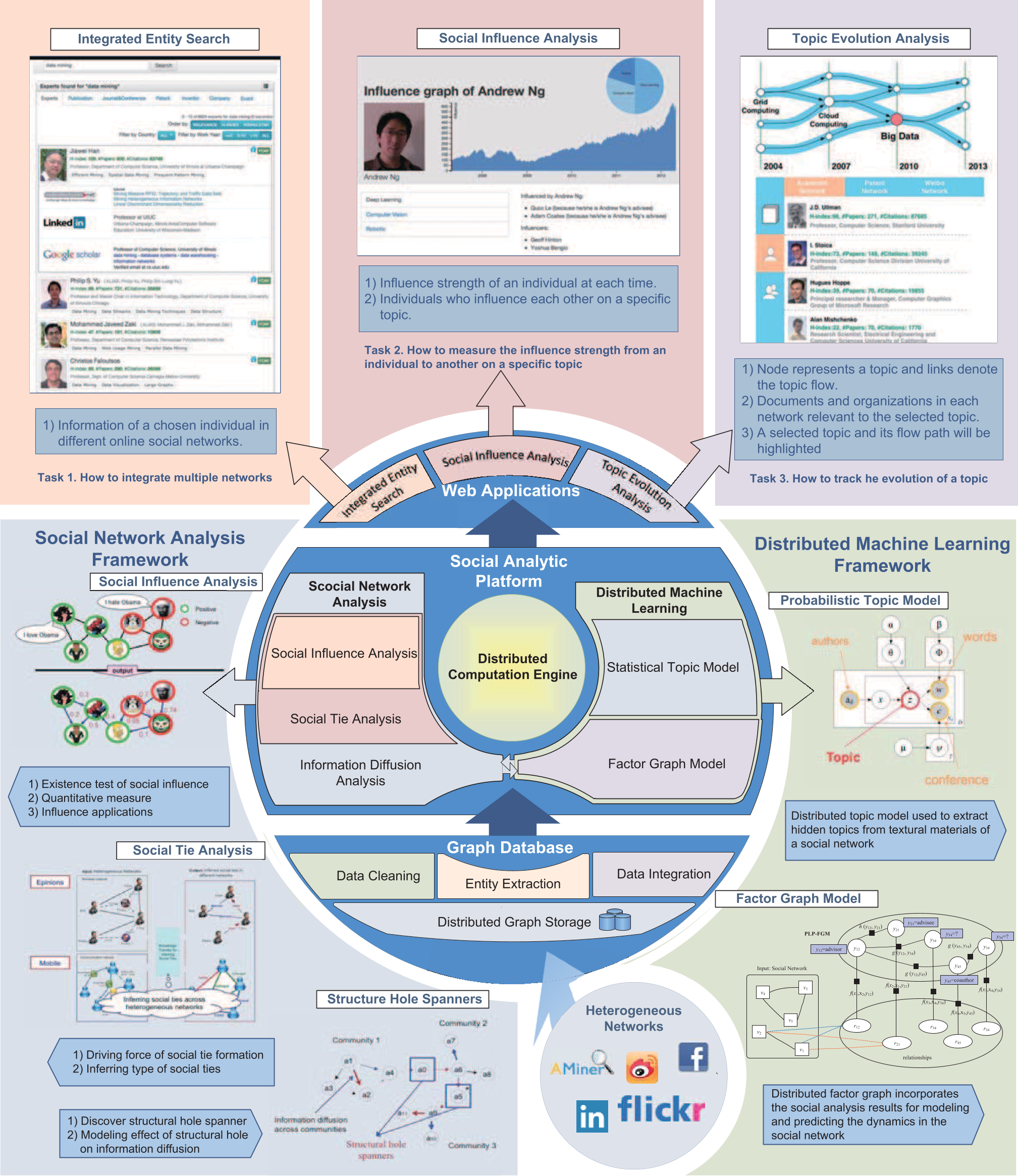
3. Topical Affinity Propagation (TAP)
To measure influence, SAE doesn't just use a single score like PageRank. It calculates topic-level influence. Using TAP, the system can determine that while a user might be influential in "Machine Learning," they have zero influence in "Fine Arts," even if they have many followers.
Key Experiments and Results
The researchers validated SAE across a diverse range of datasets:
| Dataset | #Users | #Relationships | Key Insight |
|---|---|---|---|
| 1.7M | 423M | Massive scale efficiency | |
| Co-Author | 1.6M | 2.6M | High precision in expert finding |
| Slashdot | 93K | 964K | Effective "friend vs. foe" mining |
One of the most impressive results is the Topic Flow Graph. The system can take a query like "Big Data" and automatically generate a Directed Acyclic Graph (DAG) showing its lineage. It visually proves how "Big Data" emerged from the convergence of "Databases" and "Parallel Computing."
Critical Analysis & Conclusion
Takeaway: SAE's primary contribution is the integration of social theory into big data engineering. It treats social networks as multi-layered structures where influence and identity are the primary currencies.
Limitations: While SAE is powerful, the paper reflects a 2013-era focus on Factor Graphs and Topic Modeling (LDA). In today's context, these components could be significantly enhanced using Graph Neural Networks (GNNs) and Large Language Models (LLMs) for even deeper semantic understanding.
Future Outlook: The concept of an "Analytic Engine" that integrates multiple personas into one global identity is more relevant than ever in the age of the Metaverse and decentralized social media. SAE provides the foundation for what we now recognize as "Knowledge Graph" integration for social intelligence.