
SAFE: Orchestrating a Secure, Quantum-Resistant Heartbeat for Healthcare 4.0
SAFE: SDN-Assisted Framework for Edge–Cloud Interplay in Secure Healthcare Ecosystem
The paper introduces SAFE, an SDN-Assisted Framework for Edge–Cloud Interplay in Secure Healthcare Ecosystems. It combines Software-Defined Networking (SDN) with a multi-layered Edge-Cloud architecture and a Lattice-based cryptosystem to achieve low-latency, real-time healthcare data processing and quantum-resistant security.
TL;DR
The transition to Healthcare 4.0 has created a "Big Data" crisis where biosensors generate exabytes of data requiring real-time response. The SAFE framework (SDN-Assisted Framework for Edge–Cloud Interplay) addresses this by using Software-Defined Networking to intelligently route tasks between Edge and Cloud nodes, protected by a Lattice-based cryptosystem that is faster than traditional methods and immune to future quantum attacks.
Problem & Motivation: The Bottleneck of Centralized Care
Traditional networking forces every byte of patient data to travel to a distant central cloud. For critical real-time monitoring—such as heart rate alerts or stroke detection—this latency can be fatal. Furthermore, as we approach the quantum era, the mathematical foundations of our current security (RSA, ECC) are becoming "obsolescent."
The authors identify a critical gap: How do we balance the immediate processing needs of the edge with the heavy-duty analytics of the cloud, all while ensuring data remains unhackable even by quantum computers?
Methodology: The Three Pillars of SAFE
1. Intelligent Edge-Cloud Interplay
The framework views data offloading as a "game" between Edge Data Centers (eDC) and Cloud Data Centers (cDC). It utilizes a utility function that considers bandwidth, throughput, latency, and distance.
- Forward Offloading: Moves heavy tasks from resource-constrained edge nodes to the cloud.
- Reverse Offloading: Pushes processed insights or specific applications from the cloud back to the edge for local access.
2. SDN-Assisted Flow Management
Instead of a rigid hardware-bound network, SAFE uses SDN to separate the Control Plane (the brain) from the Data Plane (the muscle).
- Multi-region Virtualization: It creates virtualized flow controllers (vOF-C) for different hospital regions, ensuring isolation and preventing network congestion through a systematic MAC address translation mechanism.
 Figure 1: The Layered Healthcare Hierarchy in the SAFE Framework.
3. Lattice-Based Cryptography (The Quantum Shield)
Why Lattices? Unlike RSA, which relies on the difficulty of factoring large integers, Lattice-based systems like Ring-LWE are based on NP-hard geometric problems.
- Efficiency: It uses Matrix arithmetic and Fast Fourier Transforms (FFT), making it significantly faster for 8-bit microcontrollers found in wearable medical devices.
- Reconciliation: A specialized function ensures that both the sender and receiver arrive at the same key even with minor signal noise.
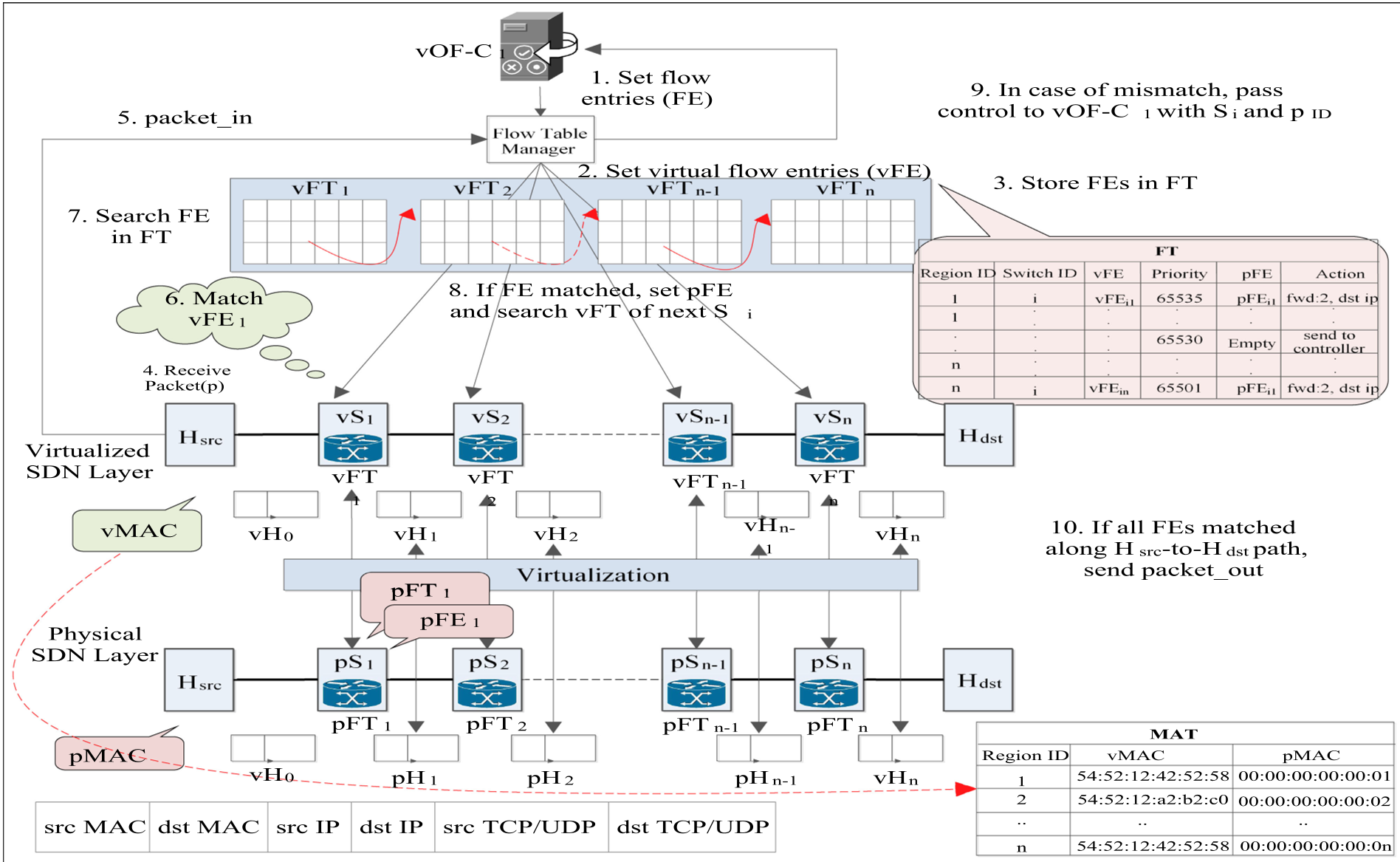 Figure 2: Virtualized SDN Layer mapping for multi-tenant isolation.
Experiments & Results: Blistering Speed and Scalability
The authors put SAFE to the test against several SOTA baselines. The most striking result is in the security overhead:
- Computation Time: SAFE total execution time was 5.665 ms, compared to 505.72 ms in traditional bilinear pairing-based schemes. This is a ~90x improvement in security efficiency.
- Network Delay: By using virtualized SDN paths, SAFE maintained lower latency even as network utilization increased, whereas traditional networks saw exponential delays.
- Resilience: The framework proved security against MITM, Replay, and DDoS attacks through its Lattice-based authentication phase.
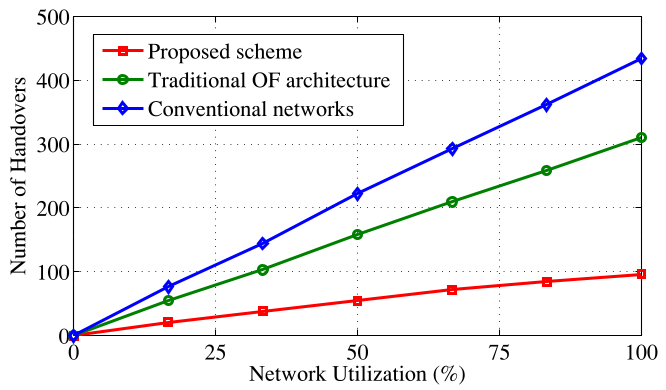 Figure 3: Comparison of Network Delay and Handover Count across different architectures.
Critical Insight & Future Outlook
The brilliance of SAFE lies in its recognition that security shouldn't be a tax on performance. By leveraging the mathematical properties of lattices, we can actually get better performance than the legacy systems we are replacing.
Takeaway: For healthcare providers, SAFE provides a blueprint for "Future-Proofing." However, the complexity of managing these virtual controllers (vOF-C) across vast geographical regions remains a challenge. Future work should focus on the autonomous placement of these controllers to further minimize the distance between the 'brain' and the 'heart' of the network.
Conclusion
SAFE successfully bridges the gap between the high-reliability requirements of Healthcare 4.0 and the looming threat of the quantum era, proving that with SDN and Lattice cryptography, we can have an ecosystem that is both lightning-fast and ultra-secure.