
Safebook: Decentralizing Privacy by Reclaiming Social Trust
Safebook: A distributed privacy preserving Online Social Network
Safebook is a decentralized, peer-to-peer (P2P) Online Social Network (OSN) designed to eliminate central authority risks. It leverages a unique "Matryoshka" architecture to store user data on trusted friends' nodes while ensuring untraceability and privacy through multi-hop communication chains.
TL;DR
Safebook is a decentralized social network that replaces centralized servers with a 3-tier architecture: the Matryoshka (social overlay), a P2P DHT (lookup system), and a TIS (identity service). By mirroring data across real-life friends and routing requests through multi-hop "shells," Safebook ensures that neither the service provider nor malicious peers can map the social graph or misuse personal data.
The Motivation: The Privacy Illusion of Centralized OSNs
In modern social networks, the service provider is the "God" of the system. While users enjoy sharing photos and posts, they inadvertently surrender their entire social graph and private life to an entity that thrives on secondary data collection. Current P2P solutions solve the central-point-of-failure problem but introduce a "stranger danger" issue: how can you trust a random peer to hold your data?
Safebook’s fundamental insight is that Social Trust—the bonds we already have in the real world—should be the foundation of the digital architecture.
Methodology: The Matryoshka Architecture
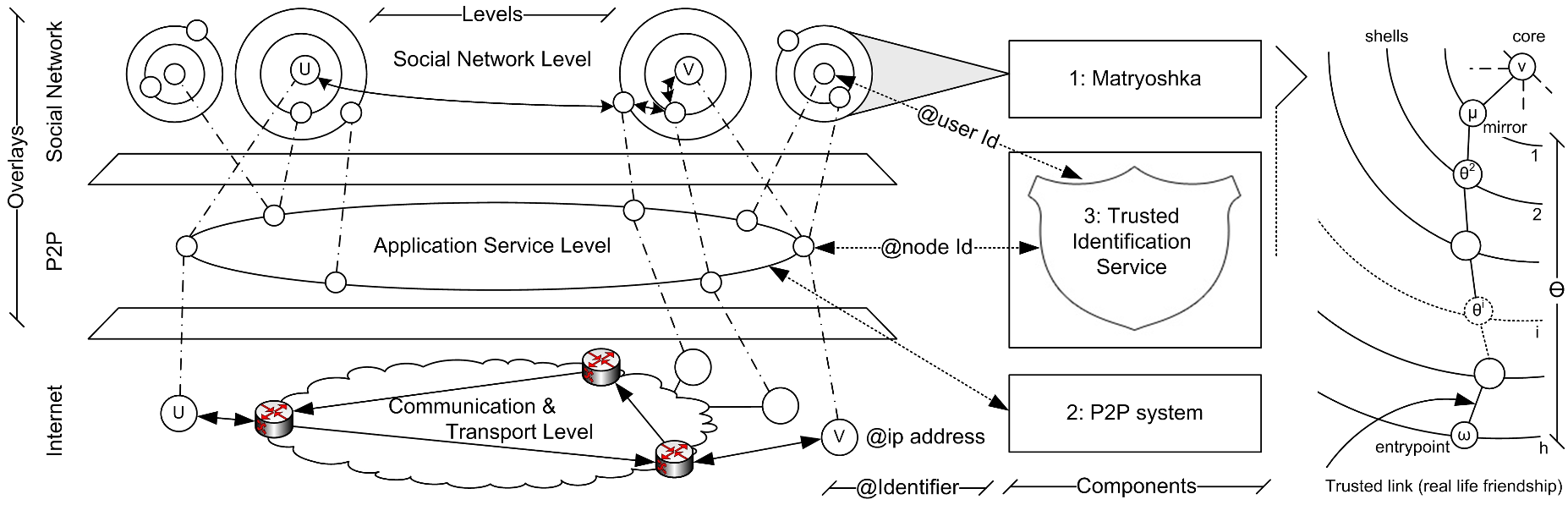
The elegance of Safebook lies in its Matryoshka structure, named after the Russian nesting dolls. Each user (the "Core") is protected by layers:
- Mirrors (The Inner Shell): These are the user’s actual trusted friends. They store the user's data replicas.
- Chains (Intermediate Shells): Hops composed of trusted nodes that forward messages.
- Entrypoints (The Outer Shell): These nodes serve as gateways. When someone wants to view your profile, they talk to the entrypoint, not you or your friends directly.
Key Technical Pillars:
- Identity Decoupling: Safebook uses separate Node Identifiers (for routing in the DHT) and User Identifiers (for social interaction). This makes it mathematically difficult to link a network packet to a specific person's social identity.
- Sybil Resistance: By utilizing a Trusted Identification Service (TIS), the system ensures each physical person has only one digital identity. Crucially, the TIS is "blind" to the social interactions; it only provides the initial passport, not the travel log.
Prototyping and Workflow
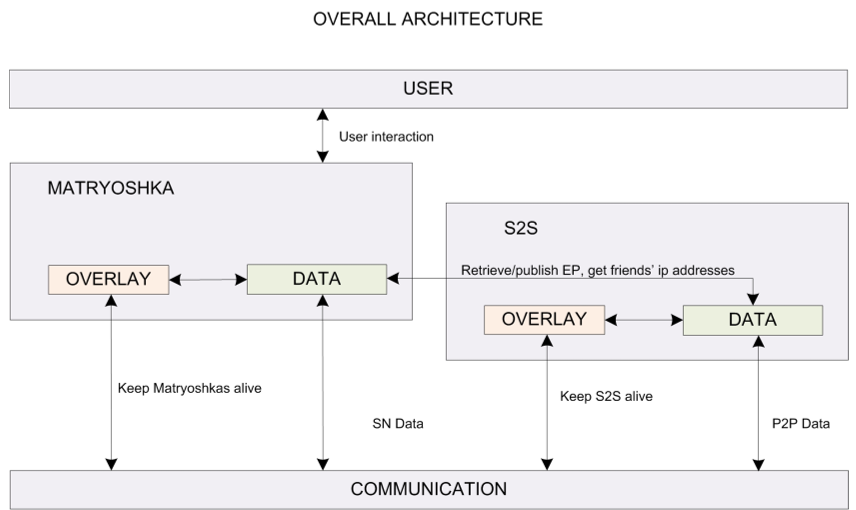
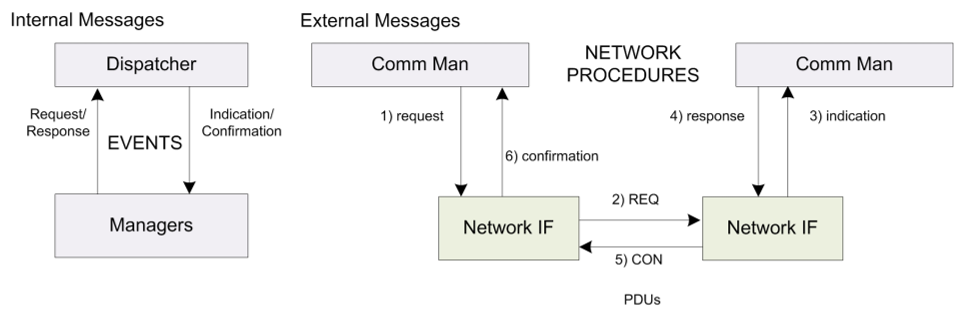
The researchers developed a Python-based prototype that functions as an event-driven system. It manages the complexity of the DHT (via Kademlia/KAD) and the Matryoshka overlay simultaneously.
Life of a Request:
- Lookup: User U wants to find friend V. They perform a recursive DHT search to hide their own identity.
- Entrypoint Retrieval: The DHT returns the IP of V's Matryoshka entrypoints.
- Path Traversal: U's request hops through V's protective shells until it reaches a Mirror.
- Data Return: V's mirror serves the data back through the chain.
Experimental Insights: Robustness & Privacy
The demonstration highlights a critical feature: Availability during Churn. In a typical P2P system, if a node goes offline, the data vanishes. In Safebook, if an intermediate node or entrypoint logs out, the Matryoshka chains are automatically rebuilt. This ensures that your profile remains accessible to friends even if you are offline—as long as your "Mirror" friends are still in the network.
Critical Analysis & Future Outlook
Safebook offers a powerful alternative to the "data-for-service" tradeoff. However, its reliance on real-life friends as mirrors introduces a Cold Start Problem: a user with few friends in the system may have lower data availability and privacy.
Furthermore, while the TIS solves the Sybil attack, it remains a centralized point of trust for identity registration. Future iterations might explore decentralized identity (DID) frameworks or Zero-Knowledge Proofs to further harden this link.
Final Takeaway: Safebook demonstrates that privacy is not just a cryptographic problem, but a structural one. By mimicking the "shells" of social intimacy within the network protocol, we can build a web that respects the user as much as it connects them.