
Sybil Defense 2.0: Fusing Social Graphs with Cryptographic Identity Protocol
Safeguarding Against Sybil Attacks via Social Networks and Multipath Routing
This paper introduces a hybrid defense mechanism against Sybil attacks in P2P overlay networks, combining a Graph-Theoretic Multipath Routing protocol with the Host Identity Protocol (HIP). By leveraging social network topologies where trust relationships limit "attack edges," the system identifies and validates suspicious node clusters with high accuracy.
TL;DR
To combat the persistent threat of Sybil attacks in Peer-to-Peer (P2P) networks, this research proposes a dual-layered defense. It utilizes social network topologies to group suspicious nodes via a novel multipath routing algorithm and validates these groups using the Host Identity Protocol (HIP). The result is a decentralized system capable of identifying malicious clusters with up to 96% accuracy.
Problem & Motivation: The Identity Explosion
In an open P2P ecosystem, "identity" is often cheap. An adversary can spawn thousands of virtual nodes from a single physical device, effectively drowning out honest participants in voting schemes or distributed storage tasks.
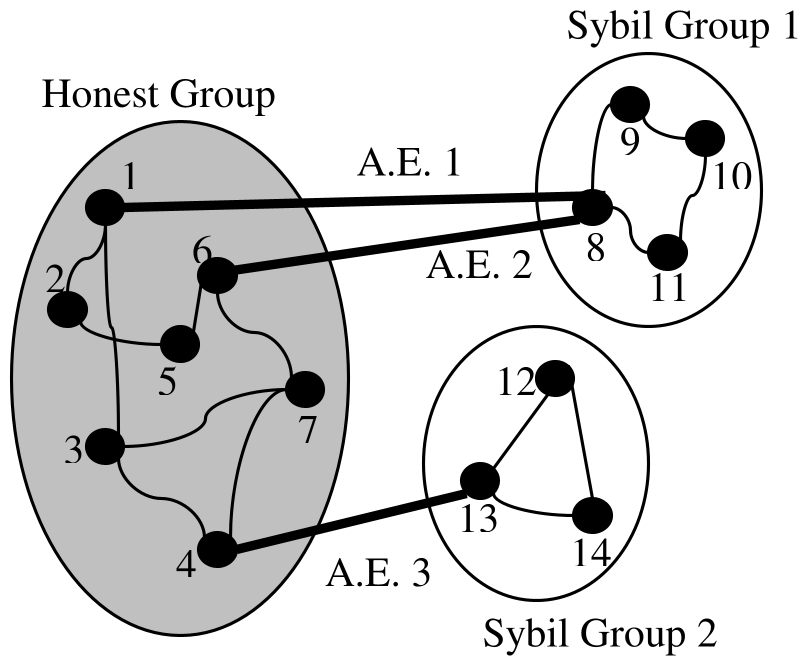
The authors identify a critical gap: Centralized solutions (like CA-based ID assignment) create bottlenecks and single points of failure, while Computational Puzzles (Proof-of-Work) favor attackers with superior hardware. Their insight? Real-world trust is skewed—malicious users find it difficult to establish many trust relationships with honest users. This creates a "bottleneck" (small cut) in the social graph between the honest and Sybil regions.
Methodology: The Core Mechanism
The proposed solution operates in two distinct phases:
1. Grouping via Multipath Routing
Instead of simple random walks, the authors use a Multipath Routing Algorithm. A verifier node (V) sends route requests to suspects (S). Because Sybil nodes must connect to the honest network through a limited number of "attack edges," their traffic inevitably converges on these edges. By intersecting the paths returned by different suspects, the system can isolate these "common segments" and group the nodes behind them as suspects.
2. Validation via Host Identity Protocol (HIP)
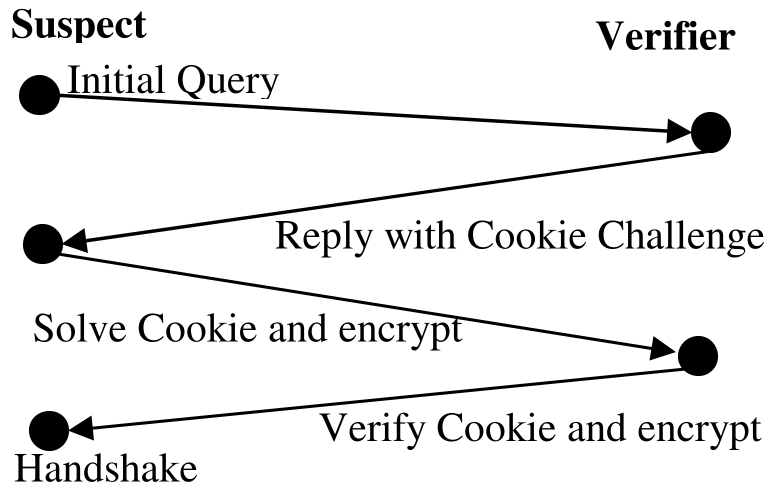
Once grouped, the system doesn't just block them—it challenges them. Using HIP, which introduces a cryptographic namespace between the transport and network layers, the verifier performs a four-way handshake.
- The Puzzle: The verifier sends a cryptographic puzzle.
- The Proof: Since an adversary has limited physical resources to solve puzzles for thousands of identities simultaneously, the HIP handshake acts as a resource-check and identity validator.
Experiments & Results: Small Worlds, Big Security
The authors tested their algorithms on networks ranging from 1,000 to 5,000 nodes using Kleinberg’s small-world phenomenon model.
Key Findings:
- Hop Count Sensitivity: As the
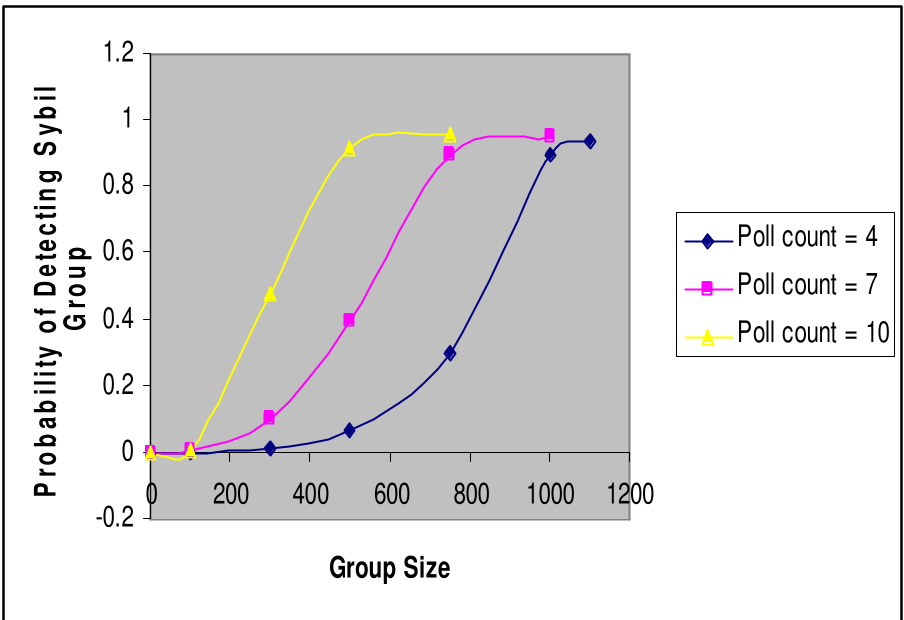
hop_max(the depth of the path exploration) increases, the probability of successfully detecting the Sybil group approaches 1.0. - Scalability: Even in larger networks (2,000 nodes), the system maintained high detection rates, though the "path diversity" in larger graphs initially requires more exploration to find common attack segments.
- Precision: The algorithm achieved a 96% probability of correctly identifying Sybil clusters. The 4% margin accounts for "honest" nodes that might accidentally share a routing path with attackers in highly dense areas of the graph.
Critical Analysis & Conclusion
This work represents a significant step toward Sybil-resilient DHTs. By combining graph theory (the structural bottleneck of attack edges) with networking protocols (HIP’s cryptographic identity), the authors provide a defense that is significantly harder to "game" than pure computational puzzles.
Limitations: The current model assumes a static social network. In reality, social ties are dynamic. Furthermore, if an adversary successfully social-engineers many honest users (creating numerous attack edges), the structural bottleneck disappears, weakening the multipath routing efficacy.
Future Work: The integration of this approach into dynamic overlays and testing against real-world social datasets (like Twitter or LinkedIn graphs) remains the next frontier for this research.