
SAFER: Revolutionizing Disaster Response with SDN-Assisted Fog Computing
SAFER: Crowdsourcing Based Disaster Monitoring System Using Software Defined Fog Computing
The paper proposes SAFER (SDN Assisted Fog computing for Emergency Resilience), a disaster monitoring framework that integrates Software-Defined Networking (SDN) and Fog Computing to process crowdsourced data from IoT and social media. It achieves real-time situation awareness by offloading computation to the network edge, avoiding traditional Cloud-induced latencies.
TL;DR
When disaster strikes, every millisecond counts. This paper introduces SAFER, an architecture that ditches the slow "upload-to-cloud" model for an agile SDN + Fog Computing approach. By processing crowdsourced IoT and social media data right at the edge of the network, SAFER slashes response times by over 250ms, potentially saving lives through early situational awareness.
The Latency Crisis in Emergency Response
In the aftermath of events like the Fukushima earthquake or Hurricane Sandy, the primary barrier to effective rescue wasn't a lack of data, but a lack of timely data. Traditional public safety networks are often siloed or dependent on Cloud infrastructures located hundreds of miles away.
The authors identify a critical bottleneck: The Cloud is too far. Sending massive amounts of heterogeneous data—photos from smartphones, sensor readings from buildings, and tweets from the crowd—to a central server creates a "delay constraint" that makes immediate action impossible. Furthermore, disaster zones often suffer from intermittent connectivity, making a centralized reliance a single point of failure.
Methodology: The SAFER Framework
The core innovation of SAFER (SDN Assisted Fog computing for Emergency Resilience) lies in its synergy between two transformative technologies:
- Fog Computing: Distributes compute and storage resources to the edge (near the users).
- Software-Defined Networking (SDN): Provides the "brain" that dynamically configures the network to prioritize emergency traffic.
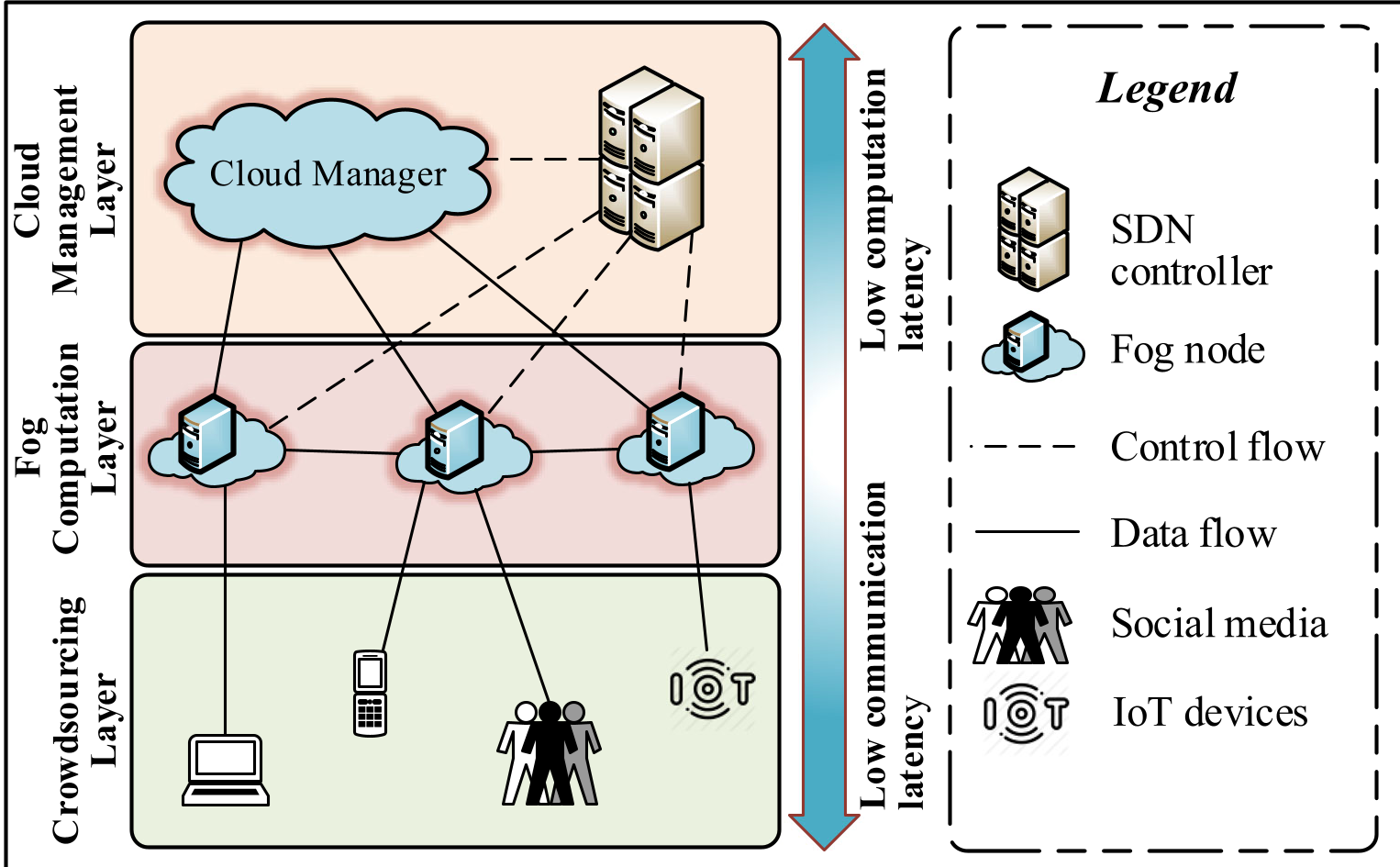
1. Three-Layer Architecture
The system is divided into functional tiers:
- Crowdsourcing Layer: The "eyes and ears" (IoT, Social Media, Sensors).
- Fog Computation Layer: Localized processing nodes that classify and analyze data.
- Cloud Management Layer: The long-term storage and high-level orchestration center.
2. The Algorithmic Engine
To make this architecture work, the authors developed two key algorithms:
- Fog Computation Placement (FCP): This algorithm decides where a job should be processed. If a local Fog node has the capacity, the task stays local. It uses a "Job Success Rate" and "Job Quality Rate" to ensure the chosen node is reliable.
- SDN Assisted Path (SAP): Once the location is chosen, the SDN controller calculates the "Strength of the Link" to find the most robust and fastest data path, bypassing congested or damaged sectors of the network.
Experimental Results: Faster than the Cloud
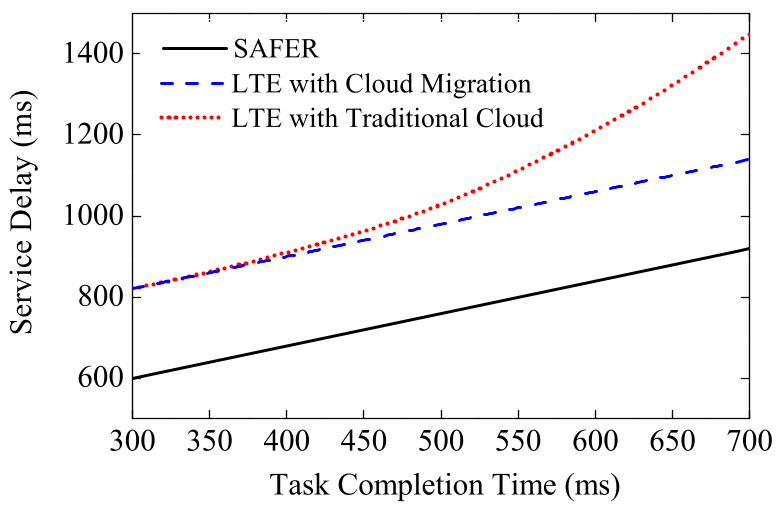
The authors evaluated SAFER using Mininet and the POX controller, comparing it against traditional LTE Cloud and LTE with Migration schemes.
- Reduced Latency: SAFER consistently reduced service delay by 250ms compared to traditional Cloud setups.
- Scalability: Even as user density increased (up to 250 users per ), SAFER maintained a significantly lower service delay because it distributed the load across Fog nodes rather than funneling it into a single Cloud bottleneck.
Critical Insight: Why This Matters
The technical brilliance of SAFER isn't just in "using Fog nodes," but in using SDN to orchestrate them. In a disaster, the network topology changes every second as towers go down or people move.
By decoupling the control plane, SAFER allows the network to be "programmable." If a specific Fog node is overwhelmed by data from a building collapse, the SDN controller can instantly reroute computation to an adjacent vehicle or a nearby IoT gateway. This Inductive Bias—favoring local, dynamic coordination over static, global planning—is what makes the system resilient.
Conclusion & Future Outlook
SAFER represents a significant leap from traditional "Crisis Mapping" to "Active Situation Awareness." While the paper focuses on disaster management, the implications for Smart Cities and Autonomous Vehicles are clear: the future of the internet is not in the Cloud, but in the Fog.
Limitations: The paper assumes Fog nodes are readily available and trustworthy. Future work must address the Security and Privacy of crowdsourced data, especially when the "crowd" becomes the primary source of intelligence in high-stakes environments.