
The Digital Agora: How Salamanca Reimagined "Learning-Outside-the-Classroom" During Lockdown
Digital ecosystem of Salamanca City Council as a complement to the learning-outside-the-classroom: Educational actions implemented by Salamanca City Council during the State of Alarm
This research examines the digital transformation of educational outreach in Salamanca, Spain, during the COVID-19 State of Alarm. It analyzes how the Salamanca City of Culture and Knowledge Foundation (FSCCyS) pivoted from physical "learning-outside-the-classroom" to a digital ecosystem, achieving a significant surge in online engagement and multimedia content consumption.
Executive Summary
TL;DR: This paper explores the rapid adaptation of Salamanca’s educational programs during the 2020 State of Alarm. By shifting from physical city tours to a digital ecosystem—featuring virtual music "capsules," online administrative procedures, and social media engagement—the city maintained its role as an "Educational Resource" despite empty streets.
Positioning: This work serves as an empirical case study within the "Educating Cities" framework. It captures a critical transformation point where digital tools moved from being secondary supplements to becoming the primary infrastructure for contextualized curriculum delivery.
Problem & Motivation: The Empty City
For decades, Salamanca has followed the philosophy of the "Educating City," using its streets, museums, and institutions as a living textbook. In early 2020, over 300 programs and 100,000 students relied on this physical interaction.
The COVID-19 pandemic represented an existential threat to this model. When the State of Alarm was declared, the author highlights a fundamental disconnect: the "real and tangible world" was reduced to what could be seen through a window. The challenge was not just "moving classes online," but how to keep the city's unique identity as a didactic resource alive when the physical city was inaccessible.
Methodology: Engineering the Digital Ecosystem
The recovery strategy was built on three pillars: Administrative Accessibility, Content Creation, and Social Connectivity.
- Paradigm Shift in Web Traffic: The website
ciudaddesaberes.eswas restructured. Resources that were previously secondary (online admissions, digital music resources) were brought to the forefront. - Multimedia Instructional Design: The "Musical Capsules" and student auditions were moved to YouTube, transitioning from physical auditoriums to asynchronous video consumption.
- The Virtual Agora: Using Twitter and Facebook, the foundation didn't just broadcast information; it created a space for participation, effectively moving the "public square" to digital devices.
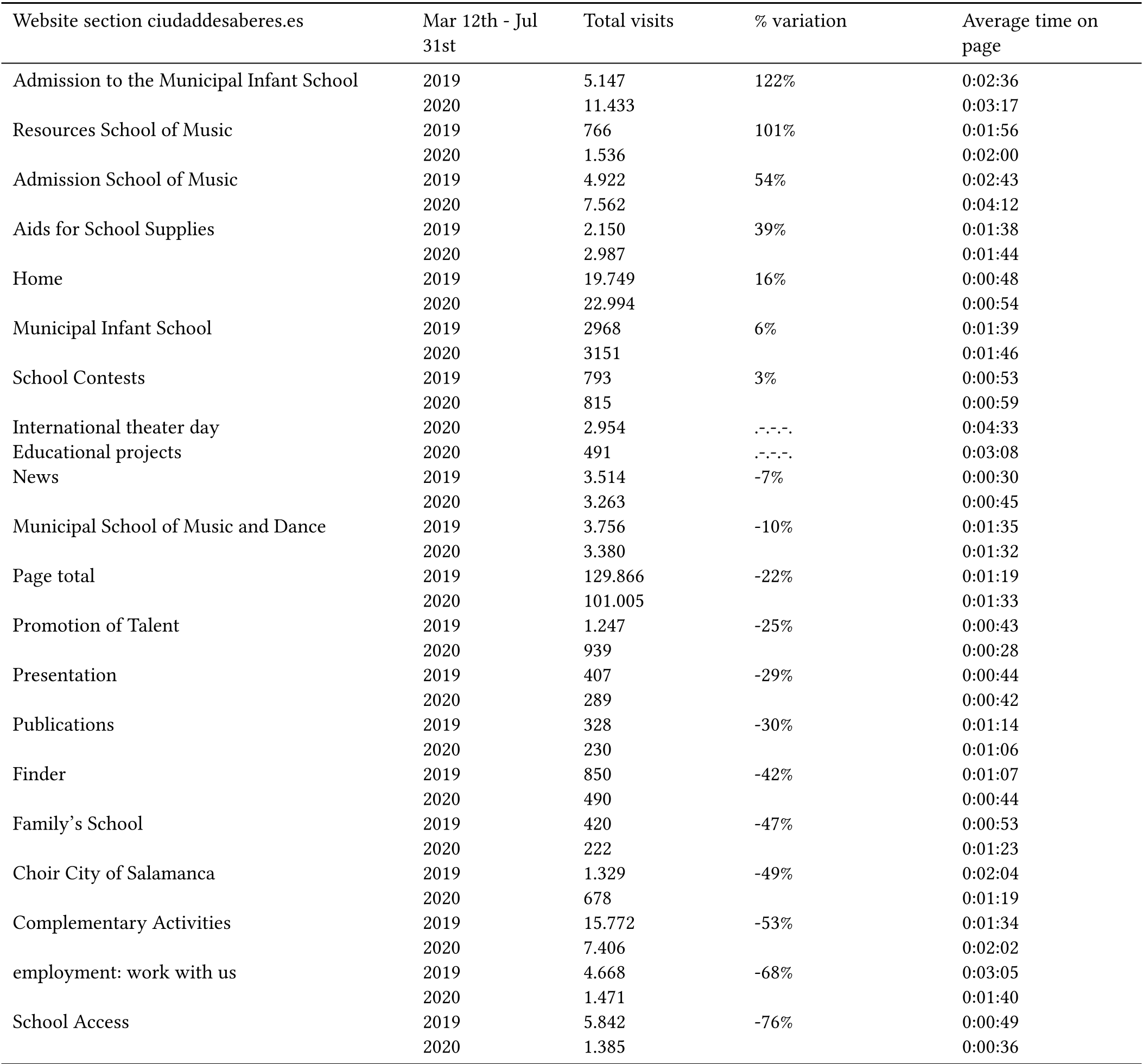 The data shows a clear inversely proportional relationship: as physical activities dropped (-53%), online school admissions and music resources skyrocketed (+122%).
Experiments & Results: Quantitative Growth
The study uses metrics from the FSCCyS web portal, YouTube Analytics, and social media data to validate the shift.
- YouTube Dominance: In 2019, the foundation published 0 videos during the period; in 2020, they published 41, resulting in 4,751 views and over 138 hours of display time.
- Social Media Correlation: A Pearson correlation (r = .68) was found between the volume of tweets and the impressions received, suggesting that the public was hungrier for municipal engagement than ever before.
- Facebook Engagement: While the "reach" per post slightly decreased due to higher frequency, the overall participation rate peaked at 7.23% in June 2020.
 The shift from 6.7 hours to 138 hours of viewing time illustrates the massive consumption of digital educational materials.
Critical Analysis & Conclusion
Takeaway
The success of Salamanca’s digital pivot proves that the "Educating City" is defined by its people and interactions, not just its buildings. The digital ecosystem successfully bridged the oikos (private home) and the oikoumene (public world) during a time of extreme isolation.
Limitations & Future Work
While the transition was successful for administrative and music-related tasks, the paper notes a significant drop-off in "Walks" and "Museum" digital resources. This suggests that VR/AR or streaming (Zoom/Meet/Teams) may be necessary to better simulate the immersive experience of "Learning-out-of-the-classroom."
The future of Salamanca’s educational strategy lies in a hybrid model—using digital tools not as a backup for lockdowns, but as a permanent bridge to visualize and revitalize the city as a permanent learning resource.