
Identifying the "Hidden Commanders": Sales Potential Optimization via QPGA
Sales Potential Optimization on Directed Social Networks: A Quasi-Parallel Genetic Algorithm Approach
This paper introduces Sales Potential (SP), a novel centrality measure for directed social networks that identifies influential low-profile nodes. To maximize collective SP for a subset of nodes, the authors propose a Quasi-Parallel Genetic Algorithm (QPGA), demonstrating superior optimization performance on the Slashdot dataset.
TL;DR
In directed social networks, the most valuable nodes aren't always the celebrities with millions of followers. This paper introduces Sales Potential (SP), a metric that highlights low-profile users with direct access to major hubs. To solve the complex task of picking the best team of these "influencers of influencers," the authors deploy a Quasi-Parallel Genetic Algorithm (QPGA), proving that dividing the search into intelligent sub-populations leads to better marketing strategies.
Background: Beyond the Celebrity Bias
In network science, we usually look for "hubs"—nodes with the highest degree centrality. However, in online marketing and network security, these hubs are protected by high barriers. The authors' intuition is clever: Look for the daughter of the movie star, not the star herself.
These "unknown" individuals have a small in-degree but are followed by (or follow) high-degree nodes. They are the "Sales Potential" of the network—easy to reach, yet high in impact.
Methodology: The Math of Sales Potential
The Sales Potential of a node is defined as the average in-degree of its first-shell neighbors:
When selecting a group of nodes, the problem becomes harder because we must avoid overlapping "audience" (second-shell neighbors) to maximize efficiency.
Pruning with the Aboav-Weaire Law
To avoid searching all 82,168 nodes in the Slashdot dataset, the authors use the Aboav-Weaire Law, which suggests that nodes with the highest Sales Potential usually have the smallest in-degrees. By filtering for nodes with an in-degree , they effectively halved the search space before the GA even started.
The Quasi-Parallel Genetic Algorithm (QPGA)
Instead of one large population, QPGA splits chromosomes into sub-populations across different computing nodes. These nodes exchange their "best" candidates periodically.
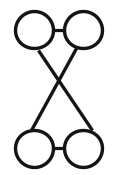 Figure: Various communication topologies (Periodic Band, Band, Pair) tested for QPGA.
Experiments & Key Results
The authors tested their approach on the Slashdot0902 dataset. Key findings include:
- SP Distribution: A small number of nodes exhibit extremely high Sales Potential, deviating from the standard power law of degree distribution.
- Convergence vs. Quality:
- More Sub-populations (e.g., ): Fast convergence. The "divide and search" strategy hits a plateau quickly.
- Fewer Sub-populations (e.g., ): Slower but deeper search, eventually finding a higher global maximum for Sales Potential.
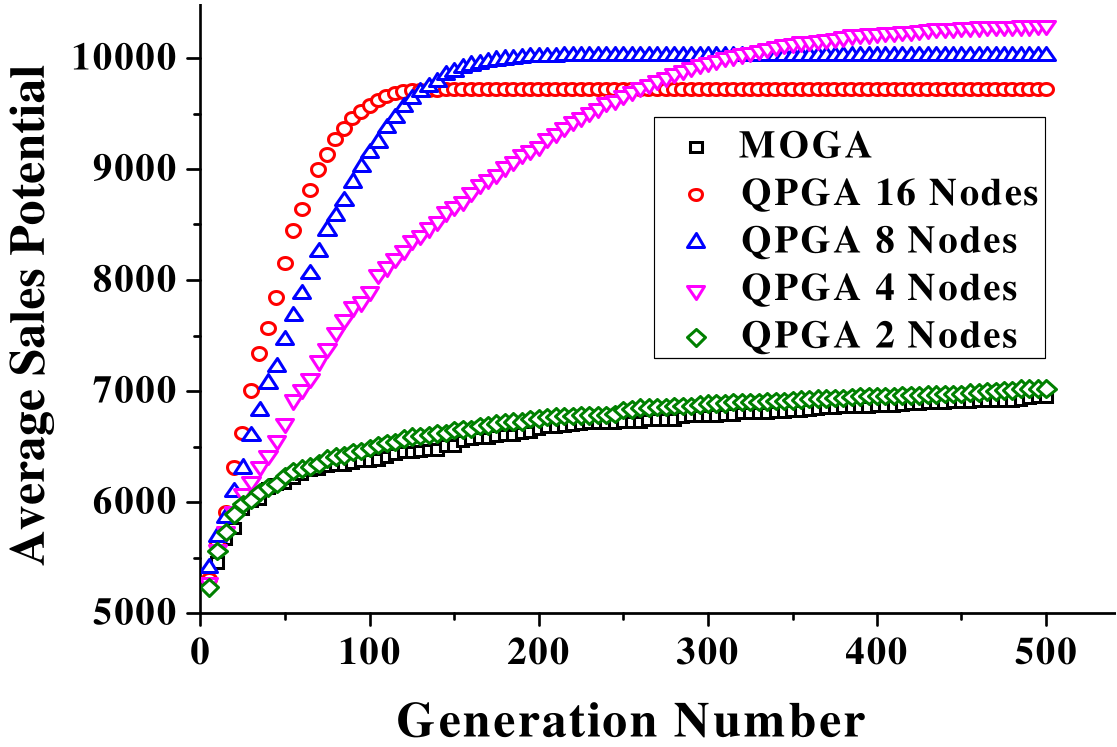 Figure: Average Sales Potential Optimization results. All QPGA variants outperform the standard MOGA (Single Population).
Critical Analysis & Conclusion
Takeaway
The paper successfully bridges the gap between theoretical network topology (Aboav-Weaire Law) and practical evolutionary computation. It proves that parallelism isn't just about speed; it's about the quality of the search. By isolating populations and controlling the exchange rate, the algorithm avoids getting stuck in local optima.
Limitations & Future Work
The authors acknowledge a limitation: the number of sub-populations was fixed during the run. They propose a hybrid approach for future study—starting with many sub-populations for speed and merging them later to refine the "chromosomal quality." Additionally, extending SP to -th shells (beyond just the second shell) could provide an even more comprehensive view of social influence, though at a significantly higher computational cost.
Final Thought
If you're looking to break the internet, don't DM the person with 1M followers; find the person with 100 followers who the 1M-follower account actually listens to. That is the essence of Sales Potential.