
DYNSAMP: Leveraging Historical Context to Crawl Communities in Dynamic Networks
Sampling Community Structure in Dynamic Social Networks
This paper introduces DYNSAMP (Dynamic Sampler), a community-focused network sampling technique for dynamic social networks. It optimizes node querying under budget constraints by leveraging historical community structures to guide future crawls, outperforming traditional sampling baselines.
TL;DR
Understanding how online groups evolve requires data, but querying social network APIs is expensive and slow. DYNSAMP (Dynamic Sampler) is a novel sampling framework that uses a "memory" of past community structures to decide how to spend its query budget. By recognizing when a network hasn't changed much, it saves queries to explore significantly changed regions, resulting in up to a 53% improvement in community representation accuracy over standard baselines.
The Challenge: Sampling Under Scarcity
In the world of social network analysis, we often want to track "communities"—nodes that are densely interconnected. However, large platforms like Twitter or LinkedIn impose strict API rate limits (e.g., 15 queries per 15 minutes). For a dynamic network where nodes and edges appear and disappear, a naive sampling method like Random Walk (RW) or Breadth-First Search (BFS) is highly inefficient because it often "re-discovers" information that hasn't changed, wasting the precious query budget.
The Core Insight: Temporal Redundancy
The researchers at Syracuse University observed a fundamental property of social networks: Temporal Stability. Communities rarely vanish overnight; they evolve, merge, or split gradually.
DYNSAMP exploits this by asking: “Does the current neighborhood look like what I saw yesterday?”
- If Yes: It reuses the known edges and saves the budget.
- If No: It triggers "extra queries" to map the new community landscape.
Methodology: The DYNSAMP Pipeline
The algorithm operates through a sophisticated feedback loop across time steps ():
- Initialization & First Step: It starts with a smart crawl combining high-degree node queries and random jumps to establish a baseline structure.
- The Startup Graph: At each new time step, it spends a small fraction of the budget (e.g., 50%) to probe the current state of previously active nodes.
- Similarity Analysis: It calculates the dissimilarity between this "startup" view and previous snapshots.
- Metric: (Jaccard-based edge similarity).
- Budget Reallocation: If the graph is similar (below a threshold ), it merges the old structure into the current view, saving queries for future "shocks" in the network.
- Community Merging: For areas that have changed, it uses the Louvain Method to re-detect communities and align them with historical data.
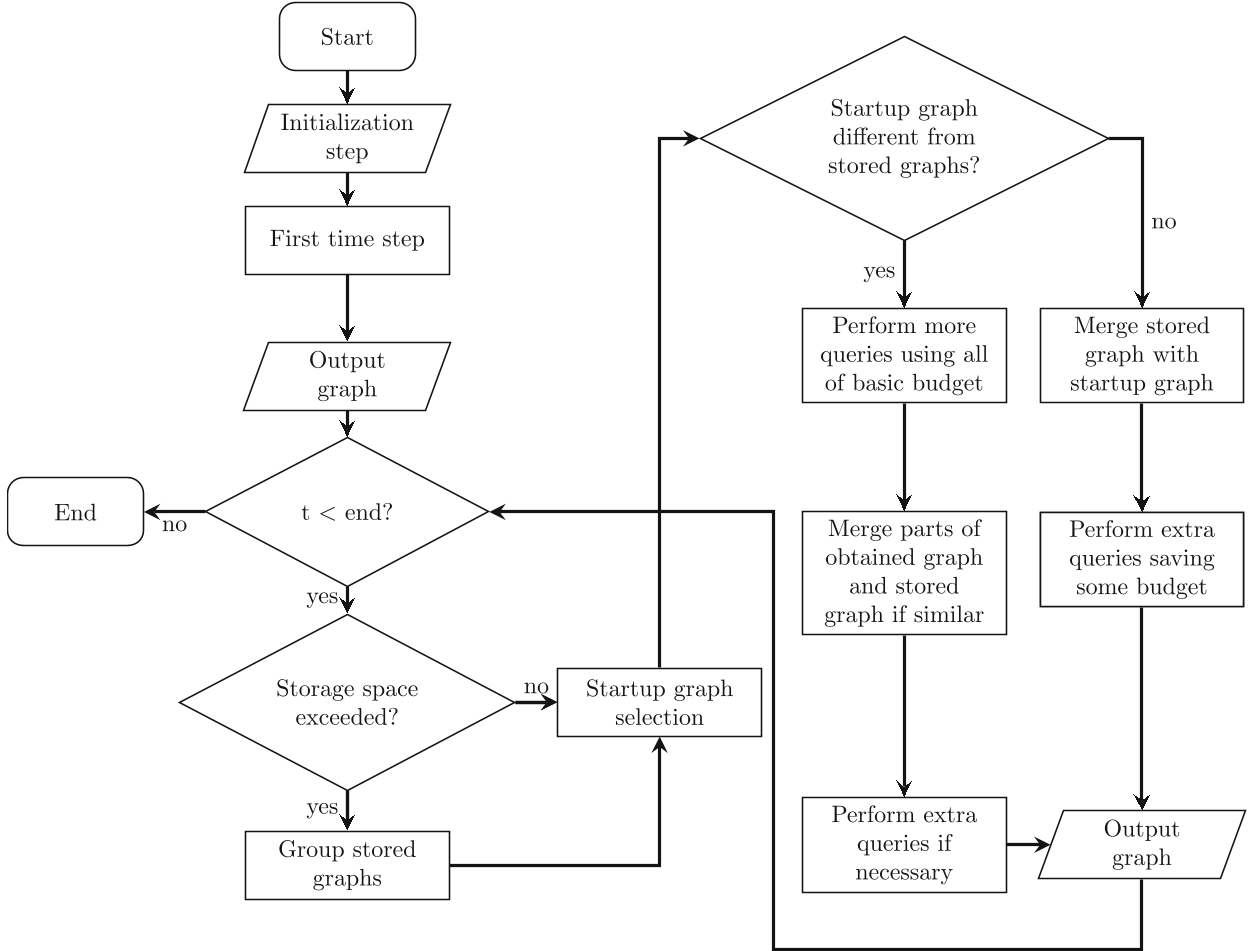 Figure 1: High-level view of the DYNSAMP process, showing the transition from startup graph to comparison and extra queries.
Experiments and Results
The authors tested DYNSAMP against Random Walk (RW) and Breadth-First Search (BFS) on various datasets, including Enron emails, MIT Reality Mining, and autonomous systems logs.
Performance Metrics
They primarily used Normalized Mutual Information (NMI) to measure how closely the sampled community structure matches the ground truth of the full network.
Key Findings
- Stable Networks (e.g., Syn1): In environments where communities are relatively stable, DYNSAMP vastly outperforms baselines because its query-saving mechanism allows it to "grow" the sample significantly over time.
- Highly Volatile Networks (e.g., Enron): In networks with chaotic changes, DYNSAMP's performance converges toward the baselines, as the "memory" of past structures provides less utility.
- Quantitative Gain: The approach showed a 35% to 53% increase in performance when the query budget was fixed over the entire duration.
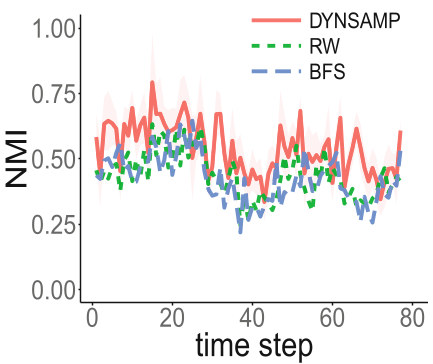 Figure 2: Performance on different datasets. Note how DYNSAMP consistently stays above baselines in various scenarios.
Critical Analysis: Storage vs. Accuracy
One potential bottleneck of DYNSAMP is the memory required to store past snapshots. The authors addressed this by introducing community-based graph clustering, where similar snapshots are merged into a single representative "group graph" when storage limits are hit. This ensures the algorithm remains scalable for long-term monitoring.
Summary and Future Outlook
DYNSAMP proves that for dynamic social networks, knowing where to look is as important as how to look. By treating the sampling process as an adaptive learning task rather than a static traversal, the method achieves SOTA results in community representation.
Future Work: The integration of "node value" predictions—predicting which specific nodes are likely to trigger a community split before querying them—could further refine the efficiency of this sampling paradigm.