
DYNSAMP: Intelligent Crawling for Dynamic Community Structure
Sampling Community Structure in Dynamic Social Networks
This paper introduces DYNSAMP (Dynamic Sampler), a crawling-based network sampling technique designed to capture the community structure of dynamic social networks under strict query budget constraints. By leveraging historical community data to guide current exploration, it achieves state-of-the-art representativeness in sampled snapshots.
TL;DR
When API limits represent a bottleneck for data collection, researchers must choose their queries wisely. DYNSAMP is a novel sampling framework that uses historical "memory" of community structures to guide current crawling. It achieves up to a 53% improvement in capturing true community partitions (measured by NMI) compared to standard methods like Breadth-First Search (BFS) or Random Walk (RW).
The Challenge: Sampling Under Scarcity
In the era of "Big Data," the irony is that data is often locked behind "Small APIs." For instance, Twitter (X) might limit a researcher to a handful of queries every 15 minutes. If your goal is to study how communities migrate, merge, or dissolve over time, you cannot afford to waste queries on nodes that haven't changed.
The authors identify a critical gap: status quo sampling methods either treat graphs as static or assume you already know the full graph. In reality, we are "crawling in the dark."
Methodology: The Power of Historical Intuition
The core philosophy of DYNSAMP is that community structures often exhibit temporal stability. If a community existed yesterday, there is a high probability it remains largely intact today.
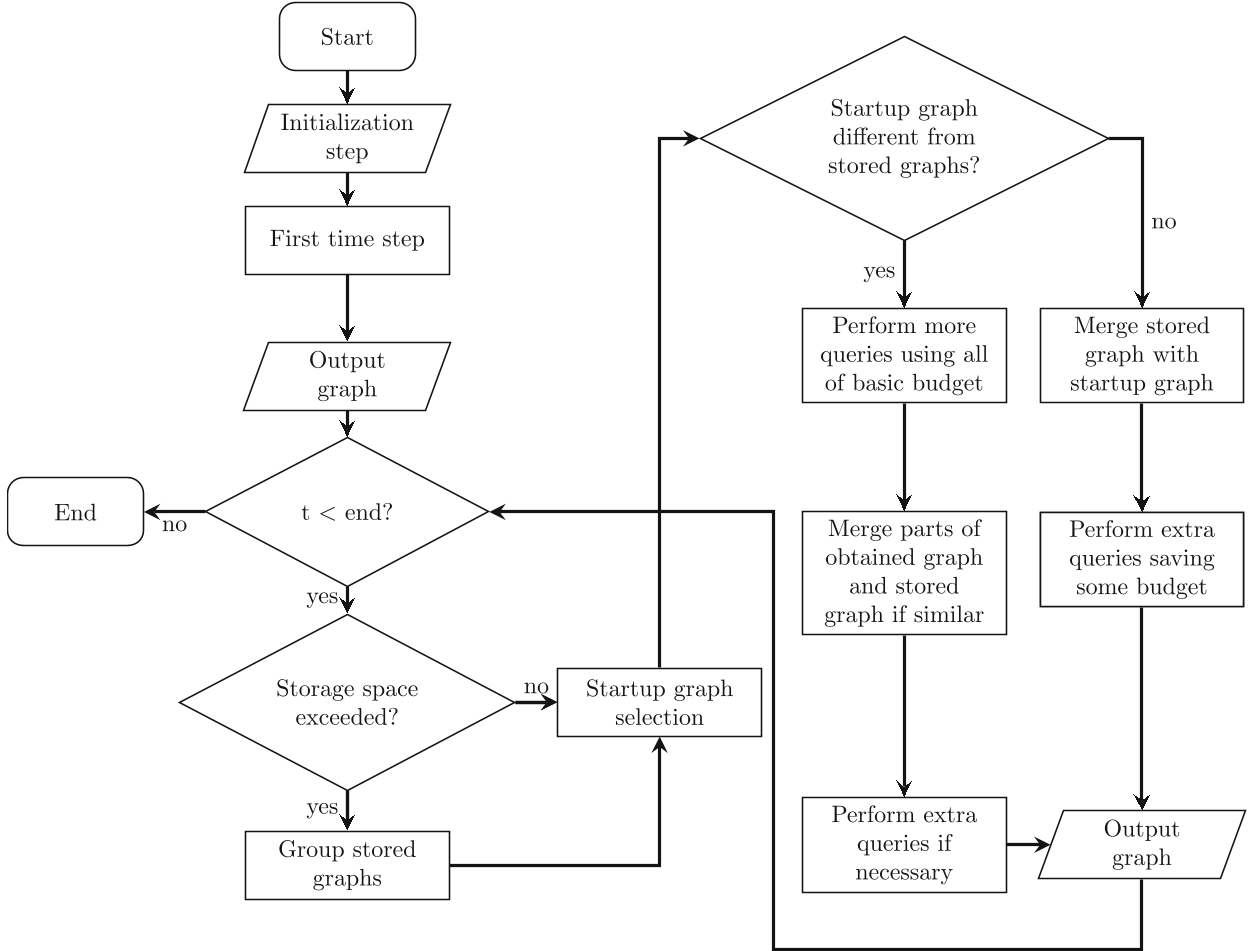
The DYNSAMP Workflow:
- Budget Allocation: Depending on the constraint (total budget vs. daily budget), the algorithm slices the available queries.
- Startup Graph: At each new time step, DYNSAMP uses roughly 50% of the budget to probe nodes that previously showed high volatility.
- Similarity Comparison: The algorithm calculates the Jaccard similarity between the new "startup" sample and stored historical graphs.
- Strategic Expansion:
- If Similar: It merges the current sample with the best-matching historical graph, effectively "filling in the blanks" without spending queries.
- If Dissimilar: It treats the current structure as a new discovery and utilizes the remaining budget to explore these "wholly new" regions.
Experiments and Performance
The researchers tested DYNSAMP against three real-world datasets (AS-733, MIT Contact, Enron) and synthetic graphs (Syn1, Syn2) featuring complex splitting and merging behaviors.
Key Findings:
- The "Stability" Advantage: In stable networks (like the Syn1 dataset), DYNSAMP dominates because it avoids redundant queries on unchanging structures.
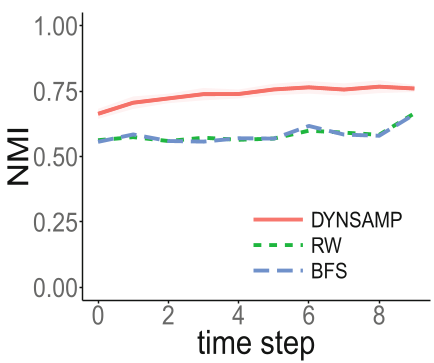
- Baseline Comparison: Using Normalized Mutual Information (NMI) to measure how closely the sample reflects ground truth, DYNSAMP consistently outperformed RW and BFS.
- Handling Volatility: In highly unstable networks (like the Enron email dataset), the performance converges toward the baselines, as there is little historical "memory" to capitalize on.
Depth Insight: Why It Works
The brilliance of DYNSAMP lies in its Inductive Bias. Most sampling algorithms are "forgetful"—they treat each time step as an independent event. By incorporating a storage mechanism and a merge-part logic (Algorithm 1 & 2), the authors turned the dynamic nature of the network from a challenge into an asset.
Critical Analysis & Conclusion
Takeaway
DYNSAMP proves that intelligent data collection is as much about "what not to query" as it is about "where to look next." For researchers working with API-constrained environments, this methodology provides a blueprint for efficient longitudinal studies.
Limitations
- Storage Overhead: While the authors address storage via clustering similar graphs, an extremely long timeline with radical changes could still pose storage challenges.
- Threshold Sensitivity: The dissimilarity threshold () is a hyperparameter that might require tuning depending on the network's known volatility.
Future Outlook
Future iterations could integrate Predictive Modeling, using Graph Neural Networks (GNNs) to predict where communities will emerge, further optimizing the "Startup Graph" selection process.