
SampleDyn: Efficiently Harvesting Social Intelligence via Near-Uniform Sampling
Sampling online social networks
This paper introduces SampleDyn, a sampling-based framework designed to efficiently collect and approximate social information from a user's extended neighborhood in dynamic online social networks. By utilizing a rejection-sampling random walk approach that simulates tree structures, the method achieves near-uniform node selection and can rank items with high accuracy while visiting only a fraction of the network compared to exhaustive crawling (DFS/BFS).
TL;DR
Social search depends on what your "neighbors" think, but crawling an entire social graph at runtime is too slow. This paper introduces a breakthrough sampling framework that uses biased random walks with a rejection-sampling correction to achieve near-uniform sampling of a user's neighborhood. It allows systems to approximate the popularity of items (like URLs or products) with high accuracy while visiting only a tiny fraction of the network.
The "Neighborhood" Bottleneck
In the era of Social Search, relevance isn't just about keywords; it's about what your circle endorses. However, modern social networks (Facebook, LinkedIn, etc.) are:
- Massive: Even a 4-hop neighborhood can contain thousands or millions of nodes.
- Dynamic: Relationships change constantly, making pre-computed indices go stale.
- Distributed: Centralized access to the full graph is often restricted.
Current methods rely on Depth-First Search (DFS) or Breadth-First Search (BFS). While robust, their complexity is (the number of edges), which is far too slow for a real-time query. Standard random walks are faster but suffer from topological bias—they naturally gravitate toward "hub" nodes with high degrees, skewing the results.
Methodology: Correcting Bias via Tree-Based Random Walks
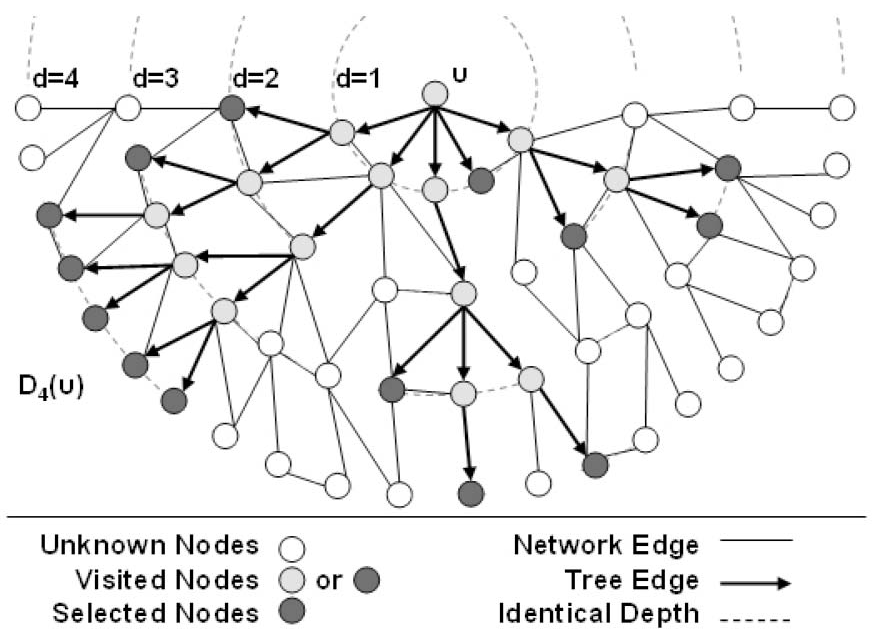
The core innovation lies in treating the neighborhood graph as a tree and performing a specific type of random walk.
1. The Tree Transformation
The algorithm converts a general graph into an Induced Spanning Tree by maintaining state information to prevent cycles during the walk. It then moves all values (data) to virtual leaf nodes to simplify the probability space.
2. The Rejection Mechanism
To ensure every node has an equal probability of being picked, the authors use a clever rejection sampling approach. If a walk reaches a node with probability , it is only accepted into the sample if a biased coin flip succeeds.
The acceptance probability is defined as: where . This mathematical "hack" perfectly offsets the path-probability bias, ensuring that nodes further away or in dense clusters aren't under-sampled.
Scaling with "Batch" Intelligence
One potential downside is the "cost" of rejection: if is too small, most walks are rejected, wasting time. The authors solve this by:
- Tuning : Using a "mark and recapture" heuristic (the Birthday Paradox) to estimate the tree size and set .
- EvalBatch: Instead of drawing a new sample for every item we want to rank (URL A, URL B, URL C...), the system draws one high-quality sample and uses it to estimate counts for all items simultaneously.
Experimental Results
The researchers tested their method against real data from Epinions and AOL search logs.
- Accuracy:
EvalSingle(their method) significantly outperformed a naive random walk. In a network of ~75k nodes, the relative error was kept consistently low even as the depth increased. - Efficiency: Compared to exhaustive crawling, SampleDyn showed "huge savings." As the network depth grows, the gap between exhaustive crawling and SampleDyn widens exponentially.
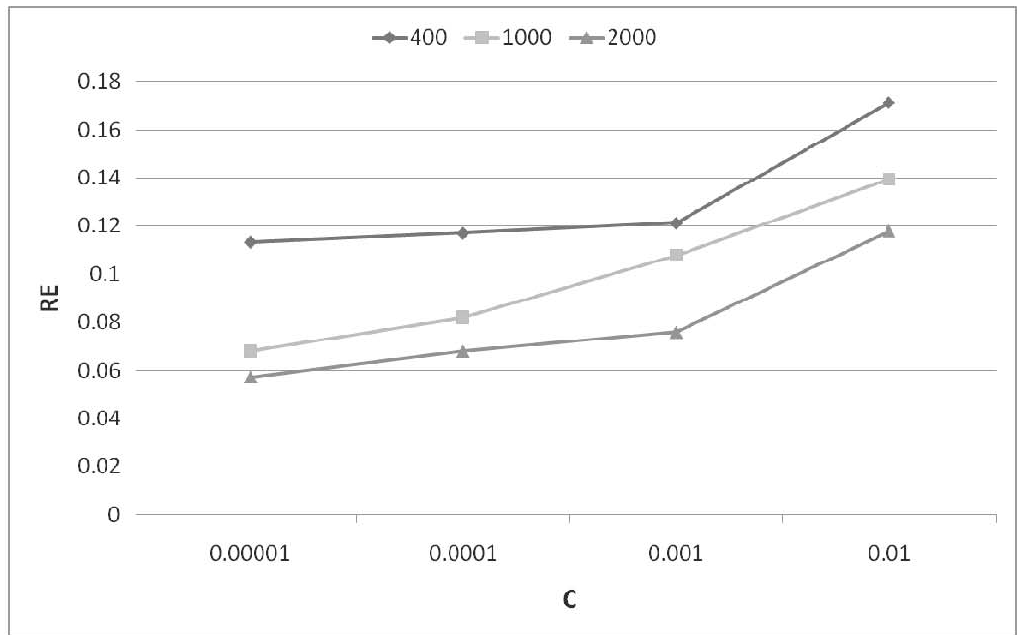 Fig: Left shows how the error (RE) drops as the sampling becomes more rigorous; right shows the corresponding increase in "hops" (cost).
Ranking Performance
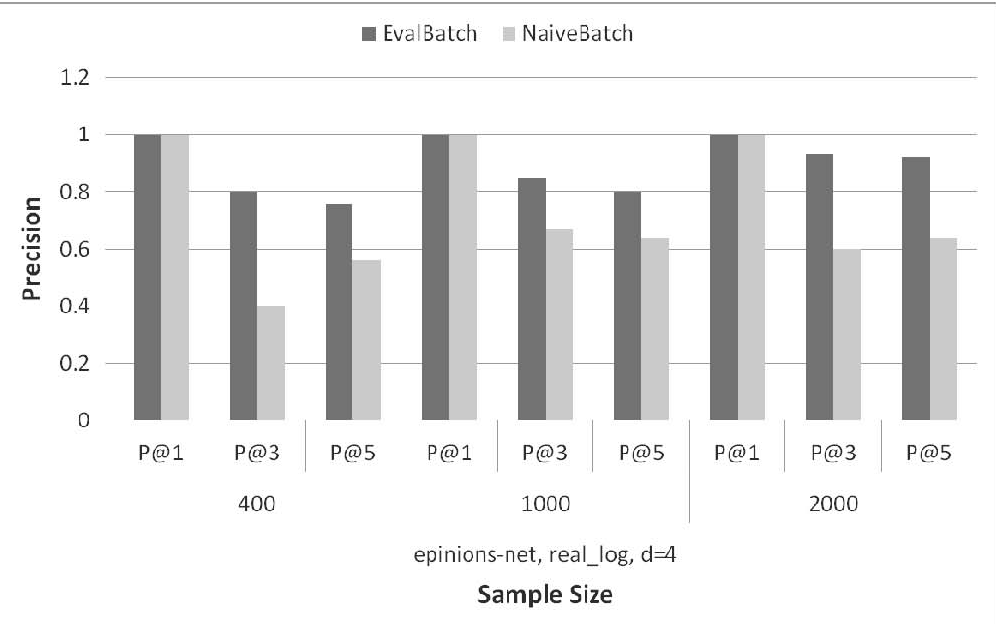
The ultimate test: Can it rank items correctly? Using the Spearman’s Footrule Distance (where 0 is a perfect match), the EvalBatch method maintained a high correlation with the "ground truth" (exhaustive crawl) while being orders of magnitude faster.
Final Insight: The Future of Distributed Social Search
This work signals a shift from "Big Data" (indexing everything) to "Smart Data" (sampling what matters). By combining graph theory with statistical sampling, the authors proved that you don't need to know everything about a user's network to provide a highly personalized experience.
Potential Limitations: The method might struggle with "low-selectivity" items (items only endorsed by 1 or 2 people in a million). However, for mainstream social search and trend detection, SampleDyn provides a mathematically sound, scalable blueprint.