
The Hidden Bias of Social Sampling: How Homophily Distorts Our View of Networks
Sampling from Social Networks with Aributes
This paper investigates the sensitivity of various network sampling techniques—Node, Edge, Random Walk, and Snowball—on social networks with binary attributes. By analyzing both synthetic and empirical datasets (Pokec and Sexworker networks), the authors demonstrate how homophily/heterophily and group size imbalances bias degree centrality rankings and group visibility.
Executive Summary
TL;DR: Sampling is not a neutral process. In social networks where people "cluster" by attributes (gender, age, ethnicity), common sampling methods like Node or Snowball sampling can systematically "erase" or over-represent certain groups. This paper reveals that Random Walk sampling is the most robust way to maintain the relative importance of groups when you can't see the whole network.
Positioning: This work moves beyond traditional "missing data" analysis by focusing on the interplay between social mechanisms (homophily/heterophily) and topology-based sampling. It is a crucial cautionary tale for sociologists and data scientists working with "sampled" social media data.
The Problem: When Attributes and Architecture Collide
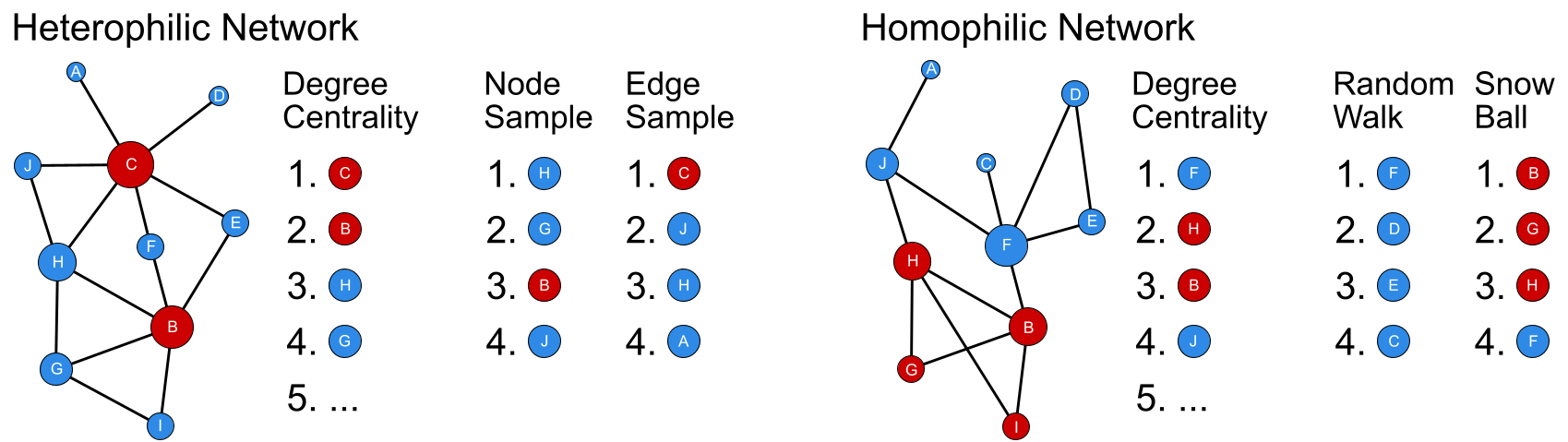
In a "colorless" network, sampling is just a matter of capturing the degree distribution. But real people have attributes. If a minority group ( of the population) is highly active in a heterophilic way (connecting only to the majority), they might actually hold all the "hub" positions in the network.
The authors argue that if we sample nodes randomly, we might miss these rare but vital hubs, leading us to believe the minority is less central than they truly are. The core challenge is that group size imbalance + homophily/heterophily = statistical dependency, which breaks the assumptions of uniform sampling.
Methodology: Simulating Worlds of Bias
The researchers tested four primary methods:
- Node Sampling: Picking nodes like a lottery.
- Edge Sampling: Picking connections.
- Snowball Sampling: Starting with one person and following all their "friends."
- Random Walk: Moving from friend to friend with a "teleport" option.
They measured success using a sophisticated metric called Normalized Cumulative Group Relevance (nCGR). Instead of just asking "did we find the minority?", they asked "is the minority's total influence in the sample the same as in the original network?"
Key Insights from Experiments
1. The Superiority of the Random Walk
The Random Walk (RW) consistently outperformed others. Why? Because RW naturally gravitates toward high-degree nodes (hubs). Since social status (centrality) is often tied to attributes through homophily, the RW "finds" the structure of the groups more effectively than a blind node-by-node pick.
2. The Asymmetry of Bias
Interestingly, the bias is worse in heterophilic networks (where groups attract opposites). In these scenarios, the majority nodes gain popularity from the minority nodes, but the node/snowball samples often fail to reflect the minority's pivotal role as the "connectors" of the system.
 The chart above demonstrates how Node sampling (red) consistently underestimates group relevance () in many scenarios compared to Random Walk (green).
3. Real-World Validation: Pokec and Sexworkers
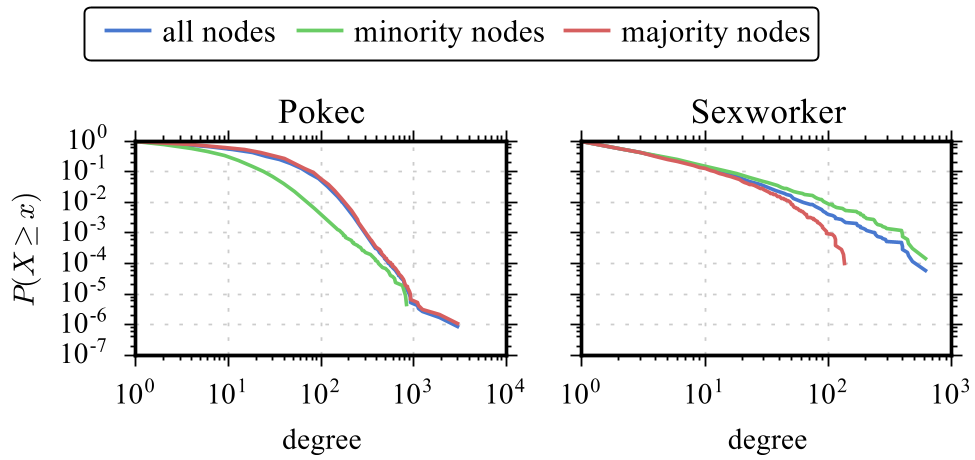
- Pokec (Slovakian Social Network): Shows moderate homophily (people friend those of similar age). Here, all sampling performed relatively well because the "hubs" belonged to the majority anyway.
- Sexworker Network: This is a bipartite, extreme heterophilic network (contacts only between workers and buyers). Node sampling failed miserably here, significantly underestimating the visibility of the minority (workers), who are actually the central hubs of the network.
Critical Insight & Conclusion
The study provides a vital framework for Sampling Robustness. If you are a researcher using a "10% Twitter Firehose" or a sampled contact dataset:
- Node sampling is dangerous if you care about minority representation.
- Homophily creates "structural shielding"; in homophilic networks, a snowball sample might get "trapped" in one group and never see the other.
- Random Walk is your best bet for a "representative" slice of social influence.
Limitations: The study assumes binary attributes. Reality is intersectional (multiple attributes) and directed (following vs. being followed). Future work must tackle whether these biases compound when we move to multi-group, directed social landscapes.