
SANA-WM: Revolutionizing Minute-Scale World Modeling on a Single GPU
SANA-WM: Efficient Minute-Scale World Modeling with Hybrid Linear Diffusion Transformer
SANA-WM is a 2.6B-parameter open-source world model developed by NVIDIA for high-fidelity, 720p, minute-scale video generation with precise 6-DoF camera control. It utilizes a Hybrid Linear Diffusion Transformer (Linear DiT) and a dual-branch conditioning mechanism to achieve performance comparable to industrial baselines while significantly reducing compute and data requirements.
TL;DR
SANA-WM is a breakthrough 2.6B-parameter world model from NVIDIA that generates high-fidelity, one-minute 720p videos with precise 6-DoF camera control. By replacing standard Transformers with a Hybrid Linear DiT (Gated DeltaNet + Softmax), it slashes compute costs while outperforming industrial giants. It proves that with the right architecture, a single RTX 5090 can simulate consistent 3D worlds.
The Scaling Wall of Video Generation
Simulating a "world" for a full minute at 720p (16 fps) isn't just a video task—it's a memory nightmare. Standard Softmax Attention scales quadratically, meaning a 60-second sequence would exhaust the VRAM of even an H100 cluster. Furthermore, most open-source models lack "metric-scale" awareness; they understand "pan left" but can't follow a precise XYZ coordinate trajectory, leading to "hallucinated" layouts and scene collapse during long rollouts.
Methodology: The Architecture of Efficiency
SANA-WM bridges the gap between efficiency and quality through four strategic pillars:
1. Hybrid Linear DiT Backbone
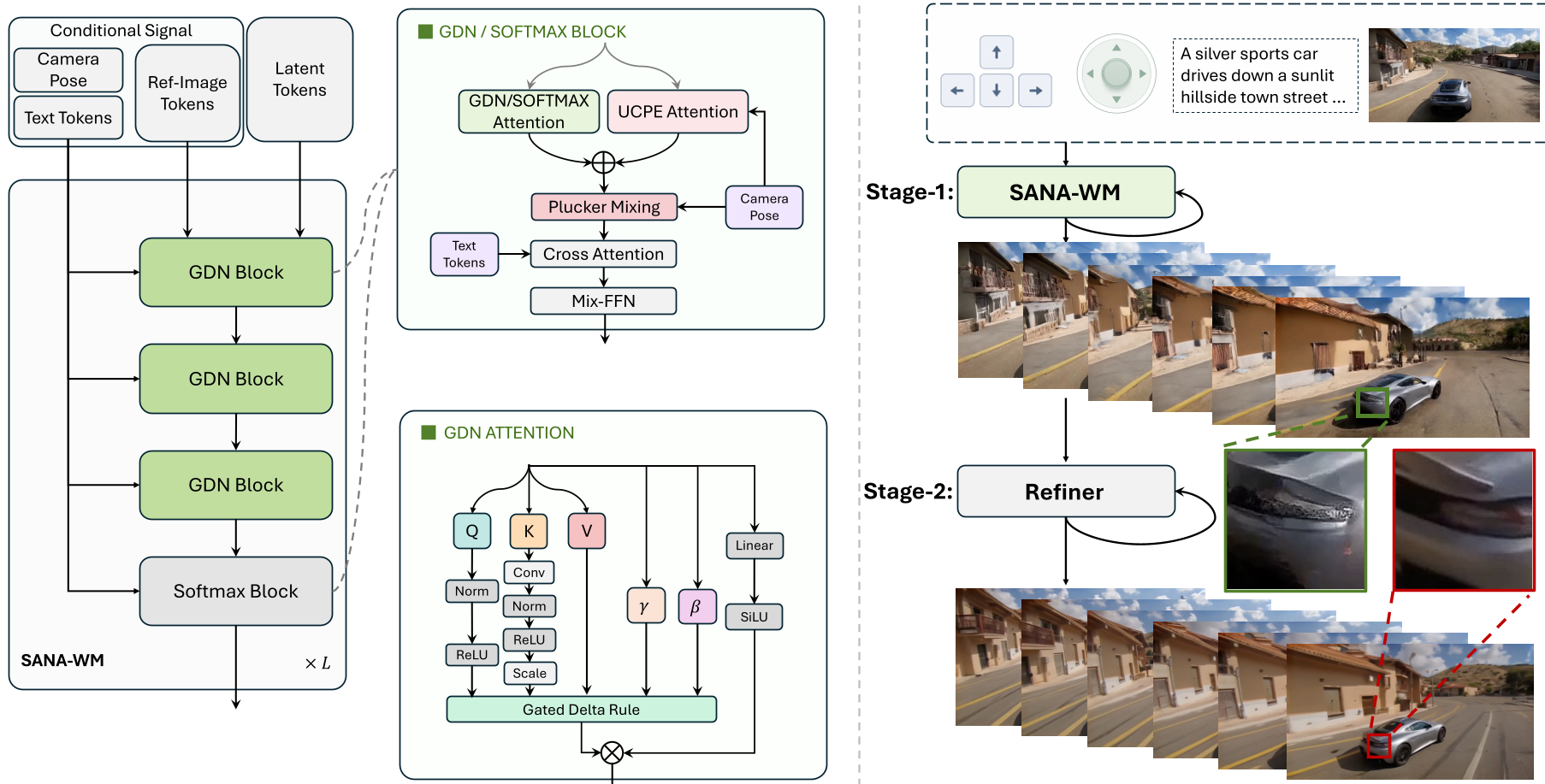
The core innovation is the move away from pure Softmax. The model uses Gated DeltaNet (GDN), a linear recurrence mechanism, to process most frames. Unlike standard linear attention, GDN uses a "delta rule" to update its latent state, allowing it to "forget" stale features and focus on new ones. To prevent the "forgetting" typical of RNNs, every 4th layer is a standard Softmax block to anchor long-term spatial consistency.
2. Dual-Branch Camera Control
To ensure the model follows a camera path exactly, SANA-WM uses two distinct signals:
- Coarse (UCPE): Operates at the latent level to handle global 6-DoF poses.
- Fine (Plücker mixing): Operates at the raw frame level to handle micro-movements within a VAE temporal stride. This "coarse-to-fine" approach prevents the jitter and drift common in previous camera-controlled models.
3. Metric-Scale Data Pipeline
Deep learning is nothing without data. The team built a massive annotation engine (using Pi3X and MoGe-2) to re-annotate 213K public clips with metric-scale 6-DoF poses. They even used 3D Gaussian Splatting (3DGS) to render synthetic paths through real-world static scenes, providing perfectly labeled training data.
Experimental Showdown: Quality vs. Speed
SANA-WM doesn't just match the quality of massive models like LingBot-World; it crushes them in efficiency.
| Metric | Matrix-Game 3.0 (720p) | SANA-WM (720p) | SANA-WM + Refiner |
|---|---|---|---|
| Rotation Error (↓) | 12.96° | 7.59° | 4.50° |
| Throughput (vids/hr) | 3.1 | 24.1 | 22.0 |
| GPU Memory (GB) | 106.2 | 51.1 | 74.7 |
Key Takeaway: SANA-WM achieves 3.7x to 36x higher throughput than baselines.

Two-Stage Refinement
To polish the output, a second-stage Long-Video Refiner (built on a 17B LTX-2 model) is used. This model is trained using Truncated-σ Flow Matching, specifically adapted to correct structural artifacts in minute-long sequences. This ensures that even at the 50-second mark, the world remains crisp and temporally stable.
Critical Insight & Future Outlook
SANA-WM marks a pivotal shift in World Modeling. By leveraging Algebraically Stabilized GDN, the authors solved the "explosion" problem of recurrent states in long videos.
Limitations: The model can still drift in hyper-dynamic scenes or when encountering extreme viewpoints not represented in the 213K-clip training set.
The Future: Imagine this technology integrated into Game Engines or Robot Simulators. Interactive worlds that used to require a server farm can now be hallucinated in real-time on a high-end consumer PC. SANA-WM isn't just a research paper; it's a blueprint for the democratized future of 3D simulation.