
SANA-WM: Revolutionizing Minute-Scale World Modeling with Hybrid Linear DiT
SANA-WM: Efficient Minute-Scale World Modeling with Hybrid Linear Diffusion Transformer
SANA-WM is a 2.6B-parameter open-source world model developed by NVIDIA that specializes in efficient, minute-scale (60s) video generation at 720p resolution with precise 6-DoF camera control. It achieves visual quality comparable to large-scale industrial baselines while utilizing a hybrid Linear Diffusion Transformer architecture that allows single-GPU inference and 3D-consistent rollouts.
TL;DR
NVIDIA's SANA-WM (2.6B parameters) is a breakthrough in generative world modeling, capable of synthesizing one-minute-long 720p videos with precise 6-DoF camera control. Unlike previous models that require massive GPU clusters, SANA-WM runs on a single GPU for inference and utilizes a "Hybrid" architecture that solves the memory explosion problem of traditional Transformers.
Background: The Long-Horizon Challenge
In the quest to create "World Models" for embodied AI and simulation, the industry has hit two major bottlenecks:
- Memory Complexity: Softmax attention used in models like Sora scales quadratically, making 60-second 720p sequences computationally impossible for most labs.
- Scene Persistence: Generating a few seconds is easy; keeping a scene consistent for a full minute without "hallucination drift" is notoriously hard.
SANA-WM addresses these by moving away from "pure" Transformers toward a more efficient recurrent-linear hybrid.
Methodology: The Secret Sauce
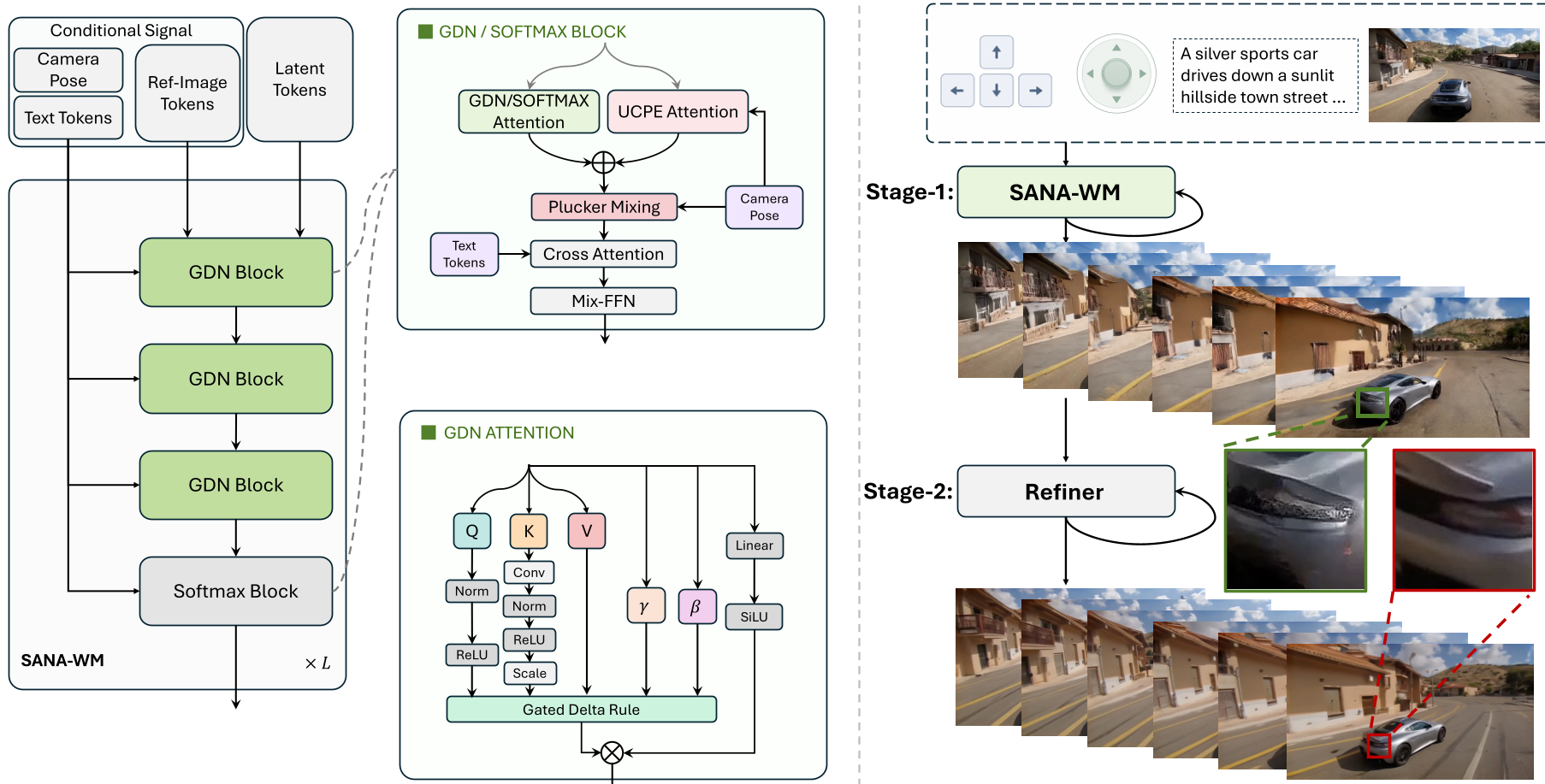
1. Hybrid GDN/Softmax Architecture
The backbone of SANA-WM is a Diffusion Transformer (DiT) that interleaves two types of layers:
- Gated DeltaNet (GDN): A linear-time recurrent mechanism that maintains a constant-size state. It acts as the model's "working memory," absorbing each frame efficiently.
- Softmax Attention: Inserted every 4th block to provide "exact recall," ensuring the model doesn't lose track of distant spatial details.
2. Dual-Branch Camera Control
To ensure the model follows a specific 3D trajectory (e.g., "dolly zoom" or "orbital pan"), SANA-WM uses a dual-branch approach:
- Coarse Branch (UCPE): Captures global 6-DoF poses at the latent frame rate.
- Fine Branch (Plücker Mixing): Compenses for high-frequency motion within VAE strides using raw-frame raymaps.
Experiments & Performance
The model was trained on 213K public video clips (annotated with a custom metric-pose engine) over 15 days using 64 H100s.
Unprecedented Throughput
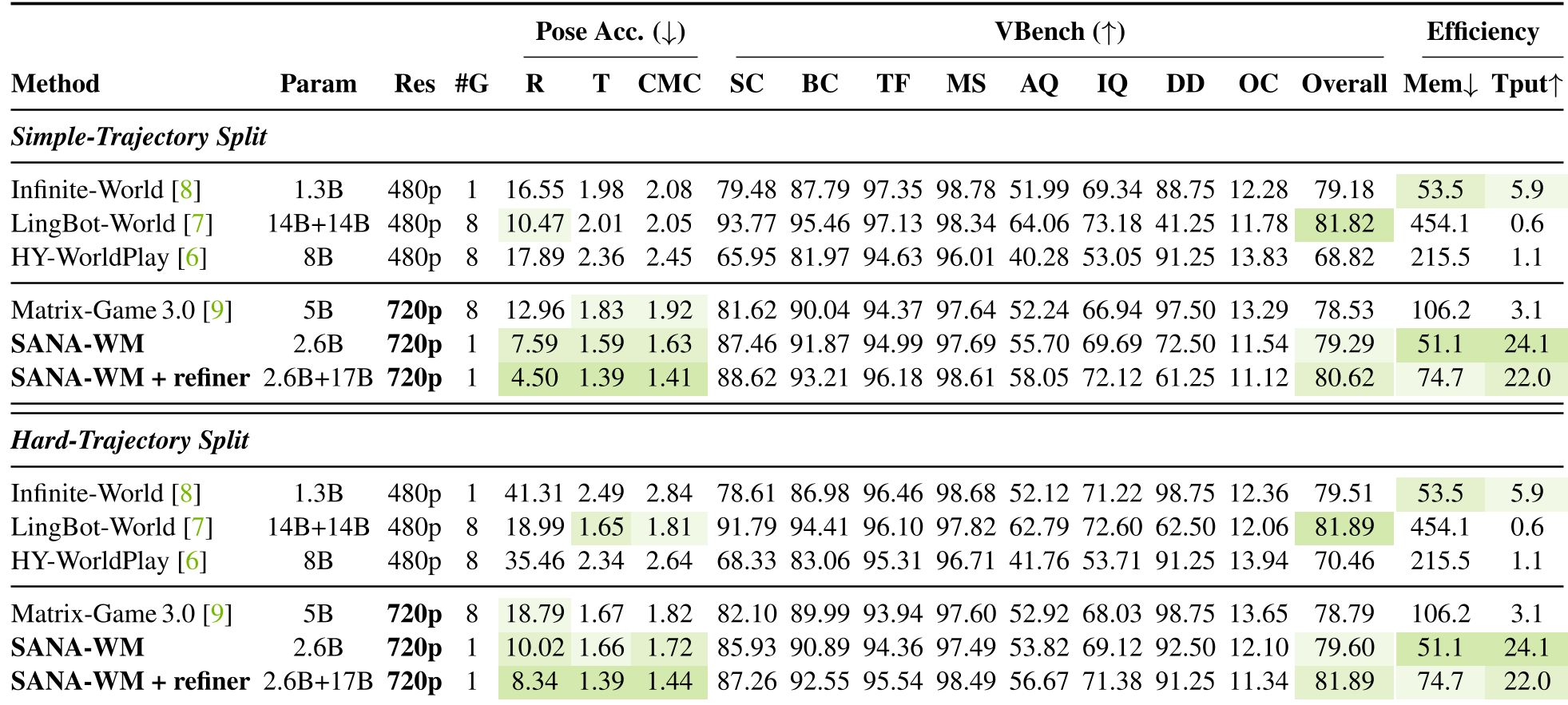
SANA-WM is built for speed. Its distilled variant, using NVFP4 quantization, can generate a whole minute of 720p action-conditioned video in 34 seconds on a single RTX 5090. Compared to industrial baselines like LingBot-World, it offers 36x higher throughput.
Action Fidelity
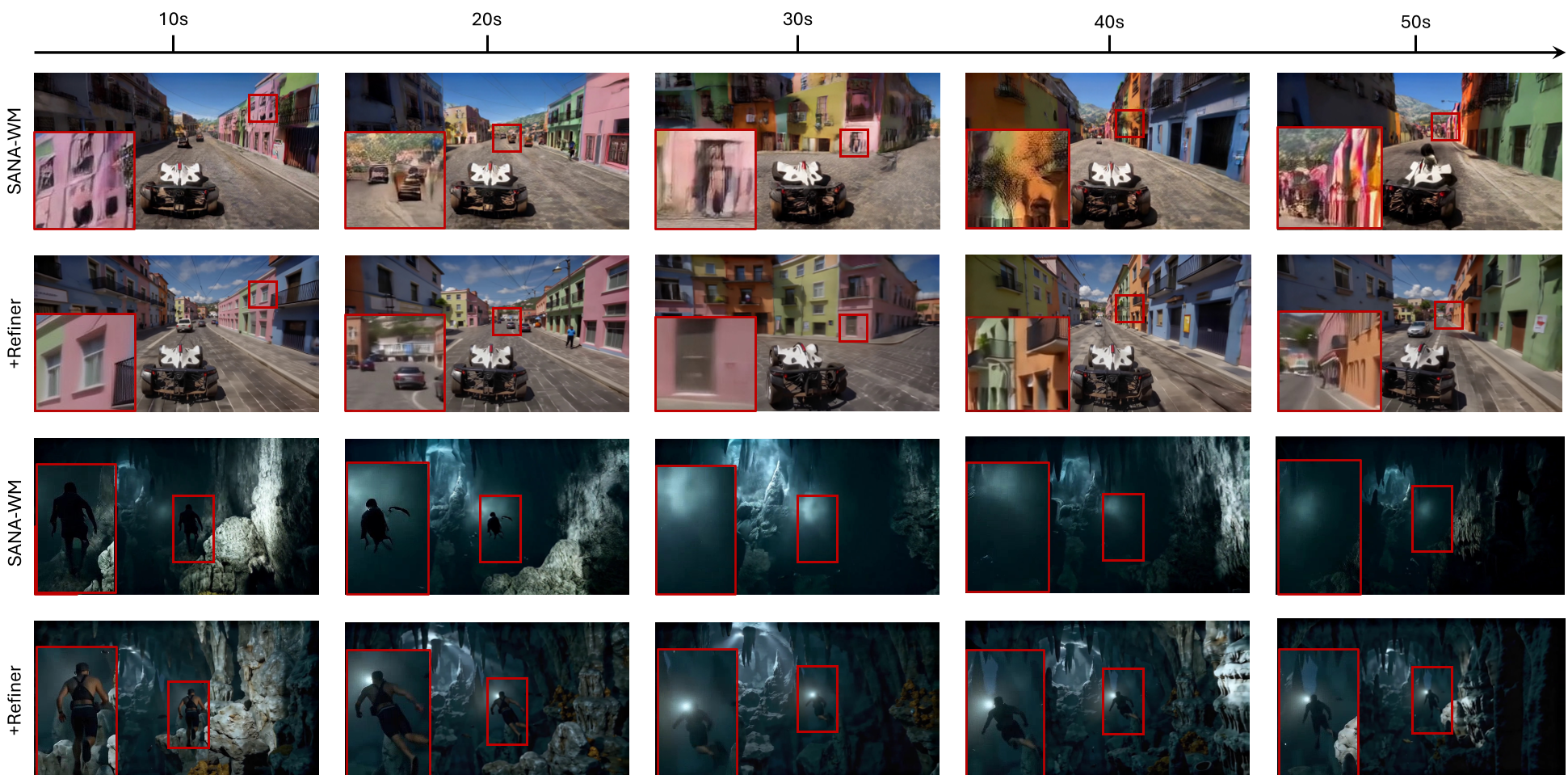
Evaluation on a new "One-Minute Benchmark" (Simple & Hard trajectories) shows that SANA-WM maintains object identity and scene layout even under extreme "whip-pan" motions where other models typically collapse into blurry noise.
Critical Insight & Future Outlook
The core philosophy of SANA-WM is "Native Training." Instead of stitching short clips together, it was trained to understand 60-second temporal dependencies from day one.
Takeaway: This work proves that linear models are now mature enough to challenge Transformers in high-stakes generative tasks. While it still lacks "explicit" 3D memory (like a voxel map), its "implicit" memory via GDN is surprisingly robust. For the research community, SANA-WM democratizes world modeling, bringing what was once a "Google/OpenAI-scale" task to a single workstation.
Limitations
- Scale: At 2.6B parameters, it may still struggle with complex semantic dynamic interactions compared to 10B+ models.
- Drift: While significantly reduced, long-horizon drift in highly dynamic environments (many moving objects) remains a challenge.
SANA-WM is open-sourced, and the community can now explore 60s 720p simulation with just a single GPU.