
SANA-WM: Revolutionizing Minute-Scale World Modeling with Hybrid Linear DiT
SANA-WM: Efficient Minute-Scale World Modeling with Hybrid Linear Diffusion Transformer
SANA-WM is a 2.6B-parameter open-source world model developed by NVIDIA for high-fidelity, minute-scale 720p video generation with precise 6-DoF camera control. It utilizes a Hybrid Linear Diffusion Transformer (GDN + Softmax) and a two-stage refinement pipeline to achieve visual quality comparable to industrial baselines while significantly improving training and inference efficiency.
TL;DR
NVIDIA researchers have unveiled SANA-WM, an open-source world model that generates one-minute 720p videos with precise 6-DoF (Degrees of Freedom) camera control. By combining high-compression latents with a hybrid GDN-Softmax architecture, it slashes the compute barrier—training in 15 days on 64 GPUs and running inference on a single consumer-grade RTX 5090.
Background: The Cost of Persistence
In the quest to build "World Models" for simulation and robotics, the industry has hit a wall: Length and Resolution. Generating a 2-second clip is easy; maintaining a consistent 3D world for 60 seconds at 720p is a computational nightmare. Conventional Softmax Attention scales quadratically, causing memory to explode as video length increases. Existing solutions like LingBot-World or HY-WorldPlay offer high quality but require massive multi-GPU clusters just to run a single rollout.
SANA-WM’s Architectural Insight: Efficiency as a First-Class Citizen
SANA-WM doesn't just throw more GPUs at the problem. Instead, it reworks the fundamental "How" of video generation through three pillars:
1. Hybrid Linear-Softmax Backbone
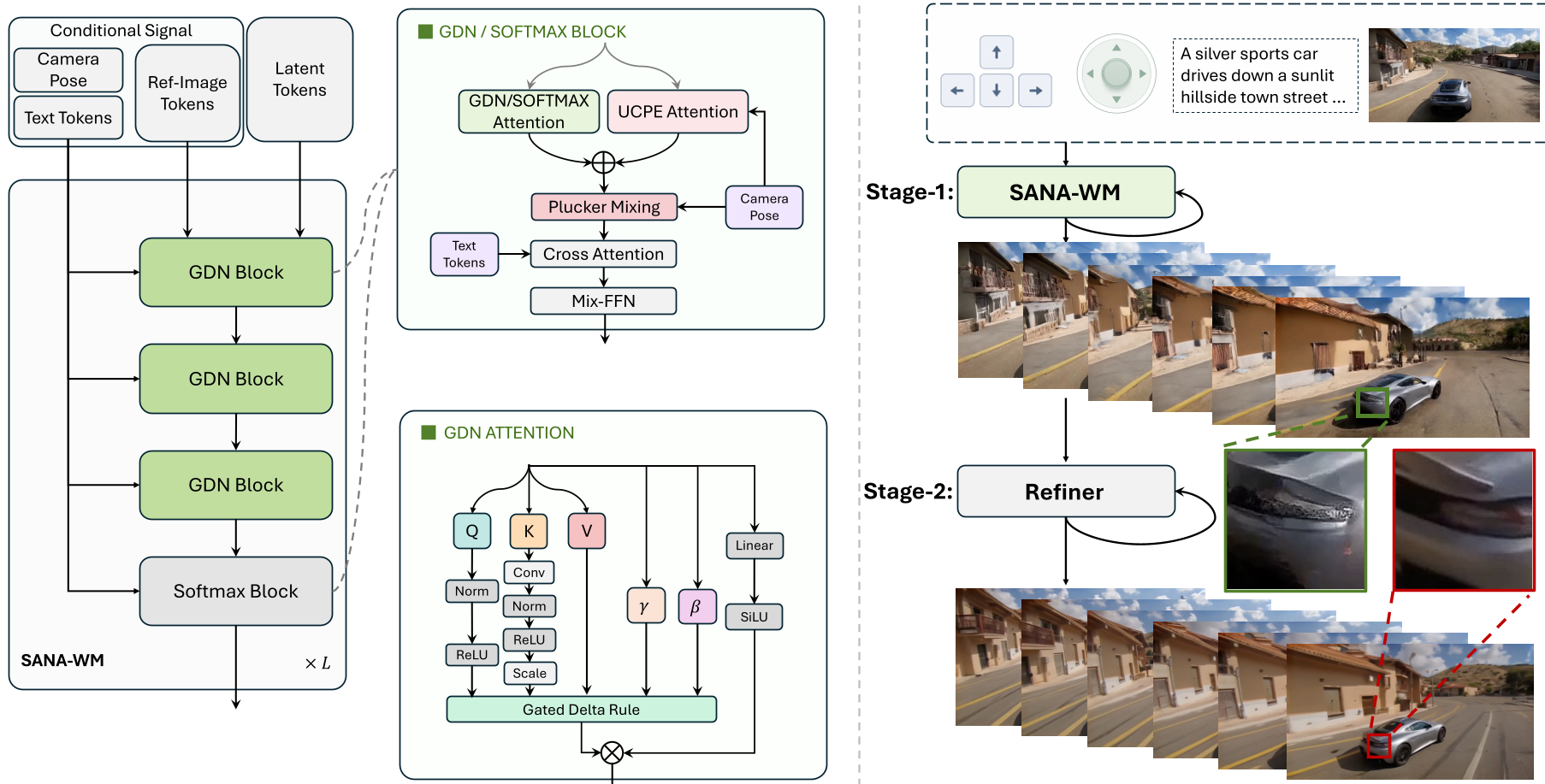
The "secret sauce" is the Gated DeltaNet (GDN) mixed with standard Softmax blocks.
- GDN Blocks: Act as a recursive memory, aggregating 720p frame data without the quadratic memory overhead.
- Softmax Blocks: Inserted every fourth layer to act as "anchor points," ensuring high spatial fidelity and global context recall that pure linear models often lack.
2. Dual-Branch Camera Control
Controlling a world model requires more than just text. You need to tell the "camera" where to move in 3D space. SANA-WM uses a dual-rate approach:
- Coarse Branch (UCPE): Handles the global 6-DoF trajectory.
- Fine Branch (Plücker Mixing): Compensates for fine-grained motion within each temporal VAE stride, preventing the "jitter" common in compressed video models.
3. Progressive Training & The Data Engine
NVIDIA's team built a pipeline to re-annotate 213K public video clips with metric-scale 6-DoF camera poses. This allows the model to understand actual distances (meters/seconds) rather than just relative pixels.
Experimental Showdown: Single-GPU Mastery
The results are striking. SANA-WM matches or exceeds industrial-scale models in visual quality while being significantly faster.
| Metric | Matrix-Game 3.0 (Baseline) | SANA-WM (Ours) |
|---|---|---|
| Resolution | 720p | 720p |
| GPU Count (Inf) | 8 H100s | 1 H100 / 1 RTX 5090 |
| Throughput | 3.1 videos/hr | 22.0 videos/hr |
| Pose Error (Rot) | 12.96° | 4.50° |
Revisit Consistency
One of the hardest tests for a world model is "loop closure"—returning to a place the camera has already been. SANA-WM’s hybrid architecture allows it to "remember" the scene identity far better than pure autoregressive models, which typically drift into a blurry mess after 30 seconds.
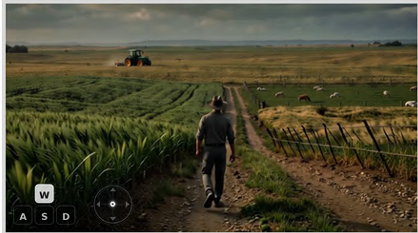 Figure: SANA-WM maintains scene identity even under extreme "Hard" trajectory stress tests where baselines collapse.
Two-Stage Refinement: The Final Polish
To push the visual quality to the limit, SANA-WM employs a Second Stage Refiner. This 17B-parameter model (based on LTX-2) uses a "truncated flow matching" technique. It doesn't regenerate the video from scratch; it "repaints" the Stage-1 output to sharpen textures and fix structural artifacts.
Future Outlook & Impact
The release of SANA-WM democratizes high-end simulation. By enabling 60s, 720p world modeling on a single GPU (RTX 5090), it opens the door for:
- Embodied AI: Testing robots in high-fidelity virtual "hallucinations."
- Gaming: Real-time generation of infinite interactive environments.
- Autonomous Systems: Generating diverse edge-case data for training self-driving stacks.
While limitations remain—such as occasional drift in highly dynamic scenes—SANA-WM proves that the path to Artificial General Intelligence (AGI) world modeling lies in the clever hybridization of memory-efficient architectures.
Conclusion
SANA-WM is a masterclass in technical pragmatism. By shifting away from pure Softmax Attention and focusing on a robust data annotation pipeline, NVIDIA has set a new SOTA for what is possible with accessible compute resources.