
SANA-WM: Revolutionizing Minute-Scale World Modeling with Hybrid Linear Transformers
SANA-WM: Efficient Minute-Scale World Modeling with Hybrid Linear Diffusion Transformer
SANA-WM is a 2.6B-parameter open-source world model developed by NVIDIA for high-fidelity, 720p, minute-scale video generation with precise 6-DoF camera control. It utilizes a Hybrid Linear Diffusion Transformer (DiT) architecture to achieve visual quality comparable to industrial baselines (like LingBot-World) while maintaining superior training and inference efficiency.
TL;DR
SANA-WM (World Model) by NVIDIA is a 2.6B parameter model that solves the efficiency-quality bottleneck in long-video generation. It can synthesize 60-second, 720p videos with precise 6-DoF camera control on a single GPU. It achieves this by moving away from standard, memory-hungry Transformers towards a Hybrid Linear DiT (GDN + Softmax) architecture, completing training in just 15 days on 64 H100s.
Problem & Motivation: The Long-Horizon Crisis
Generating a 5-second video is now "standard," but extending that to a full minute creates exponential challenges:
- Memory Ceiling: Standard Softmax attention scales quadratically. Keeping 60 seconds of 720p tokens in memory is virtually impossible for consumer hardware.
- Temporal Drift: Autoregressive models often "forget" the initial scene layout, leading to structural collapse or the "hallucination" of entirely new scenes during long camera pans.
- The Control Gap: Aligning video motion with specific 6-DoF trajectories (moving the camera left, then rotating pitch) requires dense geometric supervision that most web-scale datasets lack.
Methodology: The Core Innovations
1. Hybrid Linear-Softmax Backbone
SANA-WM introduces a frame-wise Gated DeltaNet (GDN). Unlike traditional linear attention which accumulates features blindly, GDN uses a "forget gate" and a delta-rule update. This allows the model to "delete" stale information and update its internal state only with new, salient visual features. To prevent the loss of fine-grained details, the authors interleave standard Softmax Attention every 4 blocks to act as an "anchor" for global spatial consistency.
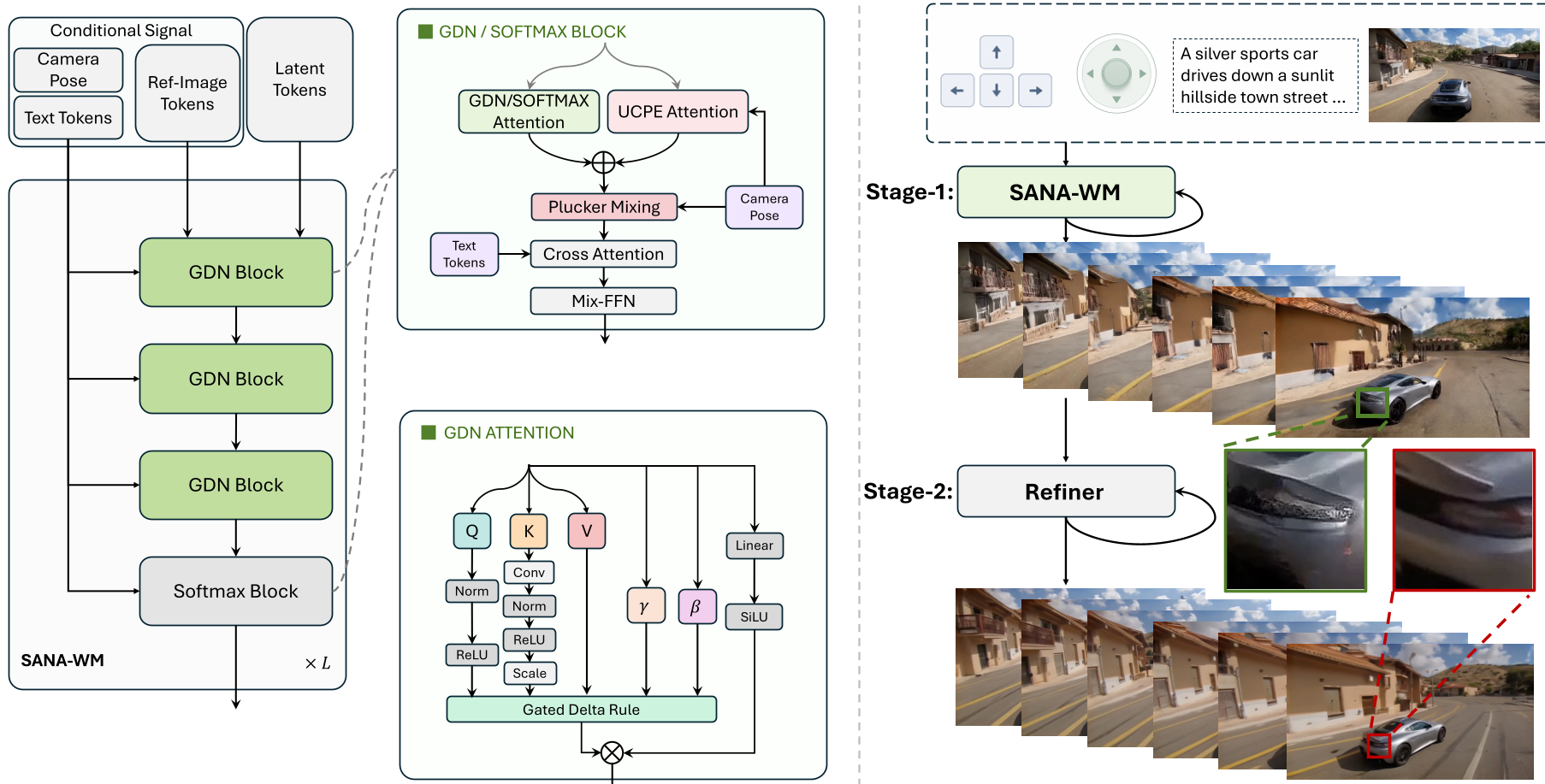 Figure 2: The SANA-WM architecture featuring alternating GDN and Softmax blocks, integrated with Dual-Branch Camera Control.
2. Dual-Branch Camera Control
To ensure the camera follows the exact path specified by the user:
- Coarse Branch (UCPE): Uses Unified Camera Positional Encoding to capture global pose.
- Fine Branch (Plücker Mixing): Injects raw-frame raymaps (Plücker rays) to compensate for motion within the temporal strides of the VAE, ensuring jitter-free movement.
3. Progressive Training & Robust Labels
Most internet videos don't come with camera logs. NVIDIA built a custom pipeline using VIPE, Pi3X, and MoGe-2 to estimate metric-scale 3D poses from 213,000 public clips, providing the first high-quality "action-labeled" dataset for open-source world modeling.
Experiments & Results: Desktop-Level World Simulation
SANA-WM isn't just a research curiosity; it's startlingly efficient.
- Throughput: It achieves 36x higher throughput than previous SOTA models (e.g., Infinite-World).
- Deployment: By utilizing NVFP4 quantization, the model runs on a single RTX 5090, denoising a 60s 720p clip in just 34 seconds.
- Refinement: A second-stage refiner (based on a 17B LTX-2 model) polishes the base outputs, drastically reducing "loop-closure" errors where the scene is supposed to look the same when the camera returns to a previous spot.
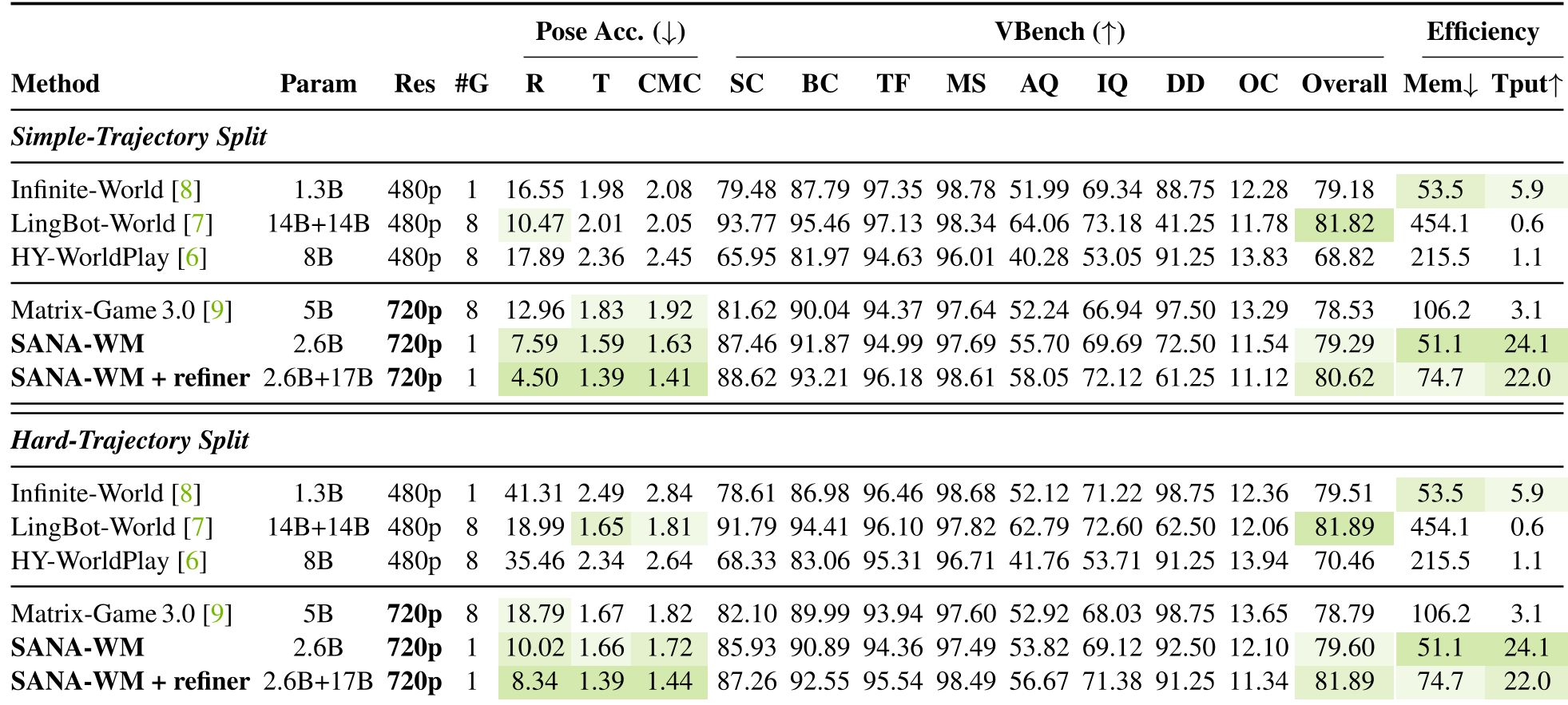 Table 2: SANA-WM achieves the highest pose accuracy and competitive visual quality (VBench Overall) while maintaining drastically lower memory requirements.
Depth Insight: Why It Works
The success of SANA-WM lies in its Inductive Bias. By treating video generation as a recurrent state-space problem (via GDN) rather than a pure sequence-modeling problem, NVIDIA effectively gave the model a "short-term memory" that acts like a game engine's buffer. The result is a system that understands geometry, not just pixels.
Limitations & Future Outlook
While SANA-WM is a massive leap for efficiency, it still faces challenges in dynamic scenes (e.g., fast-moving objects within a static room) and lacks a persistent "3D world map" beyond its latent state. However, its ability to run on a single consumer GPU marks the birth of "Desktop World Models," where developers can simulate infinite cinematic worlds without a data-center-scale budget.
Conclusion (Takeaway)
SANA-WM proves that Linear Transformers are no longer just for toy language tasks. By hybridizing them with Softmax and providing metric-grade supervision, NVIDIA has set a new standard for efficient, high-fidelity, and controllable world modeling.