
SANA-WM: democratizing Minute-Scale World Modeling with Hybrid Linear DiT
SANA-WM: Efficient Minute-Scale World Modeling with Hybrid Linear Diffusion Transformer
SANA-WM is an open-source 2.6B-parameter world model capable of generating high-fidelity 720p videos up to one minute in length with precise 6-DoF camera control. It utilizes a novel Hybrid Linear Diffusion Transformer architecture and is trained on 213K public clips with metric-scale pose supervision, achieving performance comparable to large-scale industrial baselines while being significantly more efficient.
TL;DR
NVIDIA researchers have unveiled SANA-WM, a 2.6B-parameter world model that shatters the efficiency barrier for long-horizon video generation. Capable of producing 60-second, 720p videos with precise 6-DoF camera control, SANA-WM matches industrial giants like LingBot-World while being lean enough to run on a single RTX 5090. Its secret lies in a hybrid architecture that blends the efficiency of RNN-like recurrence (Gated DeltaNet) with the "perfect memory" of Softmax Attention.
Problem & Motivation: The "Long-Context" Tax
Generating a minute of high-definition video is a nightmare for standard Transformers. The quadratic complexity of Softmax Attention means that as the video grows, memory and compute requirements explode. Most current "world models" either:
- Limit themselves to short snippets (5-10 seconds).
- Require massive multi-GPU clusters for a single inference.
- Suffer from "visual drift," where the scene identity collapses during long rollouts.
The authors of SANA-WM set out to prove that native one-minute training is possible without industrial-scale resources, focusing on architectural efficiency and metric-scale data precision.
Methodology: The Core Innovations
1. Hybrid Linear-Attention Backbone
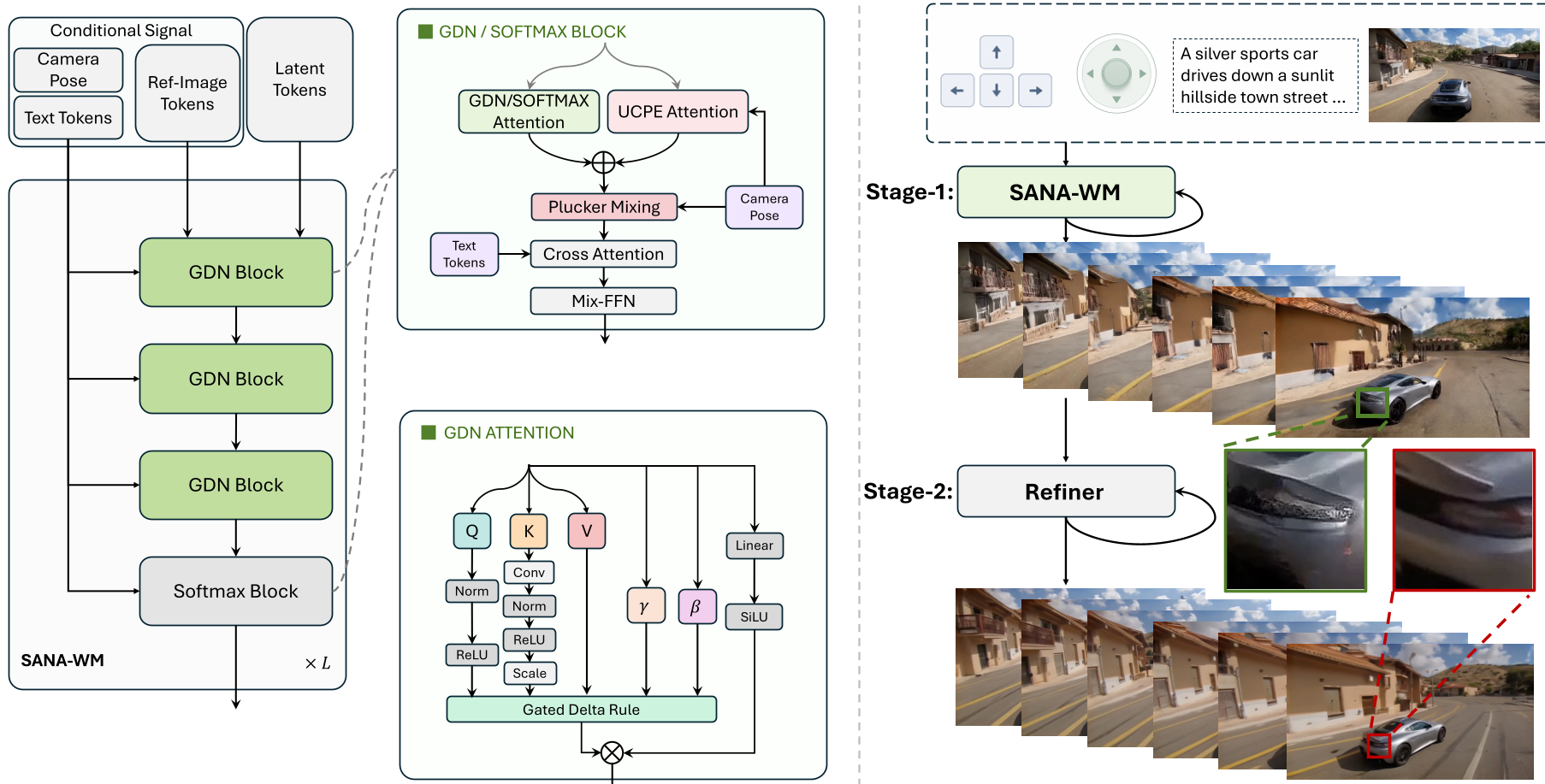
To handle the massive token count of a 60-second 720p sequence, SANA-WM moves away from pure Softmax. Instead, it uses Gated DeltaNet (GDN). GDN acts like a recurrent neural network, scanning frames one by one and updating a compact latent state. To prevent the "forgetfulness" common in pure linear models, the authors interleave standard Softmax blocks every four layers. This hybrid approach ensures efficiency (constant memory for the GDN parts) and global scene consistency (via Softmax).
2. Dual-Branch Camera Control
Action-conditioned world models need to follow 6-DoF (6 degrees of freedom) trajectories perfectly. SANA-WM uses a coarse-to-fine strategy:
- Coarse Branch (UCPE): Captures global 6-DoF pose at the latent frame rate.
- Fine Branch (Plücker Mixing): Injects raw-frame geometric information to compensate for motion that occurs inside the VAE’s temporal compression stride.
3. The Two-Stage Refiner
Even an efficient base model can struggle with fine details over a minute. SANA-WM employs a Second-Stage Refiner based on "truncated-σ flow matching." This refiner doesn't just reconstruct; it "polishes" the stage-1 output, correcting structural artifacts and sharpening the visual fidelity across the entire sequence.
Experiments: SOTA Results at High Speed
SANA-WM was evaluated on a rigorous one-minute benchmark across varied scenes (indoor, outdoor, game).
Key Results:
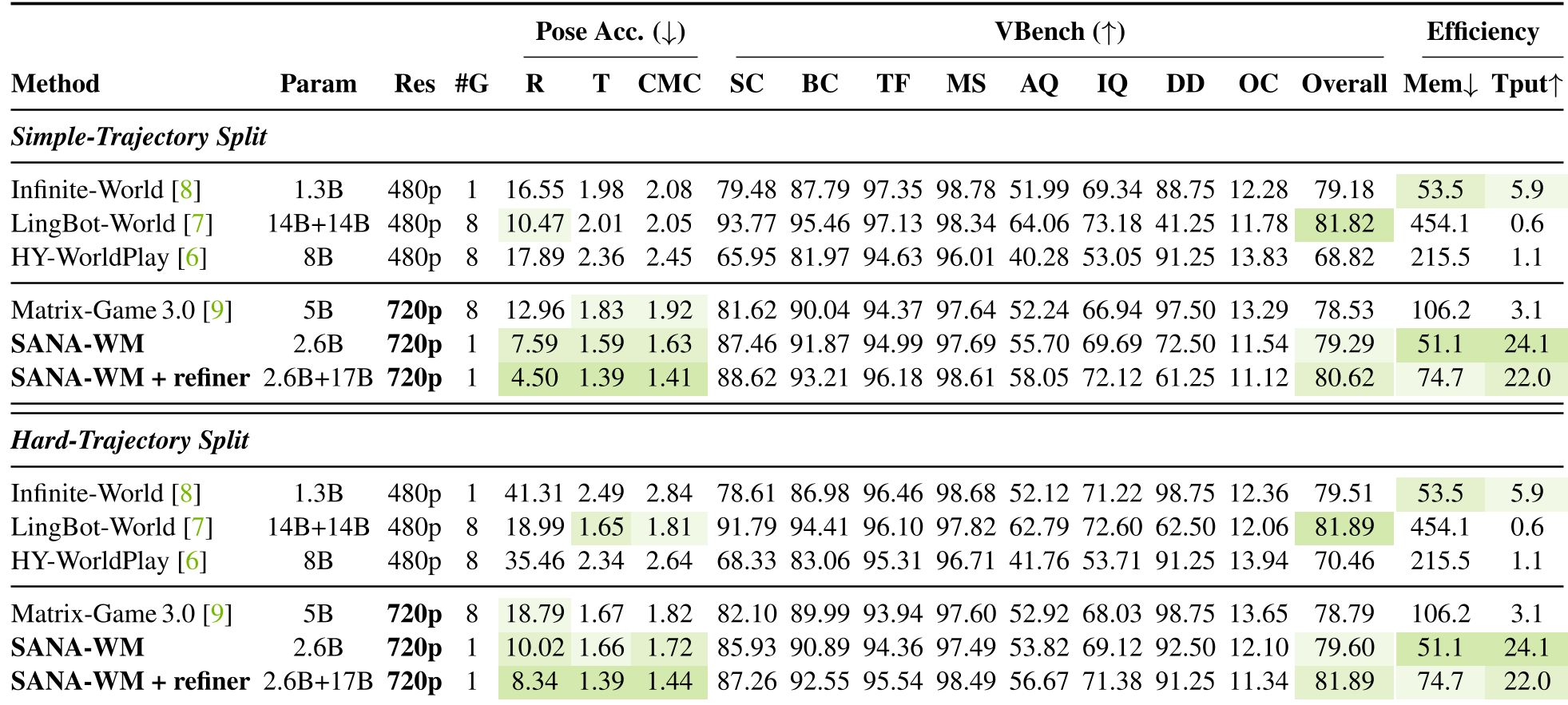
- Action Following: Outperformed open-source baselines in trajectory adherence (RotErr and TransErr).
- Throughput: Achieved 22-24 videos/hour at 720p—roughly 36x faster than industrial-scale competitors.
- Hardware Accessibility: While competitors need 8xH100 GPUs, SANA-WM runs its full pipeline (including the refiner) on a single H100, and a distilled version denoises 60s of video in just 34 seconds on an RTX 5090.
Critical Analysis & Conclusion
The true value of SANA-WM is its "democratization" of simulation. By releasing a model that is natively trained for long horizons on public data (~213K clips), it allows researchers to study embodied AI and interactive simulation without needing a supercomputing cluster.
Limitations: Despite its strengths, the model still lacks "explicit" 3D memory (like a voxel grid), which can lead to drift in highly dynamic scenes or extremely complex viewpoints.
Future Outlook: The shift toward hybrid linear-recurrent specialists (like GDN) combined with Diffusion Transformers (DiT) appears to be the winning formula for the next generation of generative world simulators. SANA-WM is a significant step toward "Infinite Worlds" running on consumer hardware.