
SANA-WM: Revolutionizing Minute-Scale World Modeling with Hybrid Linear Transformers
SANA-WM: Efficient Minute-Scale World Modeling with Hybrid Linear Diffusion Transformer
SANA-WM is a 2.6B-parameter open-source world model developed by NVIDIA for high-fidelity, 720p video generation at minute-scale (60s) with precise 6-DoF camera control. It utilizes a novel Hybrid Linear Diffusion Transformer architecture that achieves visual quality competitive with massive industrial models while maintaining significantly higher efficiency.
The quest for a "World Model"—an AI capable of simulating long-term physical reality under specific actions—has historically been a high-stakes game played by industrial giants with massive GPU clusters. Traditional Transformers, while powerful, buckle under the weight of Quadratic Complexity as video length grows.
Today, we dive into SANA-WM (Efficient Minute-Scale World Modeling), a seminal work from NVIDIA that proves we can generate one-minute, 720p, camera-controllable videos on a single GPU.
The TL;DR
SANA-WM is a 2.6B-parameter world model that breaks the "memory wall" of long-horizon video generation. By hybridizing Gated DeltaNet (GDN) with standard Softmax attention and employing a dual-rate camera control system, it achieves industrial-grade fidelity with a fraction of the data and compute. It doesn't just generate video; it simulates a persistent 3D world that you can navigate via 6-DoF (6 Degrees of Freedom) trajectories.
Why Standard Transformers Fail the "Minute Test"
Generating 60 seconds of 720p video at 16fps results in nearly 1,000 frames. For a standard Transformer:
- The KV-Cache Explosion: Storing the Key-Value (KV) cache for thousands of tokens quickly exceeds the 80GB memory of an H100.
- Temporal Drift: Cumulative error in autoregressive models often causes the world to "melt" or change identity after a few seconds.
- Action Dilution: Inside a single VAE temporal stride (e.g., 8 frames), standard models lose the fine-grained camera motion, leading to "shaky" or imprecise movement.
Methodology: The "Hybrid" Breakthrough
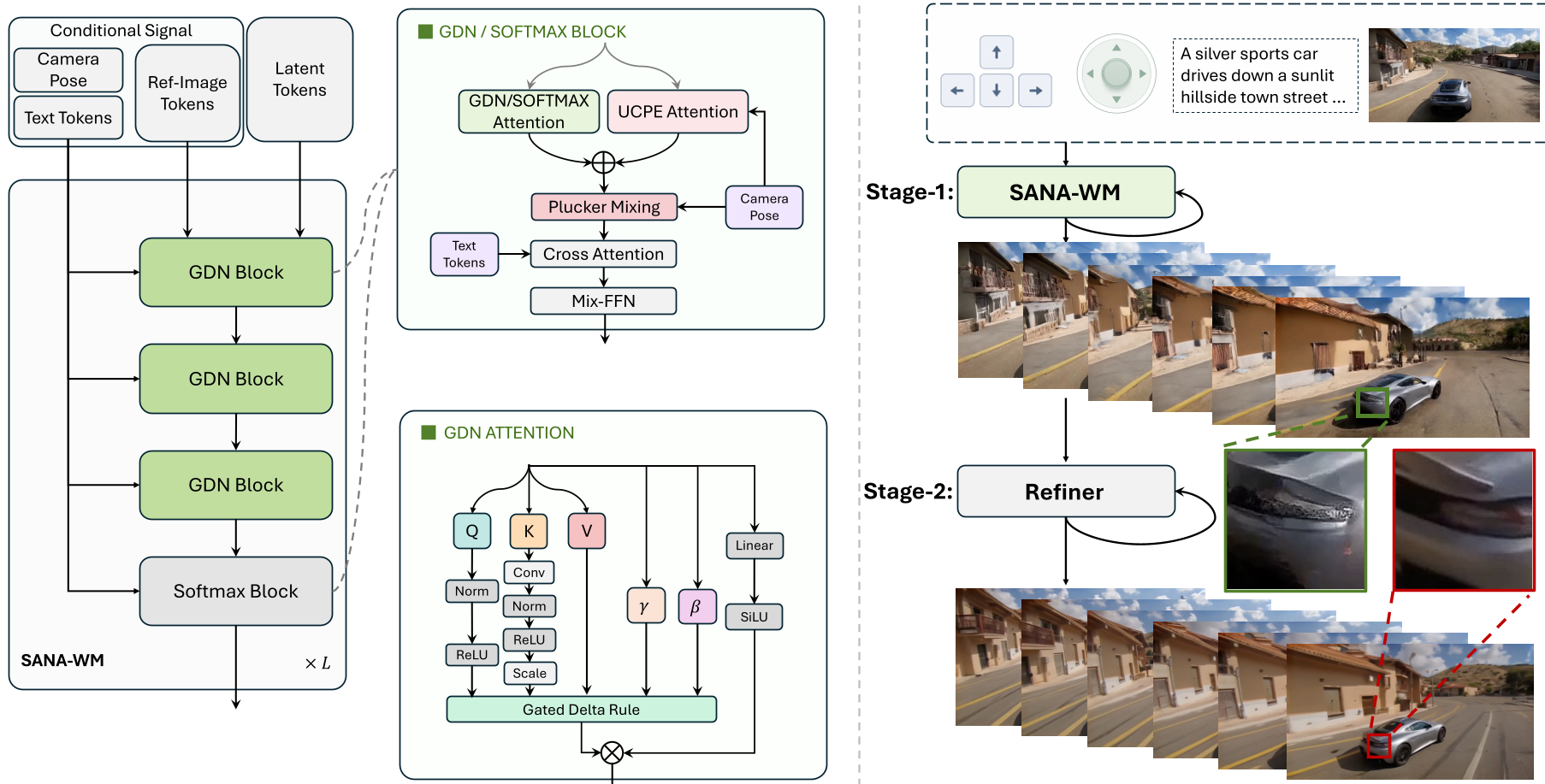
1. Hybrid Linear DiT Backbone
The core innovation is the move away from pure Softmax attention. SANA-WM uses Gated DeltaNet (GDN) blocks. Unlike standard linear attention, GDN uses a "Delta Rule" to update its hidden state, allowing it to "forget" stale information and "prioritize" new visual cues without the memory footprint of a full attention matrix.
- The Hybrid Secret: Pure linear attention often lacks the "surgical" precision of Softmax for spatial details. SANA-WM alternates: 15 GDN blocks (for efficiency) and 5 Softmax blocks (for global spatial anchoring).
2. Dual-Branch Camera Control
To follow a trajectory perfectly, SANA-WM uses a two-pronged approach:
- Coarse Branch (UCPE): Adapts Unified Camera Positional Encoding into the attention heads to handle the global "structure" of the movement.
- Fine Branch (Plücker Mixing): Injects raw-frame raymaps (Plücker coordinates) directly into the features. This ensures that even if the VAE compresses time, the specific sub-frame motion is preserved.
Experimental Results: SOTA on a Single GPU
SANA-WM was trained in just 15 days on 64 H100s—a remarkably lean budget for a world model. The results on their newly established "One-Minute Benchmark" are staggering.
Quantifying the Superiority
- Throughput: 22.0 videos/hour (720p) vs. 0.6 videos/hour for LingBot-World. That's a 36x speedup.
- Action Following: Rotation and Translation errors were reduced by ~20-30% compared to previous open-source leaders.
- Stability: The "Imaging Quality" (IQ) drift, which measures how much a video degrades over a minute, was virtually eliminated (ΔIQ of 0.31 vs. >20.0 for competitors).
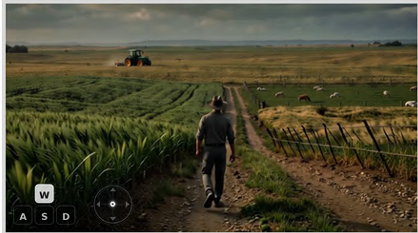 Visualizing the precision: SANA-WM maintains scene identity even through complex loop-back trajectories where the camera revisits an earlier location.
The NVFP4 Edge
For the first time, we see minute-scale world modeling viable on local consumer hardware. A distilled variant of SANA-WM running on an RTX 5090 (with NVFP4 quantization) generates a full minute of 720p action-conditioned video in 34 seconds.
Deep Insight: Why It Works
The success of SANA-WM lies in its Inductive Bias. By recognizing that a world model is essentially a "state-tracking" problem, the authors treated the video generation as a recurrent process (GDN) rather than a pure sequence-modeling problem. This allows the model to maintain a "mental map" of the scene in its recurrent state , which stays constant in size regardless of whether the video is 5 seconds or 5 minutes long.
Critical Analysis & Future Outlook
While SANA-WM is a massive leap for efficiency, it still faces challenges:
- Dynamic Complexity: It excels at static scene navigation (camera movement) but can still struggle with complex "dynamic" interactions (e.g., a person walking while the camera moves).
- The 3D Memory Gap: While the recurrence helps, there is no explicit 3D geometry engine (like a Voxel grid or Point Cloud) inside the transformer.
Takeaway: SANA-WM signals the end of the "Softmax Only" era for video generation. By embracing hybrid linear architectures, we are entering the era of real-time, high-fidelity world simulation accessible to every researcher with a single GPU.
For those interested in the code and data, the project is open-source, including the 213K metric-pose dataset.