SANA-WM: Revolutionizing Minute-Scale World Modeling with Hybrid Linear Transformers
SANA-WM: Efficient Minute-Scale World Modeling with Hybrid Linear Diffusion Transformer
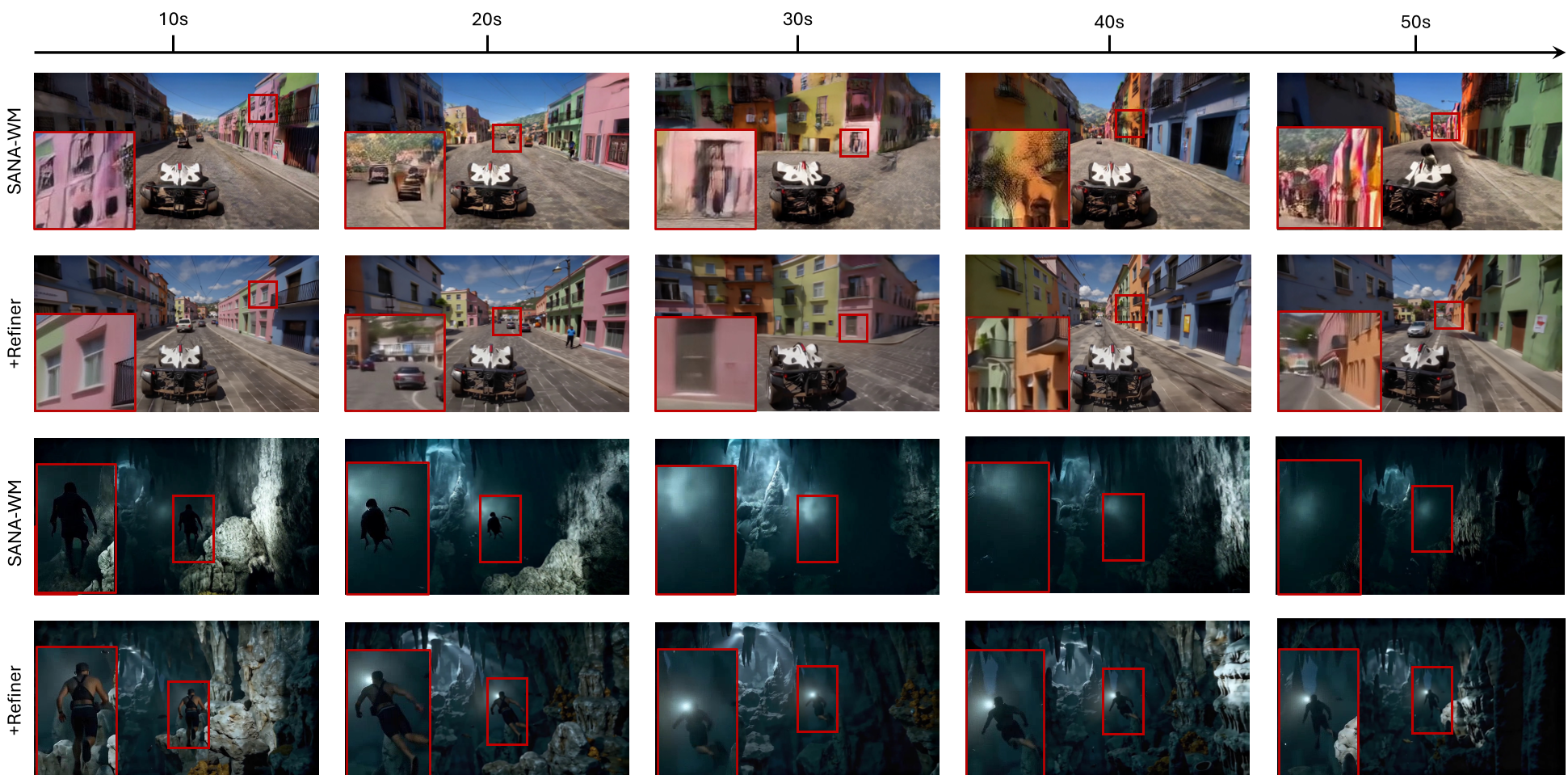
SANA-WM is a 2.6B-parameter open-source world model developed by NVIDIA for high-fidelity, minute-scale (60s) 720p video generation with precise 6-DoF camera control. It utilizes a Hybrid Linear Diffusion Transformer (SANA-Video based) and achieves SOTA action-following accuracy and visual quality while being significantly more efficient than industrial benchmarks.
TL;DR
NVIDIA has unveiled SANA-WM, an open-source 2.6B world model capable of generating one-minute, 720p videos with precise 6-DoF camera control. By ditching the pure Softmax Transformer in favor of a Hybrid GDN-Softmax architecture, the team has reduced the hardware barrier for long-horizon simulation, enabling 60s video generation on a single consumer GPU (RTX 5090) in just 34 seconds.
Background: The Cost of a Long Memory
In the world of AI simulation, "World Models" are the engines of the future. They don't just generate pixels; they simulate environments for robots, autonomous cars, and games. However, the industry has faced a "Memory Wall":
- Context Complexity: Standard Attention scales quadratically (). Modeling a 60-second 720p video (thousands of tokens) melts VRAM.
- Control Drift: Maintaining a consistent 3D scene while following a complex "Hard" camera trajectory (spinning, zooming, looping) usually leads to visual "hallucinations" or layout collapse after 10-20 seconds.
- Compute Greed: Training these models typically requires hundreds of GPUs and massive private datasets.
SANA-WM challenges this by proving that efficiency is a first-class citizen.
Methodology: The "Hybrid" Breakthrough
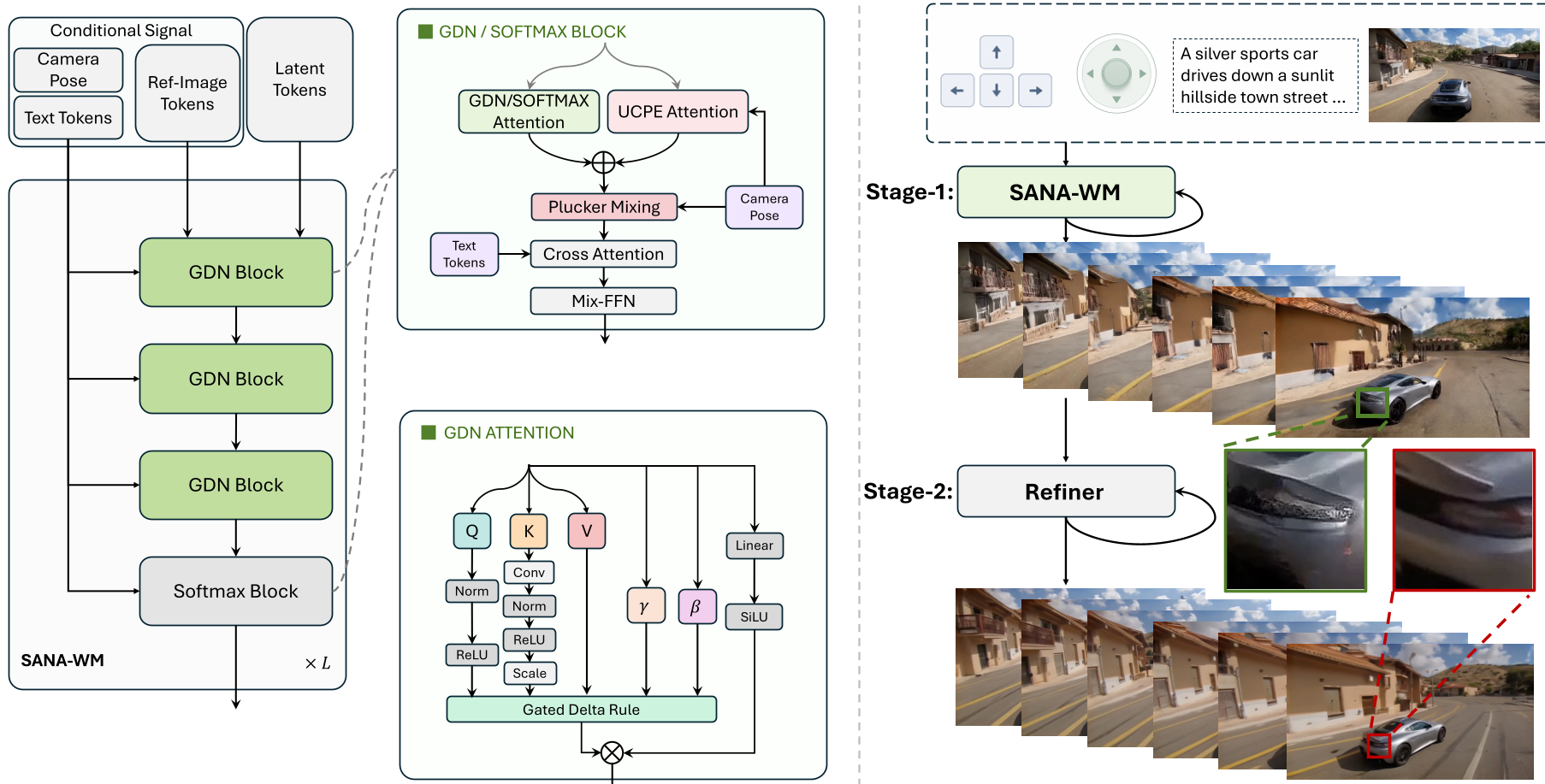
The core of SANA-WM is the Hybrid GDN-Softmax Attention. Pure linear attention (like the original SANA) lacks a decay mechanism, causing "feature drift" in long sequences.
1. Frame-wise Gated DeltaNet (GDN)
Instead of attending to every past frame, SANA-WM uses GDN to compress history into a fixed-size recurrent state. The "Delta Rule" allows the model to update only what has changed, while a decay gate forgets obsolete visuals.
- Insight: They process one latent frame per step rather than one token, maintaining spatial relationships without the quadratic cost.
2. Dual-Branch Camera Control
To ensure the camera actually follows the intended path, the authors used a two-pronged approach:
- Coarse Branch (UCPE): Transform rays into a local coordinate system to guide global structure.
- Fine Branch (Plücker Mixing): Injects raw camera data into the VAE's temporal strides, capturing micro-movements that latent tokens usually lose.
Experiments: Performance at Scale
The researchers built a robust pipeline to annotate 213K public clips with metric-scale 3D poses (using Pi3X and MoGe-2), proving that you don't need proprietary data to build a world-class simulator.
Key Result: Action Following
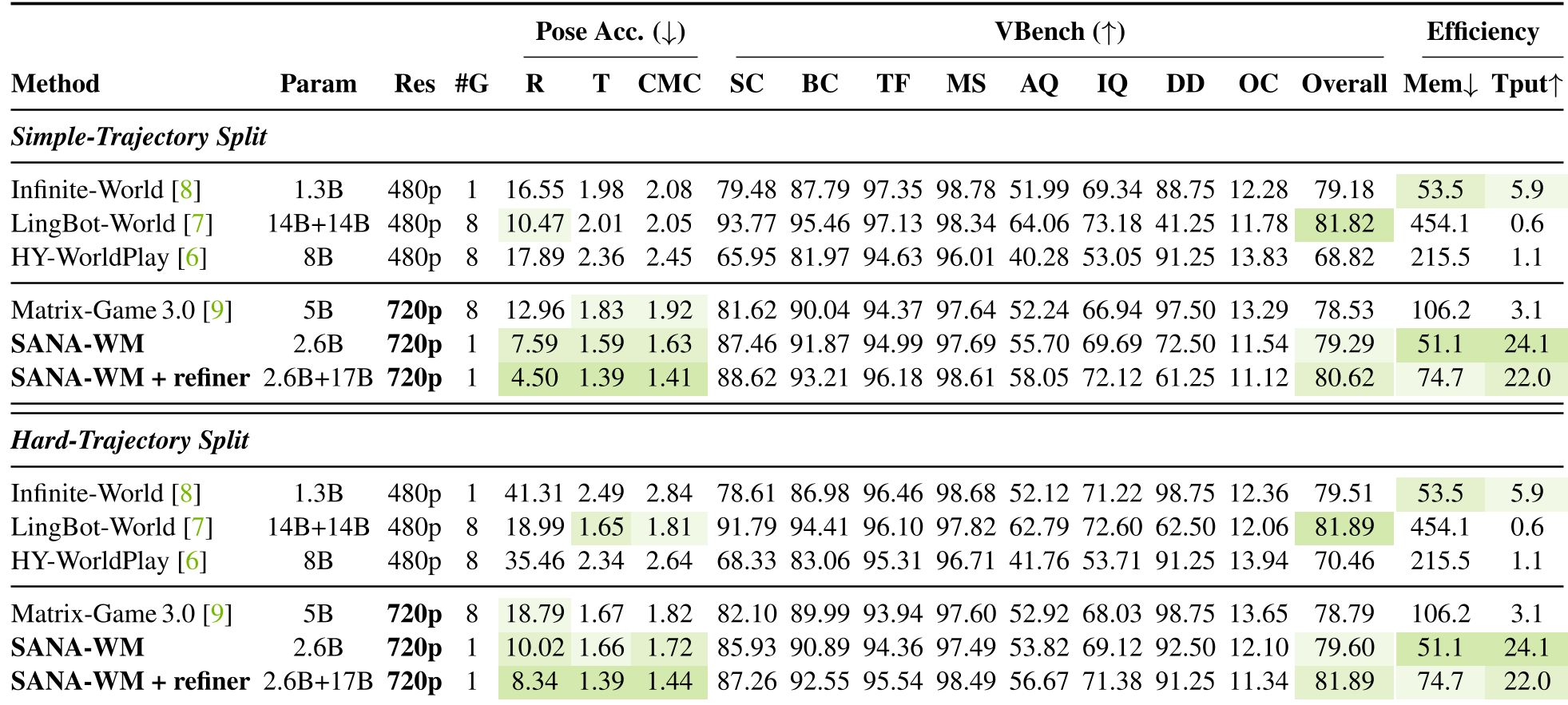
In the "Hard Trajectory" benchmark—where the camera performs complex maneuvers—SANA-WM achieved a Rotation Error (RotErr) of 8.34°, significantly lower than industrial heavyweights like LingBot-World (~19°) and HY-WorldPlay (~35°).
Efficiency: The GTX 5090 Era
Perhaps the most shocking result is the throughput. SANA-WM is 36x faster than Infinite-World. With NVFP4 quantization and self-forcing distillation:
- Inference: A 60s 720p clip denoises in 34s on a single RTX 5090.
- Training: Optimized in just 15 days on 64 H100s.
Critical Analysis: Is Softmax Dead?
Notice that the authors didn't remove Softmax Attention entirely; they placed it at every 4th block. This suggests that while linear mechanisms (GDN) handle the "heavy lifting" of temporal evolution, Softmax is still required for high-fidelity spatial anchoring.
Limitations:
- 3D Memory: While consistent, it lacks an explicit "3D map," meaning it can still drift slightly in extremely long-duration dynamic scenes.
- Complexity: The two-stage refinement pipeline adds a layer of complexity for real-time streaming applications.
Summary
SANA-WM is a masterclass in AI engineering. It demonstrates that by carefully selecting geometric encodings and hybridizing linear/nonlinear attention, we can build world models that are both physically accurate and hardware-accessible. For robotics and embodied AI researchers, SANA-WM provides the most efficient "digital twin" engine to date.