
SANA-WM: Revolutionizing Minute-Scale World Modeling on a Single GPU
SANA-WM: Efficient Minute-Scale World Modeling with Hybrid Linear Diffusion Transformer
SANA-WM is an efficient 2.6B-parameter open-source world model capable of generating high-fidelity, minute-scale (60s) 720p videos with precise 6-DoF camera control. It utilizes a novel Hybrid Linear Diffusion Transformer (GDN + Softmax Attention) and achieves parity with industrial baselines like LingBot-World while being significantly more efficient.
TL;DR
SANA-WM is a 2.6B parameter video world model that shatters the efficiency barrier for long-horizon generation. While industrial giants require massive clusters, SANA-WM generates 60-second, 720p videos with precise 6-DoF camera control on a single consumer-grade GPU. By combining hybrid linear attention and a new geometric conditioning branch, it delivers state-of-the-art action-following accuracy and visual stability.
The Problem: The "Context Wall" in Video Generation
Most modern video generators are based on the Diffusion Transformer (DiT). While powerful, they face a fundamental "Context Wall":
- Memory Explosion: Standard Softmax attention scales quadratically. Modeling 60 seconds (960+ frames) at 720p creates a token count that crashes even the most powerful H100 clusters.
- Visual Drift: Over long horizons, models "forget" the starting scene, leading to structural collapse or the "hallucination" of entirely different environments.
- Control Precision: Existing models often use text for motion (e.g., "pan left"), which is too coarse for precise embodied AI or robotics simulation requiring metric 6-DoF accuracy.
Methodology: The Architecture of Efficiency
SANA-WM introduces a radical departure from pure-attention backbones through three core technical pillars.
1. Hybrid GDN-Softmax Backbone
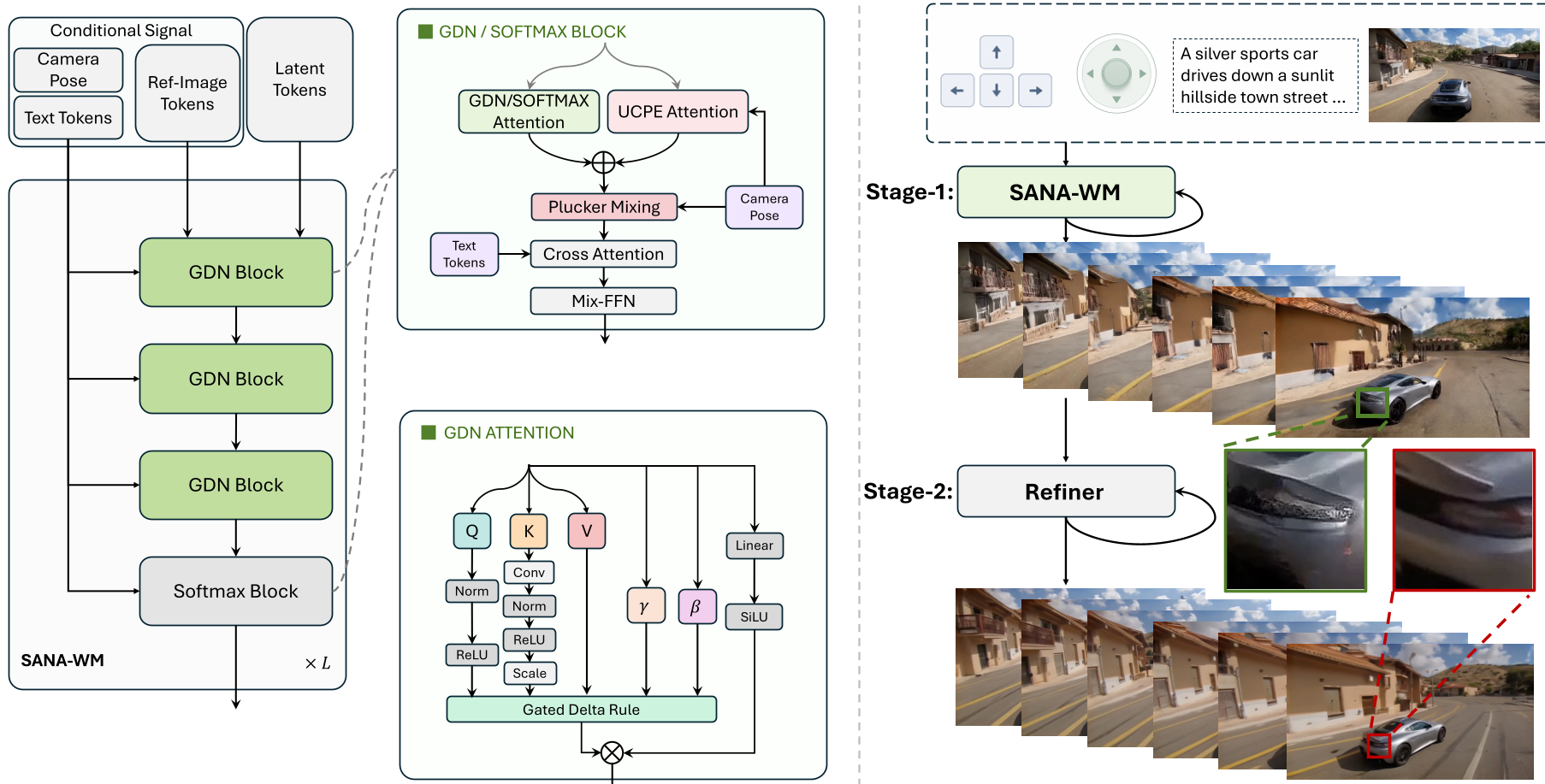
The authors replace the standard DiT blocks with a hybrid structure. They use Gated DeltaNet (GDN)—a linear recurrent mechanism—to handle the bulk of temporal modeling. GDN acts as a "compressed memory" that scans frames progressively. To prevent the "forgetting" typical of pure RNNs, every fourth block is a standard Softmax Attention layer, acting as a global anchor for exact long-range recall.
2. Dual-Branch Camera Control
To ensure the model follows a camera path exactly, SANA-WM uses two rates of control:
- Coarse Branch (UCPE): Operates at the latent frame rate to provide a global geometric "skeleton" of the trajectory.
- Fine Branch (Plücker Mixing): Injects raw-frame raymaps (Plücker coordinates) directly into the model, compensating for motion details lost during VAE compression.
3. Two-Stage Visual Refinement
Native training on minute-long videos is compute-intensive, which can sometimes lead to slight blurriness. SANA-WM solves this with a Two-Stage Generation Pipeline. The first stage focuses on layout and trajectory, while a lightweight 17B-parameter Long-Video Refiner (using LoRA) sharpens the details in a second pass.
Experiments & Results: Desktop-Class Simulation
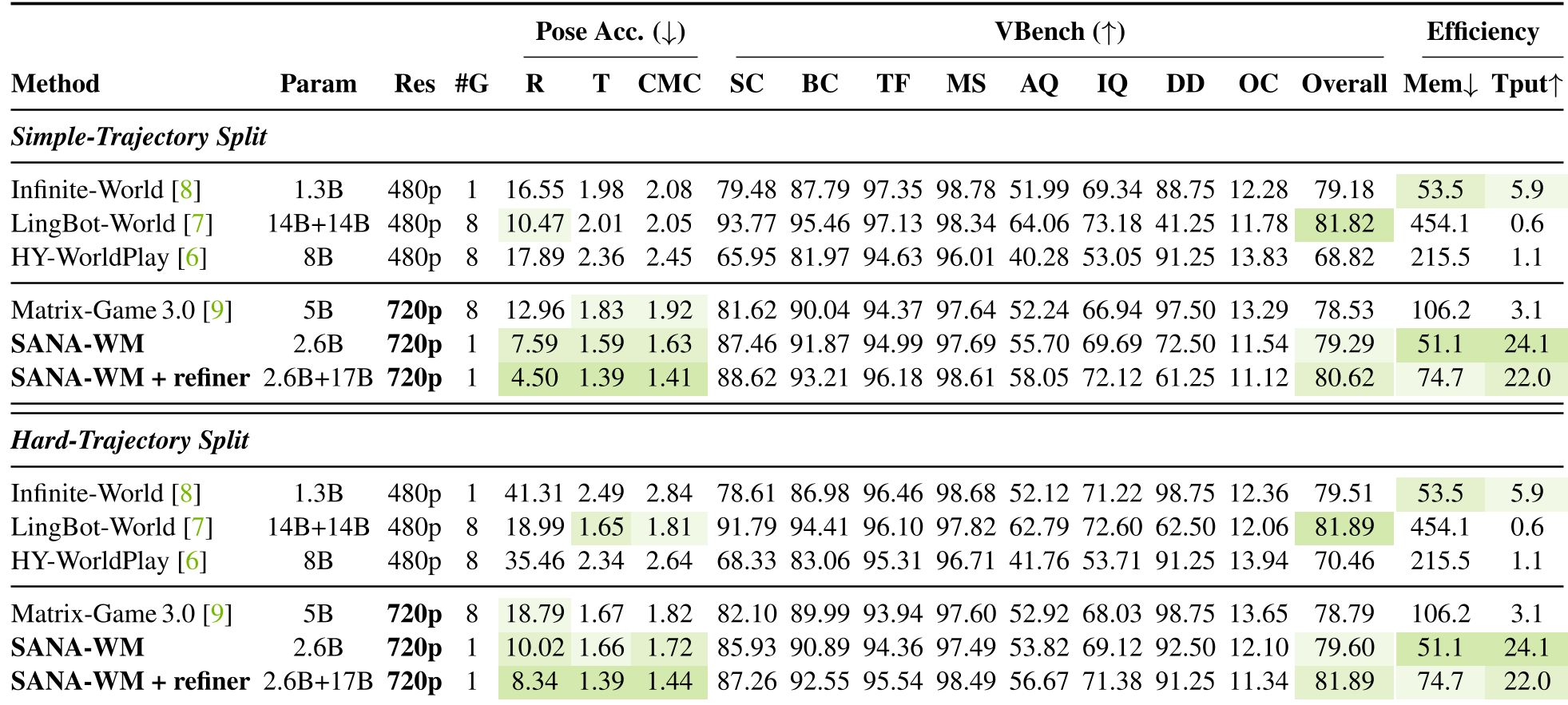
The benchmark results are startling given the model’s size. SANA-WM beats much larger industrial baselines (like HY-WorldPlay and Infinite-World) in Pose Accuracy (Rotational and Translational errors) and temporal stability.
| Metric | SANA-WM | LingBot-World (14B+14B) | Improvement/Note |
|---|---|---|---|
| GPU Memory | 74.7 GB | 454.1 GB | ~6x Less Memory |
| Throughput | 22.0 vids/hr | 0.6 vids/hr | 36x Faster |
| RotErr (Hard) | 8.34° | 18.99° | Better Precision |
Efficiency Path to RTX 5090
Perhaps the most impressive feat is the deployment of a distilled variant. By using "Attention Sinks" (keeping only the first frame and a local window in memory) and NVFP4 quantization, the model can run a full 60-second denoising cycle in just 34 seconds on a single RTX 5090.
Critical Insight & Conclusion
SANA-WM proves that the bottleneck for long-horizon world modeling wasn't just "scale" or "data," but architectural efficiency. By strategically mixing linear recurrence (GDN) with sparse attention, they've bypassed the quadratic memory wall.
Takeaway: For the first time, researchers can simulate consistent 3D worlds for a full minute on accessible hardware. This paved the way for democratized research in robotics and interactive simulation, moving away from the "cluster-only" paradigm of model development.
Limitations: The model can still drift in highly dynamic scenes with many moving objects (e.g., busy crowds) and lacks an explicit 3D scene memory for multi-minute "infinite" rollouts. Future work will likely integrate 3D Gaussian Splatting (3DGS) directly into the backbone for permanent spatial persistence.