
SANA-WM: Scaling World Models to the Minute-Scale on a Single GPU
SANA-WM: Efficient Minute-Scale World Modeling with Hybrid Linear Diffusion Transformer
SANA-WM is a 2.6B-parameter open-source world model developed by NVIDIA for high-fidelity, minute-scale (60s) 720p video generation with precise 6-DoF camera control. It utilizes a novel Hybrid Linear Diffusion Transformer (GDN + Softmax Attention) to achieve 36x higher throughput than existing baselines while maintaining visual quality comparable to industrial models like LingBot-World.
TL;DR
SANA-WM is an efficient 2.6B world model that generates high-fidelity 720p videos up to 60 seconds long with precise camera control. By combining Gated DeltaNet (GDN) with Softmax Attention, it delivers industrial-grade visual quality at 36x the throughput of current SOTA, allowing minute-long 720p generation on a single consumer GPU (RTX 5090) in under 40 seconds.
The "World Model" Bottleneck: Why Minutes are Hard
Most "world models" today are either short-horizon (generating 2-5 seconds) or efficient but blurry. When scaling to a full minute (960+ frames), two walls emerge:
- The Memory Wall: Standard Transformers (Softmax Attention) have a memory cost. For 720p video at 60 seconds, the KV cache becomes so massive that even an H100 80GB OOMs (Runs out of Memory).
- The Control Wall: High-compression VAEs (like LTX2) compress 8 frames into a single latent token. This "temporal stride" destroys fine-grained camera motion, making precise 6-DoF (degrees of freedom) control nearly impossible.
Methodology: The Hybrid Linear DiT
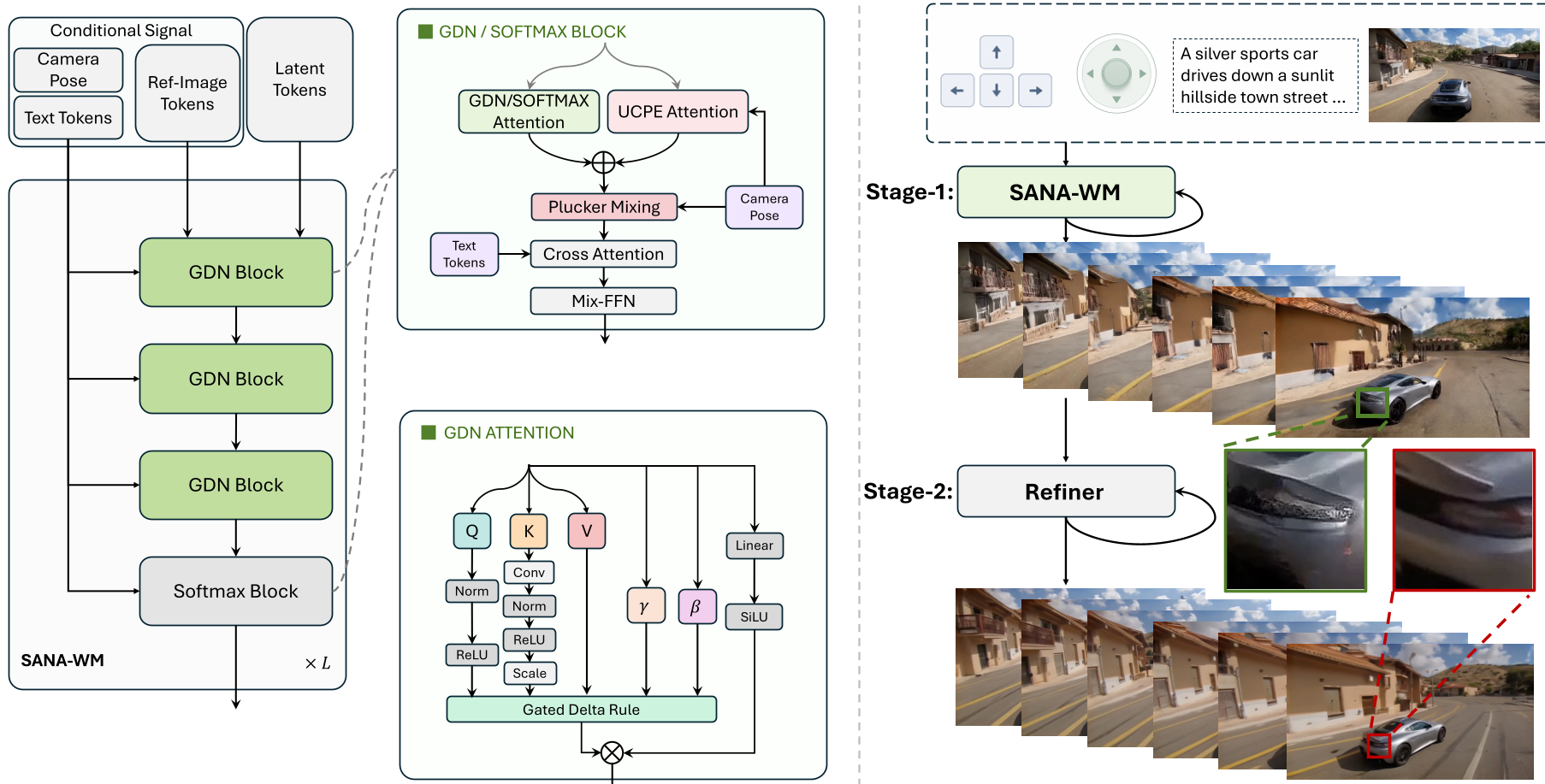
SANA-WM’s core innovation is the Hybrid Linear Diffusion Transformer. Instead of using pure attention, it interleaves 15 logic-heavy GDN blocks with 5 Softmax blocks.
1. Frame-wise Gated DeltaNet (GDN)
GDN uses a "delta rule" recurrence that updates a compact hidden state. Unlike simple linear attention, GDN includes a decay gate to forget stale information, preventing the "state drift" commonly seen in long-form generation. By scanning one frame per step instead of one token, SANA-WM keeps memory constant regardless of video length.
2. Dual-Branch Camera Control
To reclaim the motion lost during VAE compression, the authors use two branches:
- Coarse Branch (UCPE): Transform tokens into a ray-local basis to understand global 3D trajectory.
- Fine Branch (Plücker Mixing): Injects raw-frame camera rays directly after each attention block to compensate for motion within a 6-frame VAE window.
Experiments & Results: Efficiency is the New Scale
SANA-WM was trained on just 64 H100s for 15 days. Compared to industrial baselines that require 8-GPU clusters for a single inference run, SANA-WM is a breakthrough in accessibility.
| Metric | Infinite-World | LingBot-World | SANA-WM (Ours) |
|---|---|---|---|
| Resolution | 480p | 480p | 720p |
| Throughput (vids/hr) | 5.9 | 0.6 | 22.0 |
| GPU Memory (GB) | 53.5 | 454.1 | 74.7 |
| Rotation Error (↓) | 16.55° | 10.47° | 4.50° |
Two-Stage Refinement
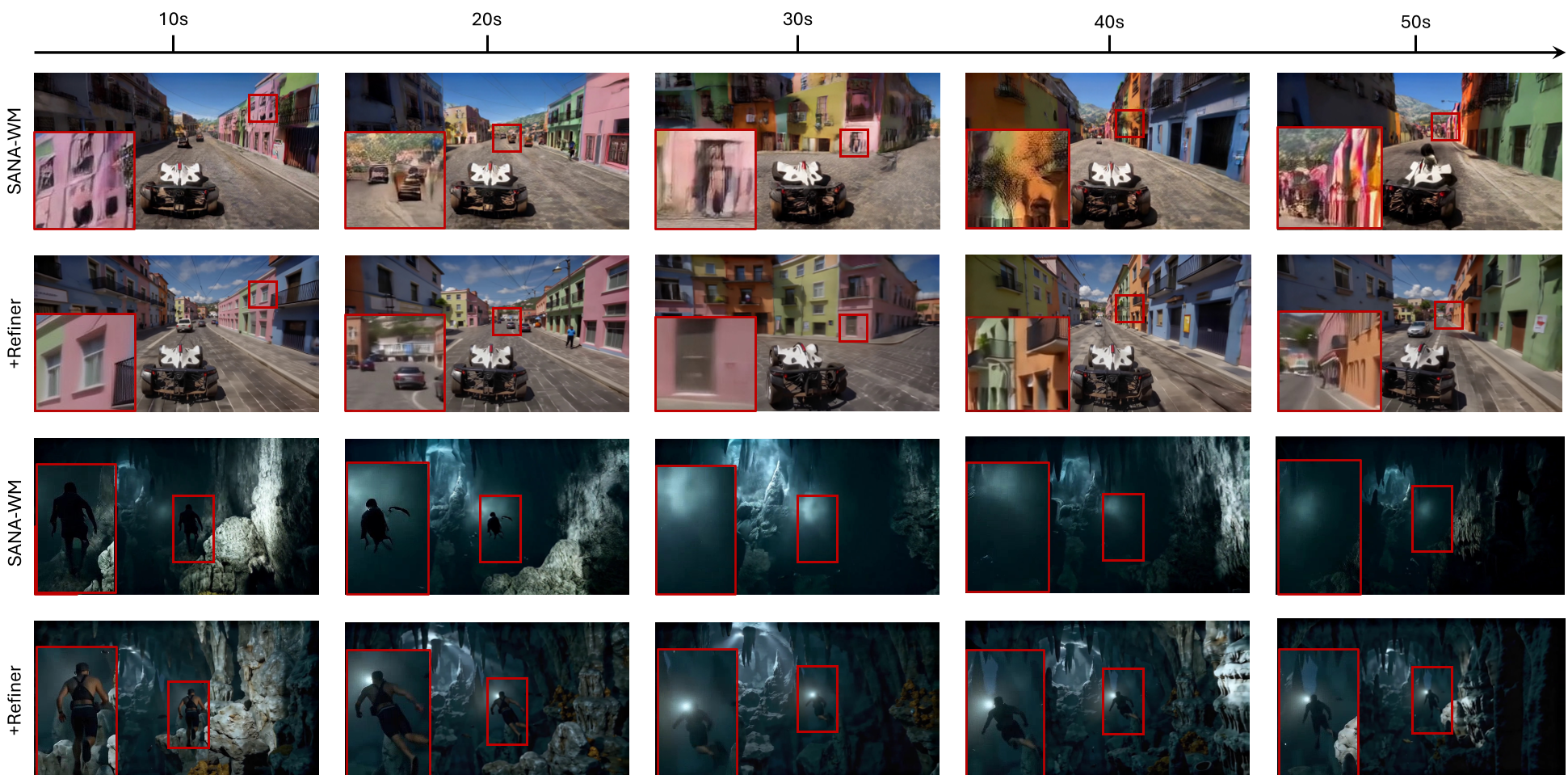
The first stage focuses on motion and structure. A second-stage Long-Video Refiner (a 17B LTX-2 model with LoRA) is then applied to sharpen details and maintain consistency across the entire 60-second window.
Critical Analysis & Conclusion
The Takeaway: SANA-WM proves that you don't need trillion-parameter models or massive GPU farms to build high-quality world simulators. The hybrid recurrent-attention backbone is likely the future of "Embodied AI" where real-time simulation is required.
Limitations: While impressive, SANA-WM still lacks explicit 3D scene memory (like a voxel map). In extremely complex scenes with many revisits, objects might still subtly morph. Future work needs to integrate "persistent spatial memory" into the recurrent state to achieve perfect 3D consistency.
SANA-WM moves us closer to the dream of "One Image, Infinite Worlds," enabling developers to simulate complex environments on a single workstation.