
SANA-WM: Democratizing Minute-Scale World Modeling with Hybrid Linear DiT
SANA-WM: Efficient Minute-Scale World Modeling with Hybrid Linear Diffusion Transformer
SANA-WM is a 2.6B-parameter open-source world model developed by NVIDIA for high-fidelity, 720p, minute-scale video generation with precise 6-DoF camera control. It introduces a Hybrid Linear Diffusion Transformer (DiT) that achieves SOTA action-following accuracy and visual quality while significantly outperforming larger industrial models in efficiency.
TL;DR
NVIDIA researchers have unveiled SANA-WM, a 2.6B-parameter world model that breaks the "compute wall" of long-video generation. By discarding pure softmax attention in favor of a Hybrid GDN-Softmax architecture, SANA-WM generates one-minute 720p videos with surgical camera control on a single consumer GPU (RTX 5090). It achieves this using a surprisingly small dataset (~213K clips) and 36x higher throughput than previous SOTA models.
The Problem: The Complexity Crisis in World Modeling
Generating 60 seconds of 720p video isn't just a "rendering" challenge; it's a memory nightmare. Standard Transformers use softmax attention, where costs grow quadratically with the number of tokens. In a minute-long video, the token count explodes, leading to:
- Memory Exhaustion: LLMs "forget" the beginning of the scene, causing visual drift.
- Compute Bottlenecks: Inference requires massive GPU clusters.
- Control Loss: Maintaining a precise 6-DoF (degrees of freedom) camera trajectory over 960+ frames is notoriously difficult, often resulting in "scene collapse."
Methodology: Engineering Efficiency
SANA-WM's "secret sauce" lies in three architectural shifts that move away from heavy-handed compute toward elegant recurrence.
1. Hybrid Linear Long-Context Modeling
Instead of calculating every token's relationship to every other token, SANA-WM uses Gated DeltaNet (GDN). GDN acts like a recurrent neural network with a "delta rule" correction, allowing the model to compress scene information into a fixed-size hidden state. To prevent the model from losing "sharp" memories, the authors interleave a standard softmax attention layer every four blocks.
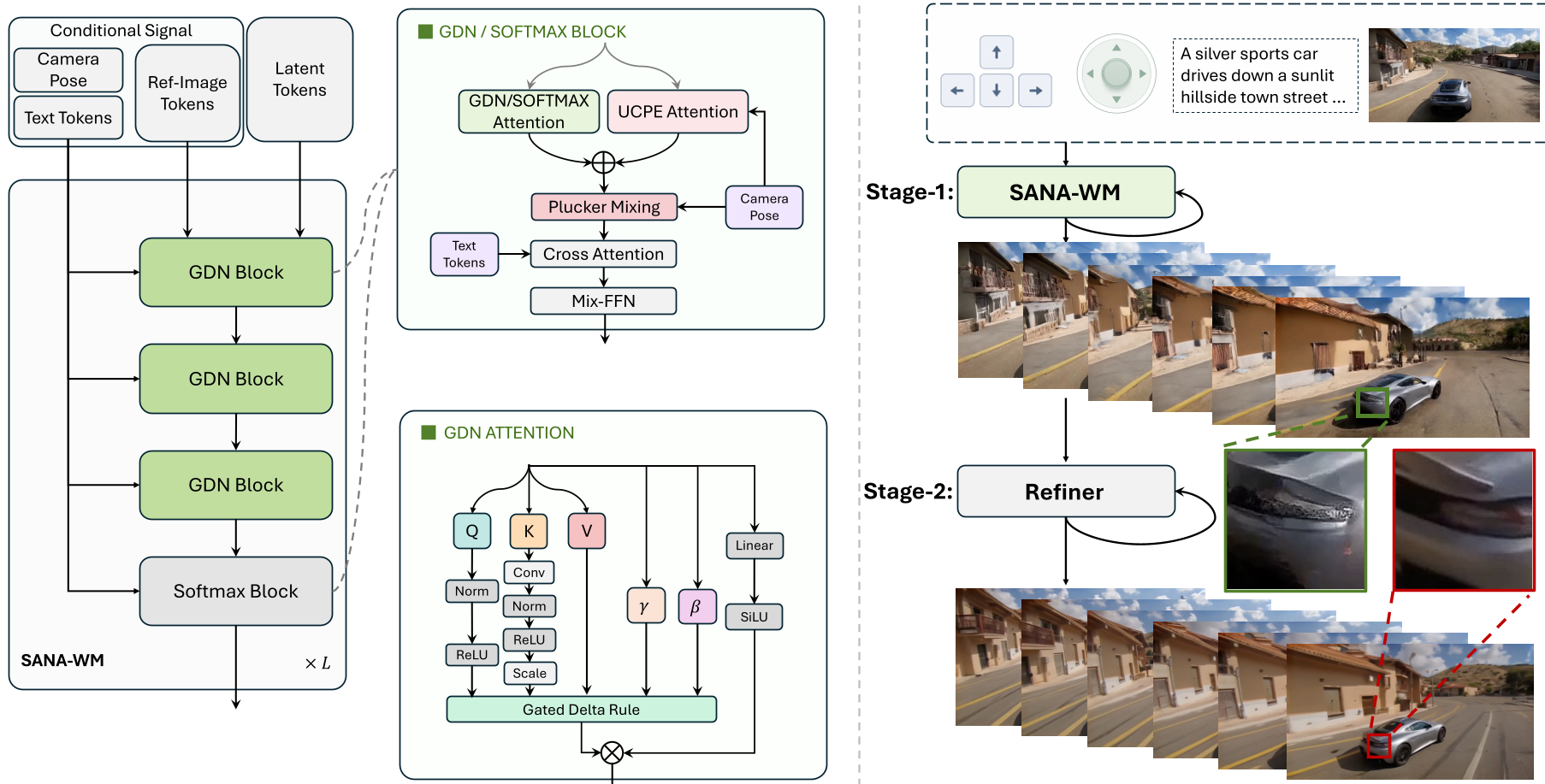 Figure 1: SANA-WM Pipeline - Combining text, video latents, and camera poses through a hybrid backbone.
2. Dual-Branch Camera Control
To ensure the camera follows the requested path (e.g., "rotate 90 degrees while moving forward"), the model uses a dual-rate strategy:
- UCPE Branch: Captures global trajectory structure.
- Plücker Mixing: Restores fine-grained motion within the time steps that the VAE might otherwise blur.
3. The Two-Stage Refiner
The first pass focuses on "where things are" (geometry and motion). A second-stage Refiner (a 17B model adapted via LoRA) then "paints" high-fidelity details over the sequence, correcting structural artifacts across the full minute.
Experiments: Performance vs. Efficiency
The results are a wake-up call for the industry. SANA-WM doesn't just match industrial giants like LingBot-World; it does so with a fraction of the resources.
- Throughput: 24.1 videos/hour on a single H100.
- Precision: Highest accuracy in action-following (lowest Rotation and Translation error) on both Simple and Hard benchmarks.
- Stability: While other models' image quality (IQ) degrades over the 60s window (ΔIQ up to 25.88), SANA-WM with its refiner maintains a near-flat stability curve (ΔIQ of 0.31).
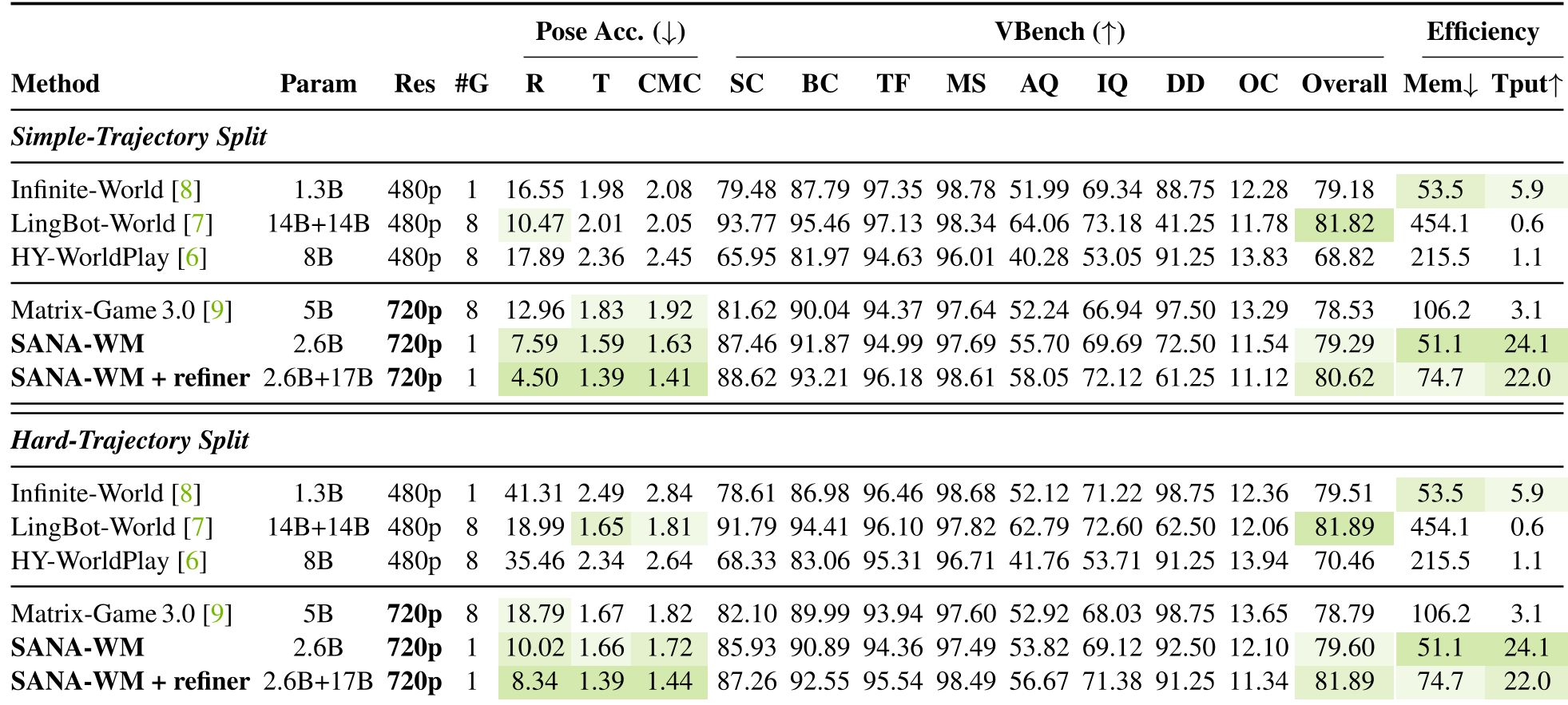 Table 1: Competitive analysis showing SANA-WM leading in both efficiency and pose accuracy.
Critical Analysis & Future Outlook
SANA-WM proves that architectural inductive bias (recurrence + linear attention) can compensate for massive scale. By natively training on one-minute clips rather than stitching short clips together, it solves the "scene drift" problem that plagued earlier generative models.
Limitations:
- The model still lacks "explicit" 3D memory (like a voxel grid), meaning it might eventually drift in extremely complex, dynamic environments (e.g., a crowded market).
- It is primarily a "camera-controlled" model; adding complex object-level interactions (e.g., "pick up the cup") remains a frontier for future work.
Takeaway: For researchers in Embodied AI and Robotics, SANA-WM is a game-changer. It provides a high-fidelity simulator that runs on a single workstation, potentially ending the era of needing a server farm to test a robot's visual navigation.
Conclusion
NVIDIA's SANA-WM is a masterpiece of technical pragmatism. It shifts the focus from "more data/more GPUs" to "smarter attention/better pipelines," providing an open-source blueprint for the next generation of interactive world simulators.