
Intelligent Rescue: Optimizing Airport Emergency Readiness through Satisfaction-Controlled Data Mining
The Satisfaction Degree Control Mining Method Applied in the Airport Emergency Rescue Scale Decision-Making
The paper introduces a satisfaction degree control mining method designed for airport emergency rescue scale decision-making. By integrating satisfaction degree evaluation functions into the Apriori association rule algorithm, the method identifies abnormal historical data to generate more rational resource dispatch rules.
TL;DR
In the high-stakes environment of airport emergency rescue, deciding exactly how many fire trucks, medical units, and police officers to dispatch is often a matter of life and death. This paper presents a novel data mining framework that leverages Satisfaction Degree Control Theory to filter historical rescue data and extract reliable decision-making rules, outperforming standard Apriori algorithms in both speed and accuracy.
Background: Beyond Subjective Judgment
Modern aviation has a massive repository of historical accident and maneuver data. However, using this data for automated decision-making is tricky. Many past rescue operations were executed based on sub-optimal or purely subjective human commands—what data scientists call "noise" or "abnormal samples."
The core innovation here is not just mining the data, but controlling the mining process to ensure that only "satisfactory" historical examples (where rescue success was balanced against cost efficiency) are used to build the rule base.
The Problem with Raw Historical Data
Traditional data mining follows a linear path: Pre-processing -> Mining -> Post-processing. In the pre-processing stage, "dirty data" is usually cleaned manually. This is problematic for airport rescue because:
- Subjectivity: Deciding what constitutes an "unreasonable" rescue operation is hard to do manually without bias.
- Integrity: Simply deleting outliers might remove vital edge-case information.
- Complexity: Airport rescue involves multi-objective trade-offs—maximizing lives saved while minimizing resource waste.
Methodology: The Satisfaction Degree Evaluation Model
The authors embed a mathematical evaluation layer directly into the mining process. This model uses two primary functions to judge every historical sample ():
- Selection Function (): Measures the combined satisfaction of the rescue mission (personnel rescued, cargo saved, damage reduced).
- Rejection Function (): Measures the cost satisfaction (firefighting cost, medical cost, etc.).
A sample is only admitted to the "Satisfying Set" () if its mission accomplishment degree is well-matched to its cost through a satisfaction mapping similar to fuzzy membership functions.
Architectural Flow
The algorithm follows a refined Apriori logic:
- Step 1: Filter the original sample set into the Satisfying Set using the evaluation model.
- Step 2: Generate frequent 1-itemsets from the filtered data.
- Step 3: Iteratively generate higher-order frequent itemsets (k-itemsets).
- Step 4: Extract Association Rules (e.g., "If Aircraft Type = A and Fire Degree = High, then Dispatch 3 Fire Trucks").
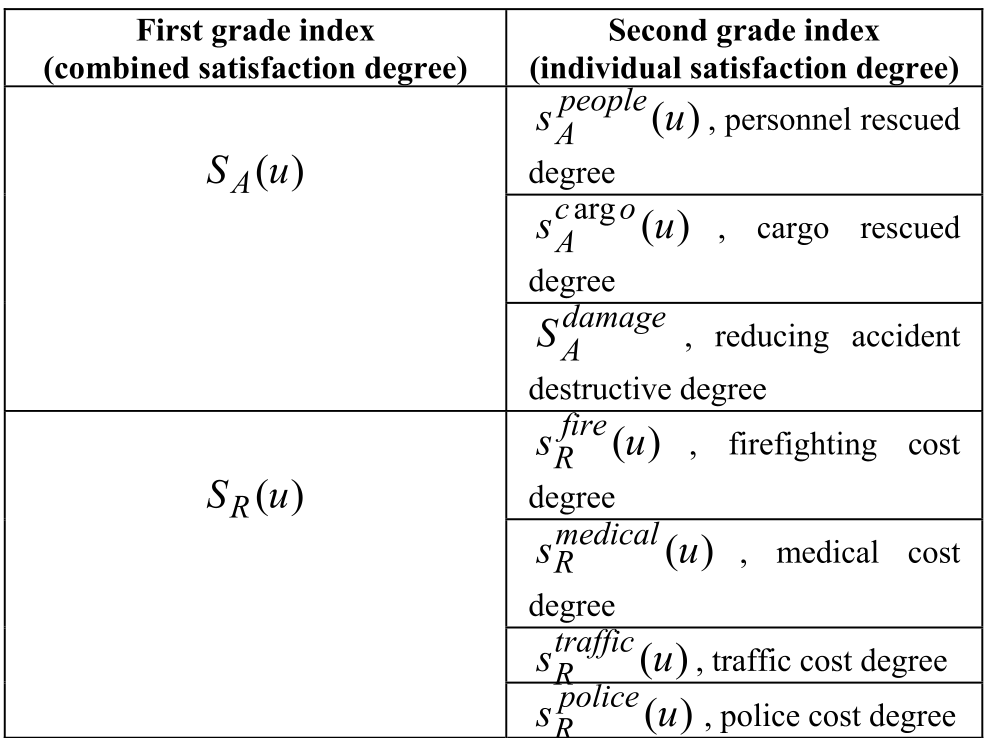 Table 1: The dual-grade index system for satisfaction evaluation.
Experiments and Performance Analysis
The authors tested their method against the standard Apriori algorithm. The results indicate a two-fold benefit:
- Efficiency: Because the search space is narrowed down to the "Satisfying Set" early on, the algorithm runs significantly faster as the number of transactions grows.
- Effectiveness: The rules generated (Association Rules) have higher confidence levels because they are derived from high-quality, "rational" historical examples rather than the raw, noisy dataset.
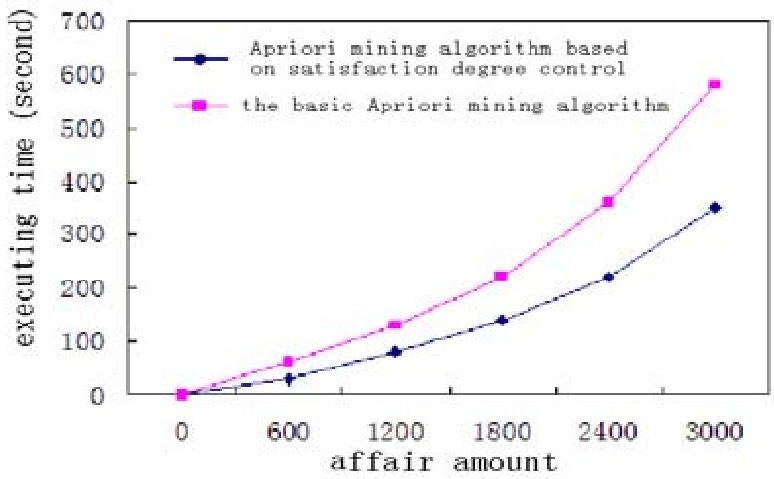 Figure 1: Comparison of running time between the basic Apriori and the satisfaction-controlled version.
Critical Insight: The Value of "Control Mining"
The real takeaway from this paper is the concept of Control Mining. Instead of treating data cleaning and data mining as two separate silos, the authors demonstrate that embedding a specialized "controller" (based on domain knowledge like the International Civil Aviation Organization standards) allows the algorithm to focus on valuable knowledge.
Limitations
- Parameter Sensitivity: The model relies on many weight coefficients and parameters (like ) which are currently derived via the Delphi Method (expert consensus). This still leaves a window for human bias.
- Fuzzy Sub-functions: As noted by the authors, some sub-functions cannot be defined rigorously and must be tailored to specific airport environments, limiting the "out-of-the-box" generalizability.
Conclusion
By planting satisfaction theory into association rule mining, this research moves us away from subjective "command-by-gut" rescue decisions toward a rational, evidence-based rule system. It proves that in critical domains like emergency response, the quality of the data is just as important as the power of the algorithm.