
Satisfaction-Driven Consensus: Anchoring Group Decisions in Trust and Fairness
Satisfaction-driven consensus model for social network MCGDM with incomplete information under probabilistic linguistic trust
This paper introduces a satisfaction-driven consensus model for Social Network Multi-Criteria Group Decision-Making (SN-MCGDM) specifically designed to handle incomplete information. The core innovation is the "Probabilistic Linguistic Trust Function" (PLTF), which models expert trust relationships with flexibility for ignorance; the model achieves group consensus by balancing individual satisfaction and group aims through an iterative feedback mechanism.
TL;DR
Making decisions in a group is hard; making them in a social network where information is missing and experts don't fully agree is even harder. This paper presents a novel SN-MCGDM model that uses Probabilistic Linguistic Trust to estimate missing data and a satisfaction-driven mechanism to reach consensus. It proves that by respecting individual satisfaction rather than just group averages, we can reach agreements that retain the "soul" (original opinions) of the experts.
The Problem: The Cognitive Burden of Precision
Most social network analysis tools assume we can quantify trust perfectly. But human intuition is fuzzy. Previous SOTA methods like Distributed Linguistic Trust Functions (DLTF) require probabilities to sum to exactly 100%. If an expert is "hesitant" or "ignorant" about a colleague's reliability, DLTF breaks down.
Furthermore, many Consensus Reaching Processes (CRP) act like a steamroller—forcing experts to change their minds until a numerical threshold (e.g., 0.8) is met. This often leaves minority experts disgruntled and creates "information distortion" where the final decision reflects no one's true initial expertise.
Methodology: The "Trust But Verify" Framework
The authors solve this through a two-pronged approach:
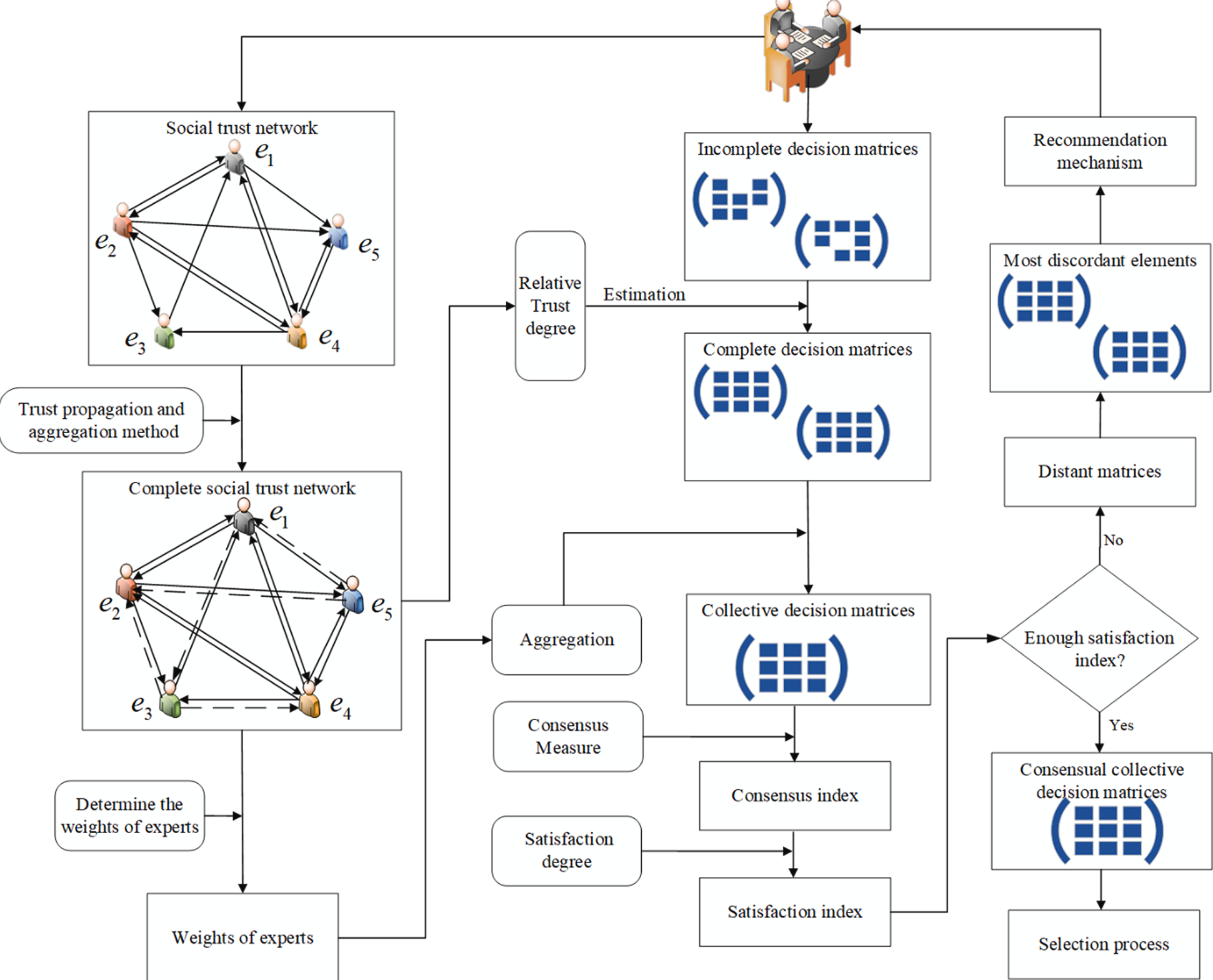
1. Modeling Ignorance with PLTF
Unlike DLTF, the Probabilistic Linguistic Trust Function (PLTF) allows for partial ignorance. If an expert trusts someone "High" (50%) and "Very High" (20%), the remaining 30% is treated as unknown.
- Propagation: When Expert A doesn't know Expert C, the model propagates trust through intermediate paths (A → B → C) using t-norm operators.
- Aggregation: Multiple paths are weighted by length; shorter paths are more "reliable" and carry more weight.
2. The Satisfaction Engine
Instead of a cold consensus threshold, the model uses a Satisfaction Index.
- Individual Aim: Every expert provides a satisfaction level using natural language (e.g., "Very High").
- Group Goal: The group consensus is only met when the least satisfied member meets the threshold. This "no man left behind" policy ensures the decision is truly collective.
Experiments: Green Supplier Selection
The model was tested on an electronics manufacturer selecting a green supplier based on hazardous chemical disposal and green competence.
Key Comparison: Proposed vs. Adjusted Consensus
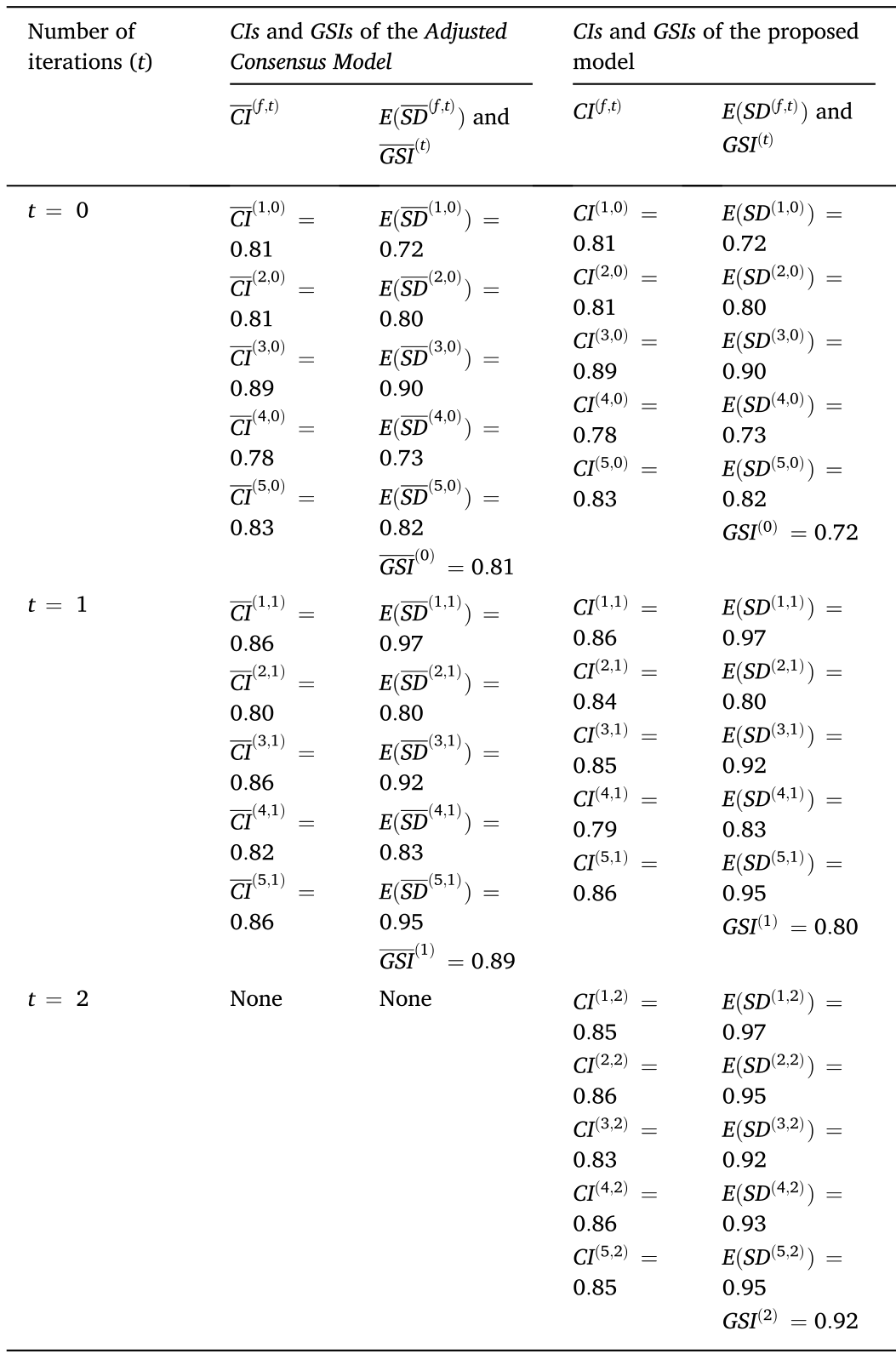
The authors compared their model against a version of the Zhang et al. (2018) model. While both eventually reached consensus, the proposed model excelled in two areas:
- Lower Information Distortion: The Modification Ratio (MR) was significantly lower, meaning experts kept more of their original data.
- Individual Buy-in: In the adjusted model, the group "agreed" even when two experts were still unsatisfied. In the proposed model, everyone’s satisfaction was guaranteed.
Critical Insight: Why This Works
The mathematical "magic" here lies in the feedback mechanism. Instead of asking everyone to change everything, the model identifies specific APS (Inconsistent Evaluation Elements). By only modifying the values that deviate most from the group collective, the model achieves consensus with minimal surgical strikes on the original data.
Conclusion & Future Horizon
This paper serves as a blueprint for "Human-Centric AI" in decision making. It moves away from treating experts as data points and starts treating them as stakeholders with individual limits and goals.
Limitations: The model currently assumes all criteria are equally weighted and primarily handles small-to-medium groups. Future Work: The logical next step is scaling this to Large-Scale Group Decision-Making (LSGDM) where thousands of social network nodes interact—a vital requirement for future digital democracy and corporate governance.