
A Place Next to Satoshi: Deconstructing the Intellectual Map of Blockchain Economics
A place next to Satoshi: foundations of blockchain and cryptocurrency research in business and economics
This paper provides a comprehensive bibliometric and social network analysis of 467 blockchain and cryptocurrency articles within the business and economics domains. It identifies five distinct research strands—Market Economics, Asset Pricing, Blockchain Principles, Transactions/Anonymity, and Monetary Theory—mapping the intellectual evolution of the field from its technical origins to mature financial discourse.
TL;DR
Is blockchain research just hype, or is it a rigorous economic discipline? Lennart Ante’s bibliometric study reveals that while the field was born from a single whitepaper, it has branched into five distinct scientific discourses. While we've become experts at analyzing Bitcoin's price efficiency, we are only just beginning to scratch the surface of how blockchain fundamentally rewires monetary policy and corporate governance.
The "Satoshi" Gravity Well
Every researcher in the crypto space feels the pull of the "Satoshi Gravity Well"—the tendency for all discourse to circle back to Nakamoto’s 2008 whitepaper. However, as the field matures, the "Business and Economics" branch of blockchain research is finally establishing its own identity. Ante's work uses factor analysis to prove that we are moving from "What is Bitcoin?" to "How does this asset fit into established financial theories?"
Methodology: Mapping the Mind of the Market
The study isn't just a reading list; it’s a mapping of Co-citations. By looking at which papers are cited together, Ante identifies the "intellectual DNA" of the field.
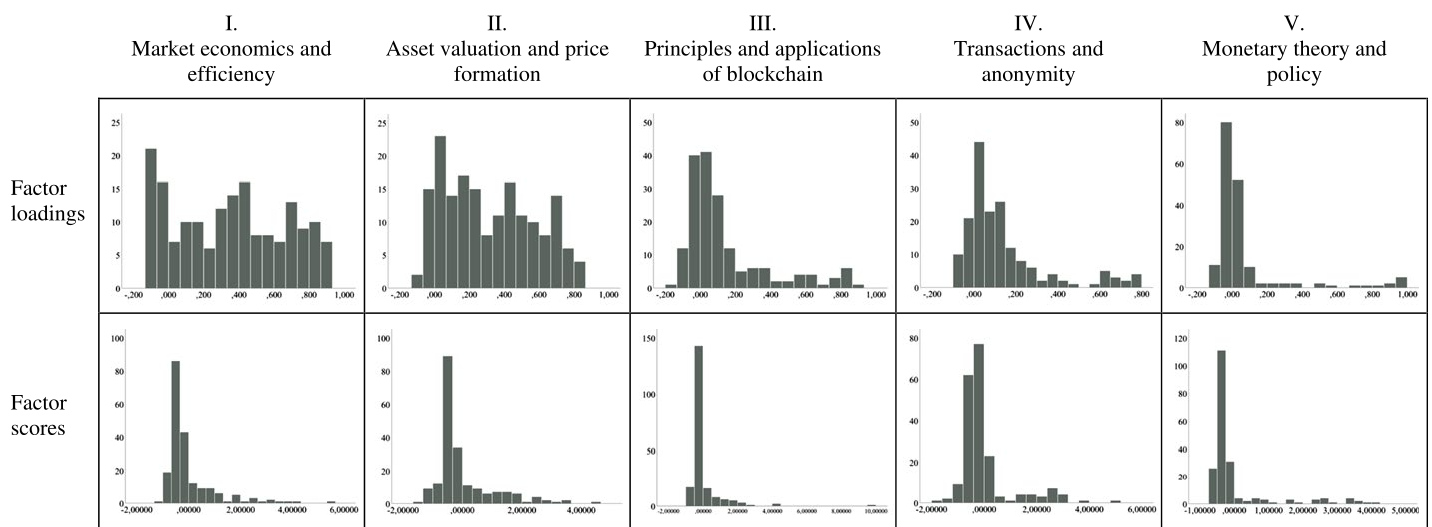
Fig 1: The distribution of factor loadings shows that while some clusters (like Market Efficiency) are highly concentrated, others remain sparse and experimental.
The Five Pillars of Blockchain Research
1. Market Economics & Efficiency (The Heavyweight)
This is the most "mature" stream. It borrows heavily from Fama’s Efficient Market Hypothesis (EMH). Researchers here (like Urquhart and Bariviera) use complex metrics like the Hurst exponent to ask: Is Bitcoin a random walk, or can it be predicted? By 2018, this stream dominated over 90% of the discourse.
2. Asset Valuation & Pricing
Closely linked to the first, this stream treats Bitcoin as "Digital Gold." It utilizes GARCH models to understand volatility and explores the speculative nature of "bubbles."
3. Principles & Applications
This is where the "Why" happens. It links blockchain to Coase’s Theory of the Firm (1937) and Jensen & Meckling’s Agency Theory. It asks how smart contracts can reduce transaction costs and replace traditional corporate hierarchies.
4. Transactions & Anonymity
A more technical/legal hybrid. It explores the paradox of "Pseudo-anonymity"—how a public ledger can be both transparent and private, and what that means for money laundering and regulation.
5. Monetary Theory & Policy
The smallest and most specialized cluster. Led by scholars like George Selgin, it explores "Synthetic Commodity Money" and asks if a decentralized protocol can truly fulfill the three functions of money better than a Central Bank.
Social Network Analysis: The Gap in the Map
The most striking visual from the paper is the Social Network Map.
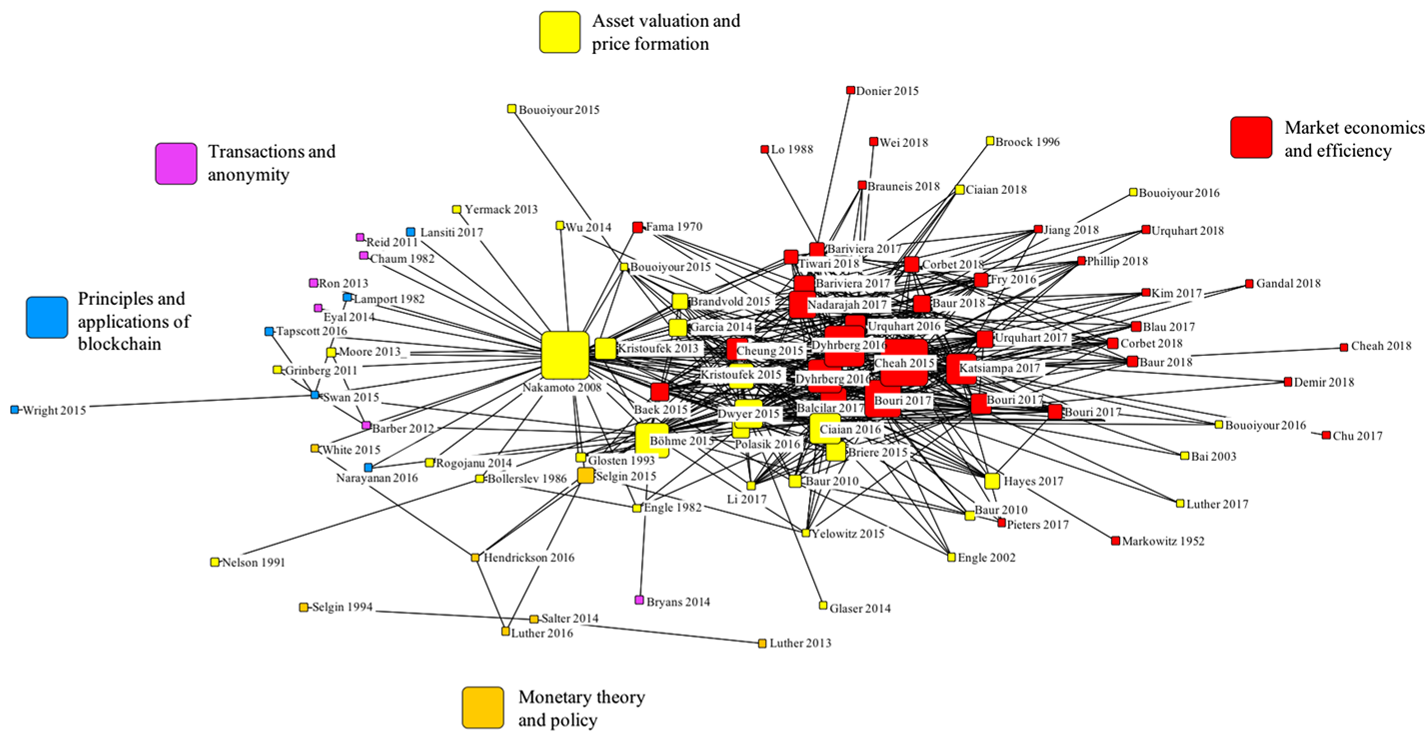
Fig 2: The network shows a dense core (Streams I and II) but reveals that the Monetary Theory cluster (Stream V) remains relatively isolated from the technical "Anonymity" research.
Deep Insight: Is the "Golden Age" Over?
Ante’s analysis reveals a surprising trend: while the volume of papers is increasing, the diversity of foundational topics in peer-reviewed journals hit a plateau around 2014-2016 for technical and monetary topics.
The author's conclusion is a call to arms: "A scientific place next to Nakamoto (2008) is still available." We have enough papers on whether Bitcoin is efficient. What we lack are peer-reviewed deep dives into:
- DeFi Governance: How do DAOs actually perform vs. traditional boards?
- Tokenomics: Developing a rigorous mathematical framework for supply/demand in ecosystem tokens.
- Management & Strategy: How do legacy firms cross the chasm into blockchain adoption?
Conclusion
This paper serves as both a history book and a treasure map. For the academic, it identifies the foundational "must-reads." For the innovator, it highlights the "empty spaces" on the map—the areas where you can still make a name for yourself in the shadow of Satoshi.
Takeaway: Stop trying to prove Bitcoin is a bubble (Stream II is full); start proving how it redefines the nature of the firm (Stream III needs you).