
EnergyRace: Transforming Energy Conservation from a Chore into a Social "Coopetition"
Saving energy with pleasure: Designing EnergyRace web application
The paper introduces "EnergyRace," a web and Facebook-integrated application designed to foster sustainable energy behavior through a "coopetition" (cooperation + competition) framework. It connects directly to household smart meters to provide real-time eco-visualization, social comparisons, and collective goal-setting.
TL;DR
EnergyRace is a persuasive web application that reimagines energy saving as a social game. By linking smart meter data with Facebook, it introduces a "coopetition" model where families collaborate internally while competing globally. The application moves beyond boring spreadsheets to use emotional avatars and "Best Practice" patterns to drive behavioral change.
Background: Beyond the "Boring" Meter
Energy saving is historically viewed as an act of sacrifice—shorter showers, lower heat, and less comfort. Complicating this is the "Eco-feedback loop" problem: most users lose interest in energy dashboards after a week. The author of EnergyRace recognizes that for sustainability to stick, it must be enjoyable, immediate, and social.
Problem & Motivation: The Boomerang Effect
Current energy monitoring systems face two major hurdles:
- The Boomerang Effect: When users see they are doing better than their neighbors, they often slack off and increase consumption.
- Individual vs. Collective: Energy saving often falls on one motivated family member, while others continue wasteful habits.
The motivation behind EnergyRace is to bridge the gap between "knowing" and "doing" by making consumption patterns visible and social.
Methodology: The "Coopetition" Framework
The researchers proposed a system built on several pillars:
- Emotional Eco-visualization: Instead of just Kilowatts, users see an Avatar. If the household exceeds its goal, the avatar becomes sad; if they save, it smiles.
- Family Collaboration: The system treats the household as a team. This ensures that children—the "consumers of tomorrow"—are educated through the behavior of their elders.
- Smart Data Integration: By connecting to smart meters, the app removes the friction of manual data entry, providing real-time feedback.
- Best Practice Patterns: Overcoming the "what do I do now?" confusion, the system calculates a target based on the season, family size, and location.
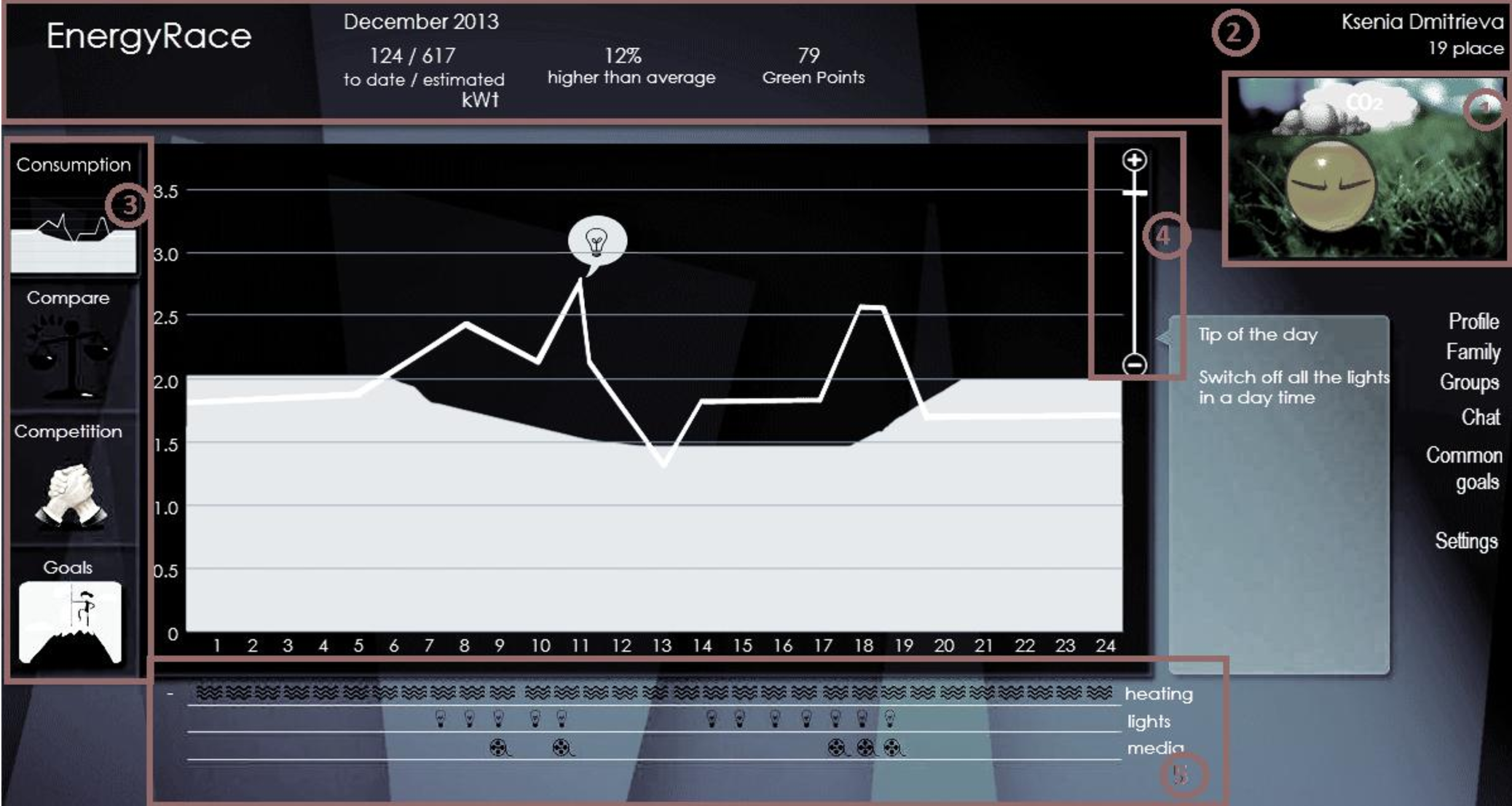 Figure 1: The EnergyRace UI layout, featuring avatar feedback (Box 1), status headers (Box 2), and consumption tabs (Box 3).
Experiments & Results: The Complexity Paradox
The prototype was evaluated using the think-aloud technique with students aged 21-25.
- The Positives: Users loved the "Avatar Metaphor" and the ability to compare their consumption with "Best Practice" benchmarks rather than just raw numbers.
- The Challenges: 40% of users found the system too complex initially. There is a tension between providing "Big Data" insights and maintaining a "Minimalist" user experience.
- Social Impact: While 78% of participants claimed to care about saving, only 5% were currently using any tracking app, highlighting a massive market opportunity for engaging solutions like EnergyRace.
Critical Analysis & Conclusion
Takeaway
The core achievement of EnergyRace is the shift from Monitoring to Engagement. By utilizing social media (Facebook), it leverages peer pressure and family bonding as a motor for sustainability.
Limitations
The primary critique of this work, as acknowledged by the author, is feature creep. Modern users demand simplicity. While the "coopetition" mechanics are theoretically sound, the cognitive load of managing "Green Points," "Global Races," and "Family Goals" simultaneously might lead to user fatigue.
Future Outlook
The next frontier for EnergyRace is simplification. Future iterations should focus on mobile-first, minimalist designs that provide "nudge" notifications rather than requiring deep dashboard dives. As smart grids become the standard, the integration of such "Social Energy Apps" will be vital for grid stability and global CO2 reduction.
Editor's Note: This paper provides a crucial blueprint for how UX designers can tackle environmental problems by focusing on human psychology and social dynamics rather than just technical metrics.