
SaW: Turning the Social Media Crowd into a High-Performance Processing Grid
SaW: Video Analysis in Social Media with Web-Based Mobile Grid Computing
This paper introduces SaW (Social at Work), a pure Web-based mobile grid computing framework that outsources compute-intensive video analysis tasks to a network of social media users' devices. By utilizing HTML5, WebGL, and WebCL, SaW achieves hardware-accelerated image processing on the client-side to complement edge-cloud infrastructures.
TL;DR
SaW (Social at Work) is a breakthrough framework that transforms the millions of browsers connected to social media platforms into a massive, distributed "Mobile Grid." By using standardized Web technologies like WebGL and WebCL, it allows service providers to offload heavy video analysis tasks—such as face detection and tagging—directly to the users' smartphones and PCs without requiring any app installation. This turns idle client hardware into a cost-saving extension of the cloud.
Problem & Motivation: The Cloud Cost Crisis
As video remains the dominant medium in social media, platforms like YouTube and Vimeo face a "Big Data" dilemma: the sheer volume of content makes automatic metadata extraction (indexing, tagging, salience detection) prohibitively expensive.
Traditional solutions rely on Infrastructure as a Service (IaaS), which incurs massive bills as the database grows. While volunteer computing (like SETI@home) exists, it usually requires native software, which is a non-starter for casual web users. The authors identified a massive, under-exploited resource: the spare CPU/GPU cycles of billions of mobile devices currently streaming video.
Methodology: The MaaIP Architecture
The core innovation is the Mobile as an Infrastructure Provider (MaaIP) model. Unlike traditional Mobile Cloud Computing (which offloads tasks from the phone to the cloud), SaW does the opposite: it offloads tasks from the cloud to the phone.
1. Zero-Install Interoperability
By sticking strictly to the HTML5/JavaScript stack, SaW bypasses the fragmentation of Android/iOS. If a device has a modern browser, it is a potential worker.
2. Harware Acceleration (The "Secret Sauce")
SaW doesn't just run simple JavaScript. It uses:
- WebGL: To tap into the GPU for parallel algebraic operations common in image processing.
- WebCL: To provide more flexible access to multi-core CPUs and heterogeneous compute assets.
3. Elasticity & QoE
To ensure the user doesn't notice their phone slowing down, SaW uses an Elasticity Factor. It typically uses only ~15% of the available CPU and ~30-50% of the GPU, ensuring the foreground video stream remains smooth.
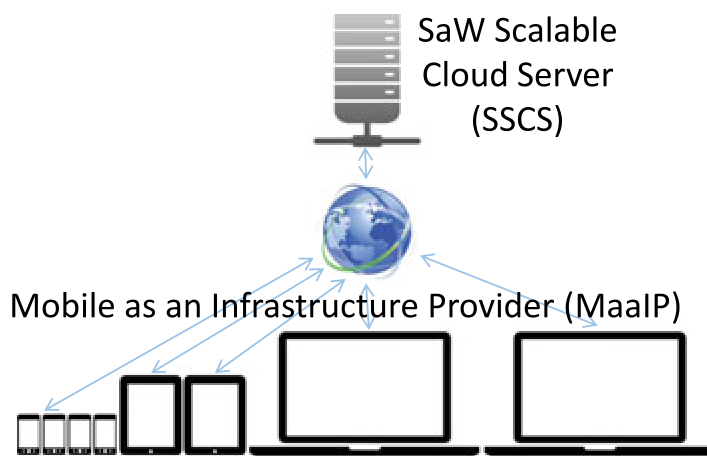 Figure 1: The SaW interaction model between the Scalable Cloud Server and Client Browsers.
Experiments & Results: WebGL vs. WebCL
The authors performed a scalability test using a complex image analysis method (DITEC).
- The Parallel Advantage: Both WebGL and WebCL showed incredible scalability. With 20 workers, the computational time dropped from 275 seconds to just 17 seconds (WebGL).
- WebCL Efficiency: WebCL consistently outperformed WebGL in raw processing speed because it allows for more efficient memory access and control flow than the graphics-oriented WebGL.
- Overcoming the Bottleneck: A key finding was that local servers eventually hit a communication bottleneck (SATA/bus limits). In contrast, the distributed SaW model scales horizontally; as more users join, the total available bandwidth and compute power increase linearly.
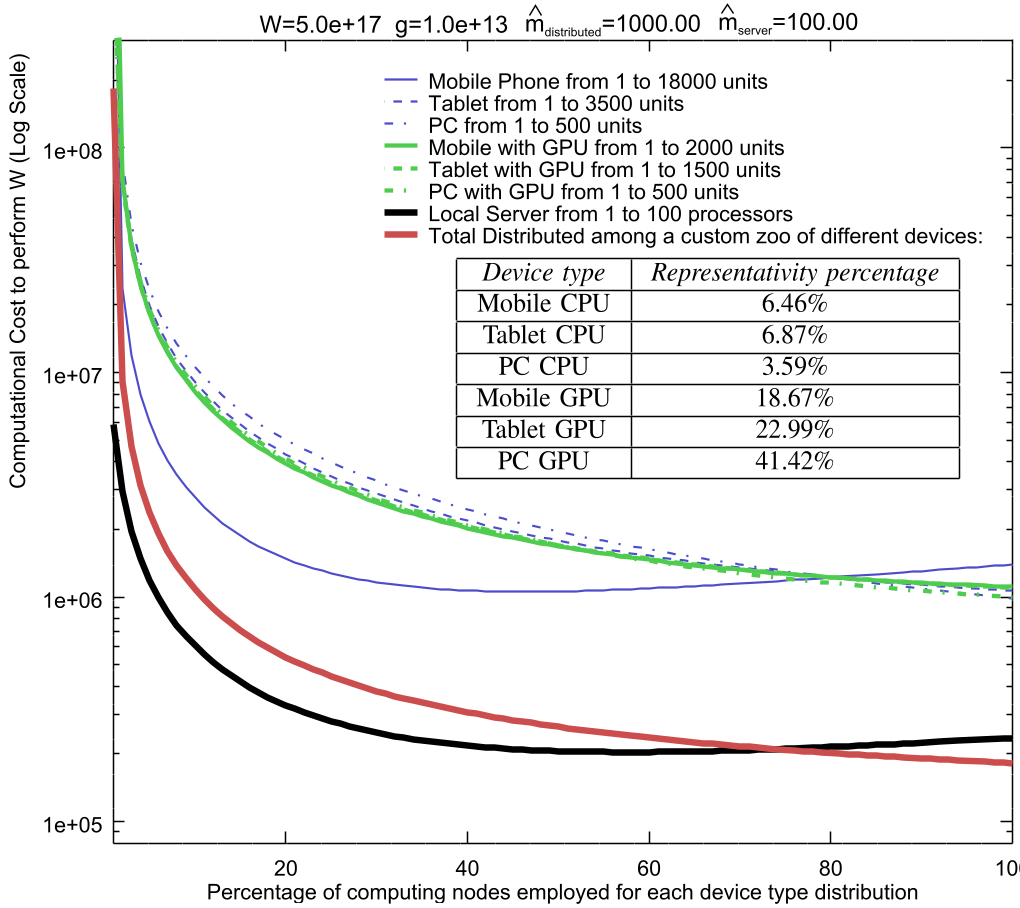 Figure 2: Performance behavior comparing a dedicated server versus a heterogeneous SaW grid.
Critical Analysis & Conclusion
Takeaway
SaW proves that "voluntary" computing is no longer limited to niche scientific research. By embedding compute tasks within a social media session, providers can drastically reduce cloud costs. The "Time-for-Money" trade-off—where the provider accepts a slight delay in analysis in exchange for near-zero infrastructure costs—is a viable strategy for modern Big Data problems.
Limitations
- The WebCL Gap: Use of WebCL currently requires external browser extensions, as native support hasn't reached the ubiquity of WebGL/WebAssembly.
- Privacy Concerns: While the authors mention encryption and tokens, offloading sensitive frame data to random client devices remains a significant hurdle for commercial adoption in private data scenarios.
Future Outlook
With the rise of WebAssembly (Wasm) and WebGPU, the performance gap between native and web applications is closing even further. SaW provides the blueprint for a decentralized web where the "Server" is simply the orchestrator, and the "Edge" is the entire user base.