
Say it with Systems: Expanding Kodu via Gender-Inclusive Game Mechanics
Say it with systems: expanding Kodu's expressive power through gender-inclusive mechanics
The paper introduces Kodu AI Lab (KAIL), an extension of Microsoft’s Kodu Game Lab designed to broaden participation in computing by middle school girls. It implements new AI-inspired language constructs—attitudes, learning, and fuzzy logic—to enable mechanics based on social interactions and dynamic relationships.
TL;DR
Researchers from UC Santa Cruz and Microsoft have developed Kodu AI Lab (KAIL), an experimental programming environment that shifts the focus from traditional combat-oriented game mechanics to social simulation. By introducing "attitudes" and "learning" as first-class language constructs, the project aims to make programming more accessible and appealing to middle school girls whose interests often lie in storytelling and relationship-driven gameplay.
Background: The Bias in Beginner Tools
In the world of game studies, "mechanics" are the rules that govern the game world. However, in educational tools like Game Maker or Alice, the built-in mechanics are often skewed. It is easy to make a character jump or shoot because the physics and collision logic are "baked in." In contrast, making a character "become friends" with another requires complex state management that beginners find daunting.
The authors argue that this technical barrier creates a gendered participation gap. If the "easy path" in a tool leads only to battlefields, students interested in social narratives may feel the field of Computer Science isn't for them.
Methodology: Encoding Social Intuition
To bridge this gap, the team extended Kodu Game Lab—a visual, rule-based language—with three AI-inspired features:
- Attitudes: Allows characters to have internal labels for others (e.g.,
see apple : think tasty). This moves beyond external state to subjective internal state. - Learning: Triggers that allow attitudes to change based on events, such as
gift from : label friend. - Fuzzy Logic: Replaces binary "yes/no" states with qualitative descriptors like "a little bit" or "somewhat," allowing for gradual personality shifts.
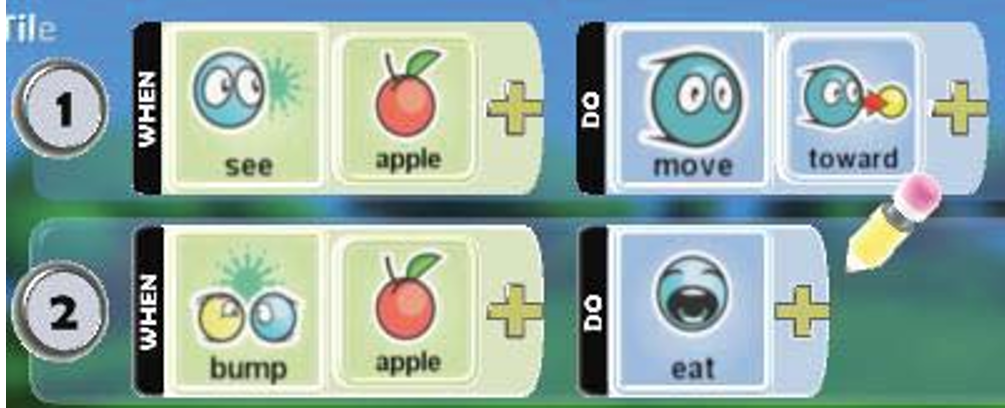 Figure 1: The standard Kodu interface where "When/Do" rules define agent behavior.
The Experiment: Insights from the Classroom
The researchers conducted sessions with middle school girls (ages 11-13) acting as "informants." The results provided a crucial reality check for educational tool designers:
- The "Giving" Problem: While girls wanted characters to share items, the "giving" mechanic was too complex. Unlike "shooting," which handles the projectile physics automatically, "giving" required students to manually code the hand-off logic across multiple lines.
- Misunderstood Abstractions: Many students used "Attitude" tiles (like finding a 'friend') but forgot to write the rules that actually assigned that attitude, causing their code to fail silently.
- The Power of Dialogue: The "say" command was the most popular feature because it allowed for instant self-expression, even though it was purely visual and had no functional effect on the game's logic.
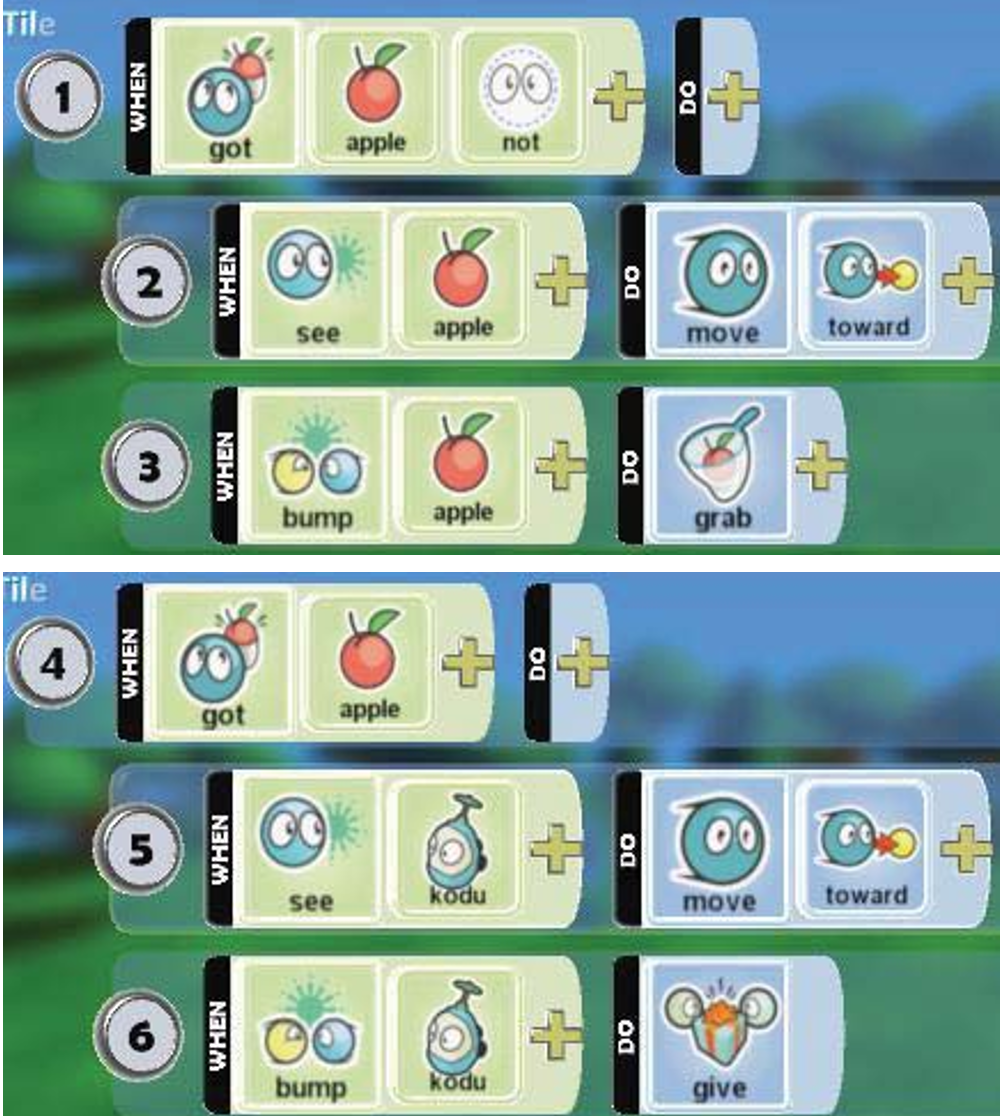 Figures 2 & 3: The multi-step logic required for a character to give an apple—a far more complex task for a novice than a "shoot" command.
Future Outlook: The "Say" Mechanic
The paper concludes with a pivot: if students love the "Say" command, why not make it a functional game mechanic? The authors propose a system where characters can "listen" for specific speech tags.
Instead of checking for exact string matches (which causes syntax errors), characters would listen for "friendly greetings." This would allow a "vain" character to become friends with anyone who "says" a flattering compliment, turning dialogue into a primary driver of game state.
Conclusion
The core takeaway is profound for the CS education community: The verbs we provide in a programming language define the identities we welcome into the field. By making "social interaction" as effortless as "combat," we can empower a broader range of creators to "say it with systems."
Limitations: The study was small and early-stage; the lack of success with fuzzy logic indicates that even simplified AI concepts might need more visual "scaffolding" for 11-year-olds.