
TS-TD: Scaling Truth Discovery with Time-Sensitive Intelligence in Social Sensing
Exploring Scalability and Time-Sensitiveness in Reliable Social Sensing With Accuracy Assessment
The paper introduces TS-TD (Time-Sensitive Truth Discovery), a scalable estimation theoretic framework for social sensing. It utilizes a Maximum Likelihood Estimation (MLE) approach to simultaneously determine claim correctness and source reliability by incorporating temporal features like source responsiveness and claim lifespan.
Executive Summary
TL;DR: Researchers from the University of Notre Dame have unveiled TS-TD, a framework that treats social media as a massive sensor network. Unlike previous models that only look at what was said, TS-TD analyzes when it was said and how long it lasted. By leveraging GPU acceleration and rigorous statistical bounds, it filters rumors from reality with unprecedented speed and accuracy.
Context: In the landscape of Social Sensing—where humans act as "sensors"—this work bridges the gap between raw data mining and rigorous signal processing. It moves beyond simple voting mechanisms to a sophisticated, scalable MLE (Maximum Likelihood Estimation) framework.
Problem & Motivation: The "Time" Ingredient
Traditional truth discovery algorithms often fail because they treat all reports equally over time. The authors identified two critical temporal signals being ignored:
- Source Responsiveness: A user who reports a fire immediately is statistically different from one who retweets a report five hours later.
- Claim Lifespan: Counter-intuitively, the study found that true claims often have shorter lifespans (focused events) while false claims/rumors often propagate longer.
Prior works like TruthFinder or Sums operate sequentially and lack a way to tell the user: "How sure are we of this result?" TS-TD was designed to solve this lack of scalability and rigorous assessment.
Methodology: The Core Engine
The TS-TD framework models the problem as an unsupervised learning task where truth is a hidden variable.
1. The Multi-Dimensional EM Algorithm
The authors define a likelihood function that accounts for the probability of a source reporting a claim given its responsiveness () and the claim's lifespan ().
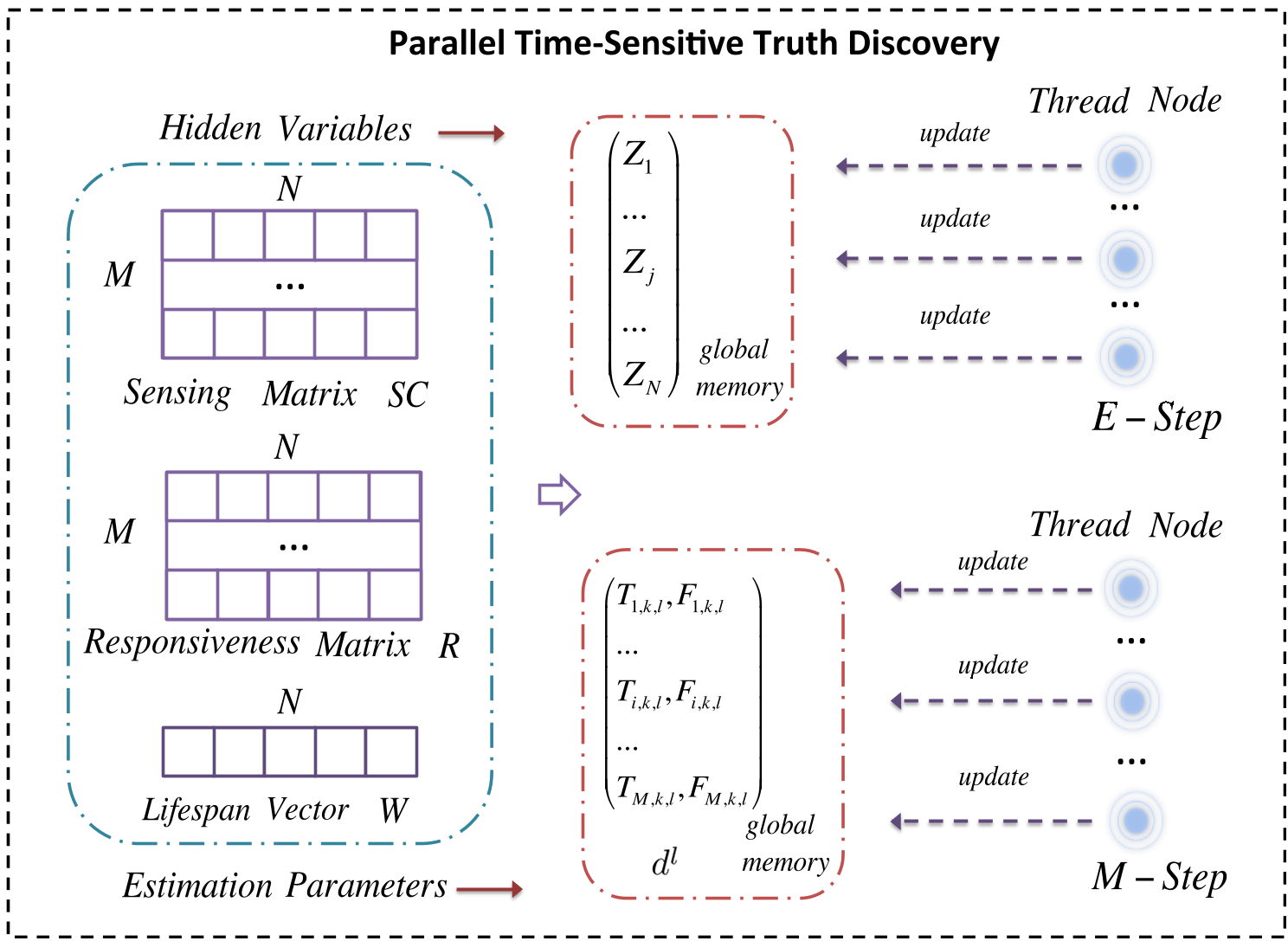
- E-Step: Estimates the probability that a claim is true based on current source reliability.
- M-Step: Updates the reliability parameters and prior truth probabilities to maximize the likelihood of the observed reports.
2. Quantifying Certainty (CRLB)
To provide "Confidence Bounds," the authors derived the Cramer-Rao Lower Bound (CRLB) for their model. This allows the system to output not just a "True/False" result, but a margin of error. This is vital for disaster response where a false positive can lead to wasted rescue resources.
3. GPU Acceleration
To bridge the gap between theory and real-world Twitter firehoses, the algorithm was parallelized. By assigning each claim and source to individual GPU threads, the heavy matrix operations of the EM steps are executed in parallel.
Experiments & Results
The team tested TS-TD against three chaotic real-world events: the Paris Shooting (2015), Boston Marathon Bombing (2013), and Hurricane Sandy (2012).
- Accuracy Boost: In the Hurricane Sandy dataset, TS-TD outperformed the "Regular EM" baseline by identifying significantly more verified news events within its top-ranked claims.
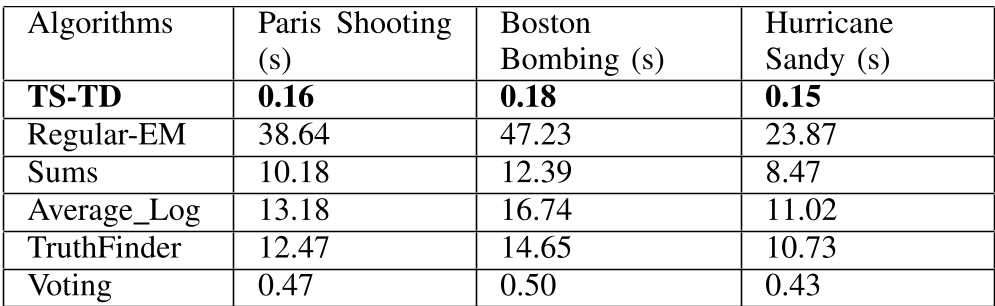
- Massive Speedup: The table below highlights the efficiency leap. While standard EM took 47 seconds to process Boston Bombing data, TS-TD finished in 0.18 seconds.
Validation of Confidence Bounds
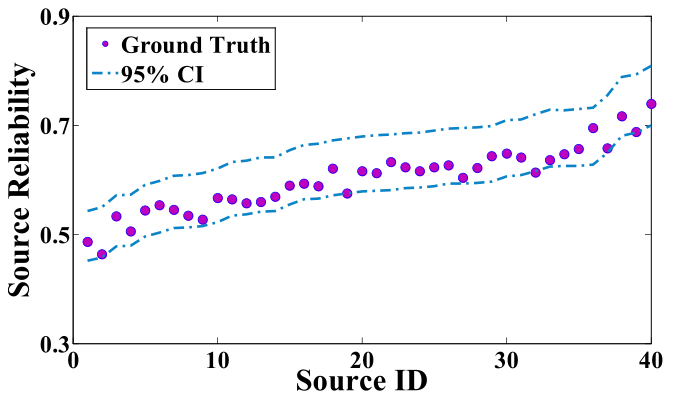
Using simulation, the authors proved that their derived 90% and 95% confidence intervals successfully contained the ground truth for source reliability, confirming the mathematical soundness of their accuracy assessment.
Critical Analysis & Conclusion
Takeaway: TS-TD proves that the temporal context of human behavior is a powerful filter for data noise. It transforms social media into a reliable, real-time sensing tool for emergency services.
Limitations:
- The model assumes responsiveness and lifespan are independent, which might not hold if a source is a "professional bot" designed to mimic human timing.
- The clustering relies on Jaccard distance, which can struggle with complex linguistic nuances like sarcasm.
Future Outlook: The integration of recursive model updates (streaming truth discovery) and more advanced NLP/Transformers for claim clustering could make TS-TD the backbone of future AI-driven crisis management centers.
Source: Huang, C., & Wang, D. (2017). Exploring Scalability and Time-Sensitiveness in Reliable Social Sensing With Accuracy Assessment. IEEE Access.