
Scalable Topology Discovery: Beyond Neighborhood Density in Big Data Social Networks
A Scalable Algorithm for Discovering Topologies in Social Networks
The paper presents a scalable topology discovery and clustering framework for large-scale social networks using the Apache Giraph platform. It introduces specific "topology scores" for Star, Ring, and Mesh structures and proposes a clustering algorithm based on structural density that outperforms traditional neighborhood-density methods like DBSCAN.
TL;DR
This research tackles the challenge of identifying specific organizational patterns (Star, Ring, Mesh) in massive social networks. By moving away from the I/O-heavy MapReduce model to the vertex-centric Apache Giraph platform, the authors implement scalable centrality measures to identify influential "seed" nodes. Their flagship contribution is a clustering algorithm that prioritizes structural density (how nodes are actually connected) over simple neighborhood density (who is nearby), leading to more robust community detection.
Problem & Motivation
Most social network analysis (SNA) tools are built for "small-world" data. When applied to billion-scale graphs, two problems emerge:
- Computational Bottleneck: Algorithms like Betweenness Centrality are or , which is impossible for large graphs.
- Semantic Noise: Traditional clustering (like DBSCAN) relies on "Neighborhood Density." However, in social networks, appearing "near" someone doesn't mean you share a structural relationship.
The authors argue that Structural Density is the key. A cluster generated through structural density ensures that every node is connected either directly or indirectly through meaningful paths, reflecting real-world social interactions.
Methodology: The Giraph Powerhouse
The paper leverages Apache Giraph, which uses the "Think Like a Vertex" paradigm. This allows for iterative computations to stay in memory, avoiding the massive disk overhead of standard Hadoop MapReduce.
1. Scalable Centrality via Approximation
To find the most important nodes (Seeds), the authors implemented:
- Effective Closeness & Radii: Using Flajolet-Martin (FM) bitstrings to approximate unique neighbor counts in space.
- LineRank: A scalable alternative to Betweenness Centrality that works on the "Line Graph" (where edges from the original graph become vertices).
- Clustering Coefficient: Calculated through a scalable triangle-counting approach.
2. Topology Scoring
The authors define three distinct scoring functions to find "Hubs":
- Star Score: High Degree + High Closeness + Low Clustering Coefficient (identifies central connectors of diverse groups).
- Mesh Score: High Clustering Coefficient + High Closeness (identifies tight-knit cliques).
- Ring Score: High Degree + Specific Effective Radius balance.
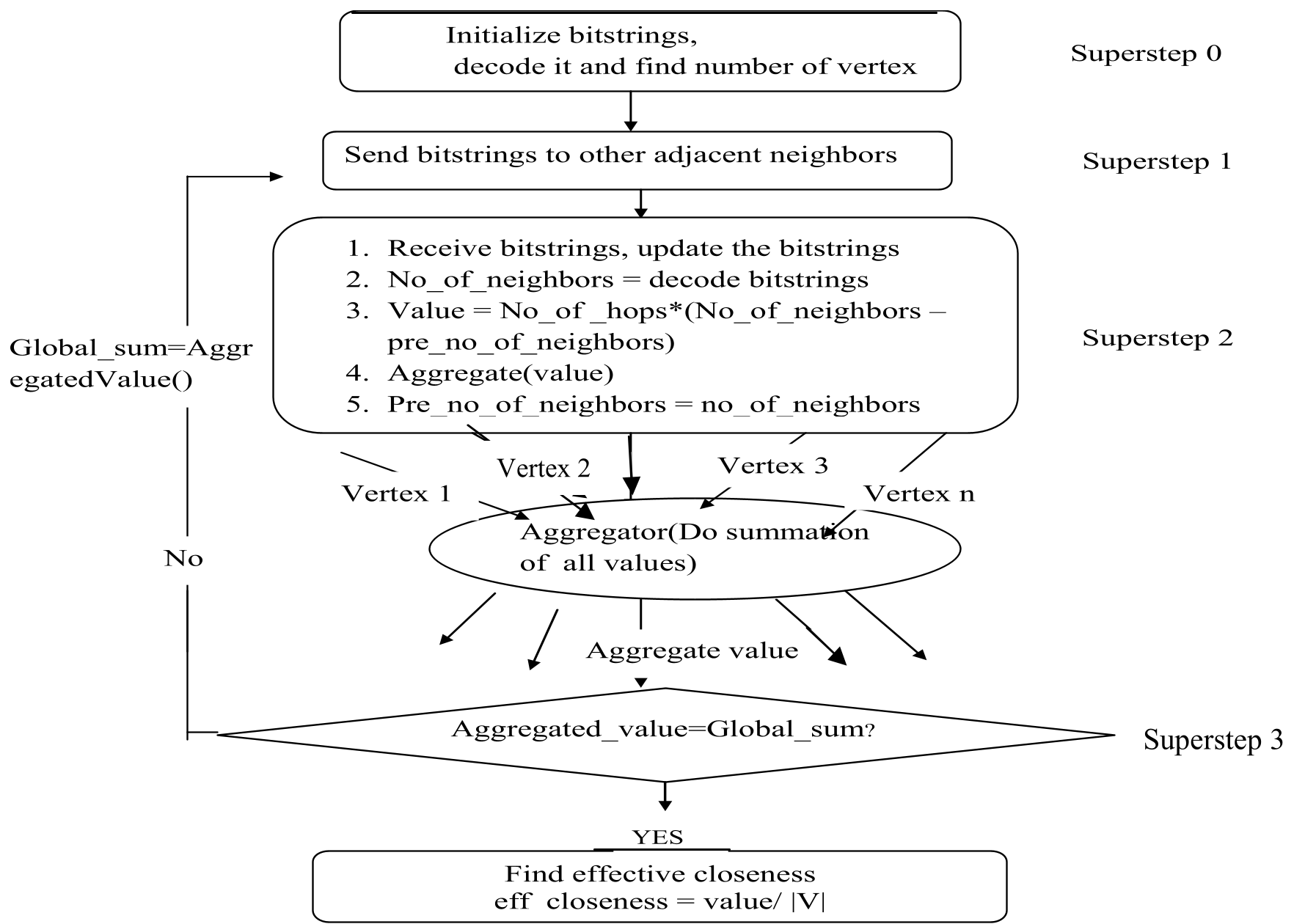 Figure 1: The iterative BSP flow in Giraph for approximating Closeness Centrality.
3. The Structural Density Clustering
Once seeds are identified, clusters grow based on a shared neighborhood threshold. A node is added to a seed's cluster if:
where represents the neighborhood defined by a max_hops parameter.
Experimental Results
Using the DBLP dataset (academic co-authorship), the study identified top influencers like Philip S. Yu and Elisa Bertino based on their topology scores.
Comparison with DBSCAN
The research compared their approach against DBSCAN using Modularity, a measure of the strength of division of a network into clusters.
- Finding: Clusters generated through structural density were "denser" and more semantically accurate.
- Observation: As the Clustering Coefficient (C) threshold increases, modularity tends to decrease because the criteria become more exclusive, resulting in smaller, tighter "core" groups.
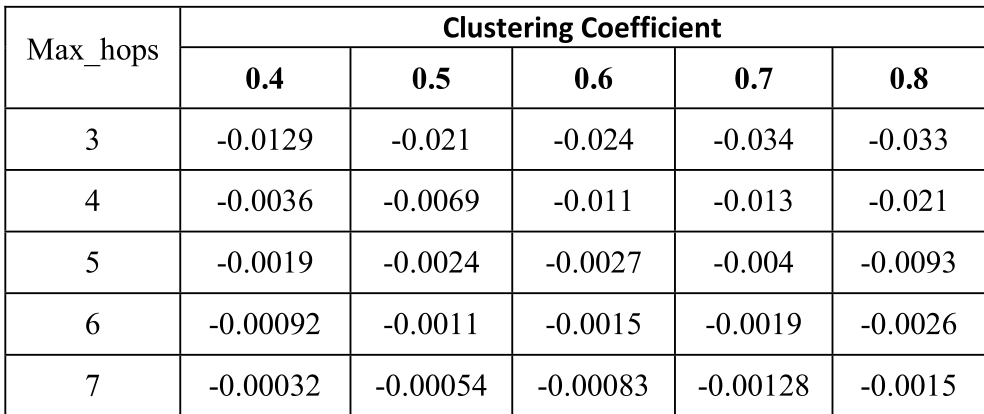 Figure 2: Modularity scores across different hop counts and clustering thresholds.
Critical Insight & Conclusion
The true value of this work lies in its Scalability-First design. By using probabilistic counting (FM bitstrings) and vertex-centric parallel processing, the authors prove that deep structural analysis isn't restricted to small datasets.
Limitations: The reliance on max_hops as a manual parameter can be tricky; if set too high, the cluster might "swallow" the entire graph; if too low, it produces too many singletons.
Future Work: Integrating these topology scores into real-time recommendation engines could allow platforms to recommend not just "similar" users, but users who fulfill specific structural roles (e.g., mentors in a star network vs. collaborators in a mesh network).
Takeaway: In the era of Big Data, don't just look at who is next to whom—look at the structure of the path between them.