
Beyond the Pilot: Architecting Scalable AI Factories for the Financial Sector
16441_Toward Scalable Artificial Intelligence in Finance.
This paper presents a comprehensive conceptual framework designed by IBM Research and MIT-IBM Watson AI Lab to address the "scalability problem" of AI in the financial sector. It introduces a multi-dimensional architecture—comprising Design Dimensions, Modeling Building Blocks, and Work-Practices—to transition AI from isolated experimental use-cases to repeatable, production-level enterprise solutions.
TL;DR
Despite the hype, nearly 85% of enterprise AI projects fail to reach production or deliver ROI. This paper from IBM Research and MIT-IBM Watson AI Lab argues that the culprit is the "use-case afterthought" approach. To solve this, the authors propose a rigorous "AI Foundation Edifice"—a structural framework that shifts AI from artisanal experiments to a scalable, repeatable, and industrial-grade software practice tailored for the complexities of finance.
The Problem: The High Cost of the "Pilot Purgatory"
In the financial industry, AI is often treated as a series of isolated experiments (use-cases). While a single fraud detection model might work in a sandbox, it often collapses when faced with:
- Data Inseparability: Data sources in finance are fragmented across legacy systems and multi-cloud environments.
- Regulatory Friction: Models must be "predictably accurate" and compliant with "defensive law" standards.
- The Scalability Wall: Translating an inductive machine learning model into a 24/7 service requires more than just code—it requires a systemic architecture.
The authors note a sobering statistic: 65% of companies have not seen business gains from AI investments. The bottleneck isn't the algorithms; it's the lack of an enterprise-level foundation.
Methodology: The AI Foundation Edifice
The paper introduces a three-tiered blueprint to bridge the gap between "sub-symbolic" AI performance and real-world value.
1. Design Dimensions (DDs)
The foundation of any AI system is the data, but the authors move beyond simple quality checks. They emphasize Data Provenance—knowing the origin, sufficiency, and adequacy of data at every point in time.
- Contextual Footprints: AI must understand the "activity context" within a domain. A model trained on market data without understanding the underlying regulatory environment is fundamentally brittle.
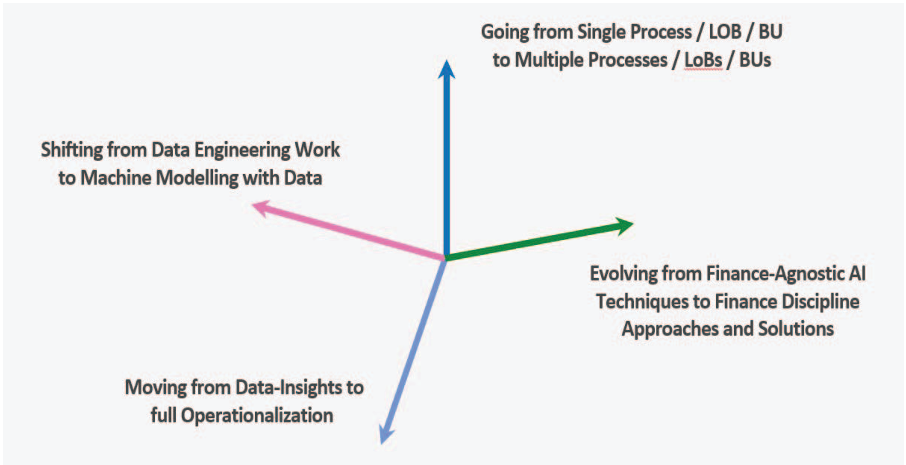
2. Modeling Building Blocks (BBs)
Rather than building bespoke models for every task, the authors advocate for modular Building Blocks. This allows for:
- Interoperability: Different AI components (e.g., NLP for sentiment and symbolic logic for risk) working together.
- Repeatability: Creating "templates" for AI solutions that can be deployed across different business units without reinventing the wheel.
3. Work-Practice (WP): From "Play" to "Process"
This is perhaps the most critical shift. AI development must evolve from a data science "lab" mindset to a Machine Learning as-a-service (MLaaS) discipline. This involves:
- Ensuring Explainability is a core requirement, not a post-hoc add-on.
- Integrating Hybrid/Multi-Cloud strategies to ensure resilience against cloud provider outages.
Key Insights & Critical Results
The research underscores that Scalable AI is a byproduct of three converging forces: Technology, Law/Ethics, and Risk.
| Challenge | Proposed Solution (The Edifice) | Impact |
|---|---|---|
| Fragile Models | Domain-dependent "Activity Context" | Higher resilience in volatile markets |
| Opaque Decisions | Integrated Explainability Toolkits | Regulatory compliance & trust |
| Siloed Data | Data Provenance & Sufficiency Mapping | 3x faster transition to production |
The paper highlights that successful organizations are those that "combine Strategy, Organization Behavior, and Technology." In short, scaling AI is as much about human workflow as it is about GPUs.
Critical Analysis & Conclusion
Takeaway
The "AI Factory" concept presented here is a necessary evolution for the financial sector. By standardizing the "Modeling Building Blocks" and grounding them in "Design Dimensions" like data provenance, banks can finally overcome the 85% failure rate of their AI initiatives.
Limitations
While the framework is logically sound, the paper remains primarily conceptual. It lacks a deep-dive quantitative ablation study comparing the cost-to-scale using this framework versus traditional methods. Furthermore, the integration of Generative AI (LLMs)—which has shifted the landscape since 2023—is hinted at but not explicitly detailed in the "Building Blocks" section.
Future Outlook
As AI becomes "defensive" (aligned with law) and "predictable," we will likely see fewer "one-off" AI projects and more horizontal AI platforms. Organizations that fail to build these foundations today will find themselves locked in an endless cycle of expensive, non-scalable pilots.
Note: This analysis is based on the IBM Research paper on "Enterprise AI, Systems and Solutions" presented within the context of Finance and Scalability.