
aspect2vec: Mastering Intent-Aware Diversification in Social Networks
Scalable Aspects Learning for Intent-Aware Diversified Search on Social Networks
The paper introduces an intent-aware search result diversification method for social networks, featuring a novel Network Representation Learning (NRL) model called aspect2vec. It maps nodes into a low-dimensional space that preserves topological structure, node attributes, and query-specific proximity, ultimately outperforming state-of-the-art algorithms like Exp2 and RelExp2 in S-recall and novelty.
TL;DR
When you search for "Elon Musk" on Twitter, do you want to see Tesla updates, SpaceX news, or his latest tech-policy debates? Standard search algorithms often fail to capture these distinct "aspects," resulting in redundant or irrelevant results. This paper presents aspect2vec, a scalable Network Representation Learning (NRL) model designed to understand multiple query intents by blending social structures, node attributes (interests/age), and query proximity into a unified vector space.
The Problem: One Query, Multiple Truths
Prior work in graph diversification typically treats "diversity" as a global property—like the expansion ratio of a neighborhood. However, real-world queries are ambiguous.
- Prior Work's Failure: Methods like DivRank or Exp2 assume a universal goodness metric. They don't care who is asking or the specific context of the query.
- The Resolution Problem: Standard embedding techniques (DeepWalk, node2vec) cluster the whole graph. The query node often gets "swallowed" by a massive community, making it impossible to distinguish between the smaller, varied sub-interests (aspects) specific to that query.
Methodology: The aspect2vec Framework
The authors propose an intent-aware pipeline: first, turn the network into specialized "query-aware" vectors; second, use these vectors to pick a diverse set of results.
1. The Tri-Partite Objective
The core of aspect2vec is a loss function that balances three forces:
- Network Structure (): Keeps connected nodes close.
- Node Attributes (): Groups nodes sharing similar features (e.g., job titles or hobbies).
- Query-Oriented Proximity (): Projects the entire embedding space through the "lens" of the query node .
2. Attribute Augmented Random Walks
To make this scalable, the authors don't just calculate similarities. They build an Attribute Augmented Network where attributes (like "California" or "Engineer") are treated as special nodes in the graph. By starting random walks specifically from the query node , they ensure that the "corpus" used for training the model is naturally biased toward the query's local neighborhood.
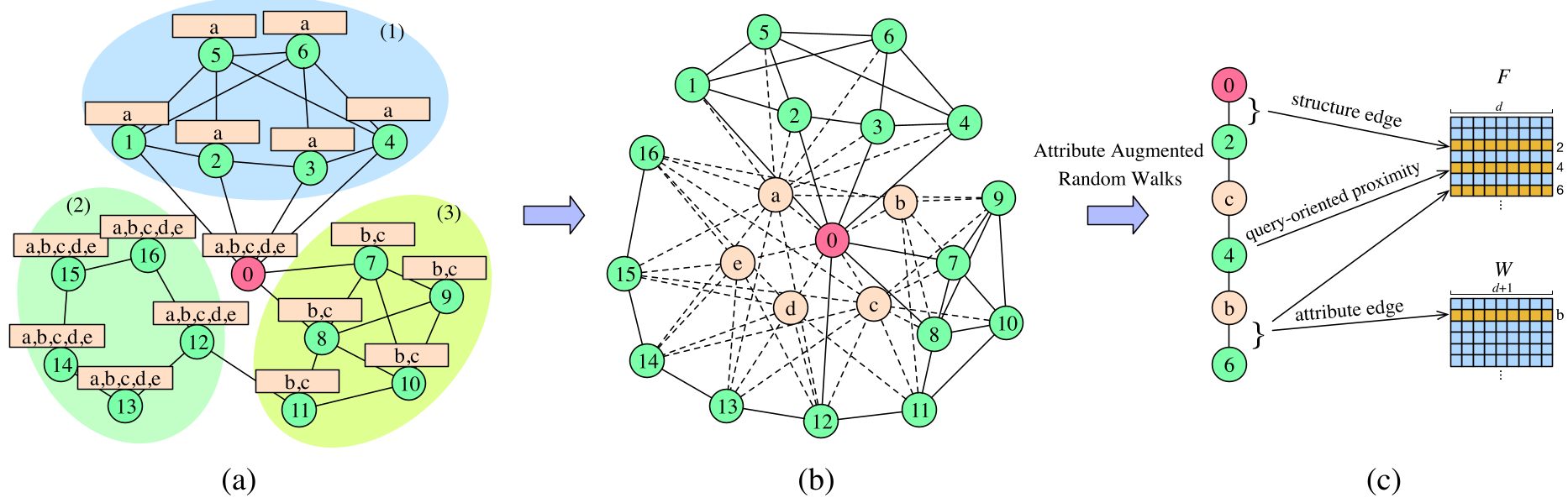 Figure 1: (a) Original attributed network. (b) The augmented graph with attribute nodes. (c) The mapping into vector space.
Experimental Insights: Seeing is Believing
The most striking evidence of the method's effectiveness is the t-SNE visualization of the Facebook dataset.
 Figure 2: Comparing aspect2vec (d) with global models like DeepWalk (a) and node2vec (c). Note how in (d), the social circles (colored dots) are clearly organized around the query, whereas in others they are scattered.
Key Performance Wins:
- S-Recall Boost: In DBLP (co-authorship) and Flickr networks, aspect2vec-based methods (A2VPM2) consistently outperformed baselines in reaching relevant sub-communities.
- Efficiency: The training time scales linearly with the number of random walks, making it practical for large-scale social graphs.
- Ablation (Impact of Attributes): The study confirmed that adding node attributes significantly clarifies the "boundaries" between different query aspects, preventing the model from just picking structurally similar but semantically identical nodes.
Critical Analysis & Future Outlook
aspect2vec represents a shift from "global diversity" to "local intent." By defining aspects as feature subspaces, it provides a bridge between Information Retrieval (IR) theory and Graph Representation Learning.
Limitations:
- The model currently treats graphs as static, while social networks are inherently dynamic.
- It uses binary attributes, missing the nuance of rich text (documents) associated with nodes.
Future Work: The logical next step is integrating Large Language Model (LLM) embeddings directly into the aspect2vec attribute nodes, allowing for a deep semantic understanding of why search results are diverse.