
Predictive Edge Replication: Leveraging Social DNA for Scalable Content Distribution
Scalable content distribution for social networking websites
This paper proposes a proactive content replication strategy for Social Networking Websites by mining information dissemination patterns. By leveraging geographical, temporal, and social graph predictors from Twitter, the method aims to predict future content demand locations to minimize user-perceived latency.
TL;DR
As User-Generated Content (UGC) dominates internet traffic, traditional "wait-and-see" caching is becoming obsolete. This paper proposes a proactive replication framework that uses geographical time lags, temporal topic lifecycles, and social network cohesion to predict where content will be requested before it even arrives. By treating social media as a sensor network, we can pre-place replicas at the edge, drastically reducing latency and backbone congestion.
Background: The UGC Explosion
The paradigm of the internet has shifted from a broadcast model (one-to-many) to a UGC model (many-to-many). With consumer traffic growing at 36% annually, centralized architectures are buckling under the strain of "Flash Crowds"—sudden spikes in demand that lead to service outages and high latency. While CDNs (Content Delivery Networks) help, the core challenge remains: With limited storage at the edge, which 1% of content should we store to satisfy 99% of future requests?
The Core Insight: Social Networks as Predictors
The author argues that content doesn't move randomly; it diffuses through social structures. Instead of waiting for a "cold start" request at an edge server, we can monitor the "buzz" on platforms like Twitter to forecast demand.
1. Spatial-Temporal Patterns
Events usually start at a specific origin and spread. By analyzing the time lag between a topic's emergence in one region and its peak in another, the system gains a "lapsed time" window to replicate data across global surrogate servers.
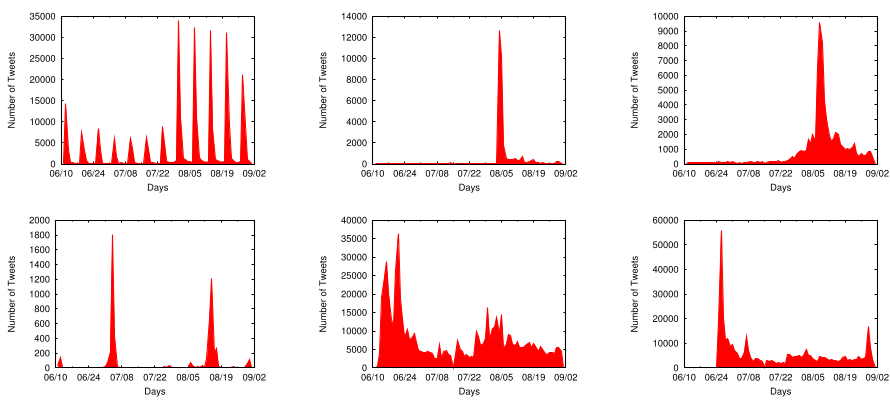 Figure: Temporal analysis shows distinct patterns of periodicity and decay used to decide whether to uphold or evict content from caches.
2. The Social Cohesion Metric
A critical contribution of this work is the analysis of Social Cohesion—the ratio of existing follower relations among content producers to the maximum possible relations. The study finds a fascinating inverse relationship:
- Niche Topics: High social cohesion. A tight-knit group of users talks about specific content. This makes their future location and demand highly predictable.
- Popular Topics: Low social cohesion. As a topic goes viral, the producers become socially fragmented, making broad geographical replication necessary.
Methodology: A Multi-Predictor Approach
The proposed solution doesn't rely on a single metric but a triad of predictors:
- Geographical: Uses account spatial data to map the "speed" of a topic's spread across the globe.
- Temporal: Classifies topics based on stability and decay rates. If a topic is "periodic," the system prepares the cache in advance of the next cycle.
- Social Graph: Uses the follower/followee relationship to identify communities of interest, pinpointing the physical locations of these users to select the right surrogate servers.
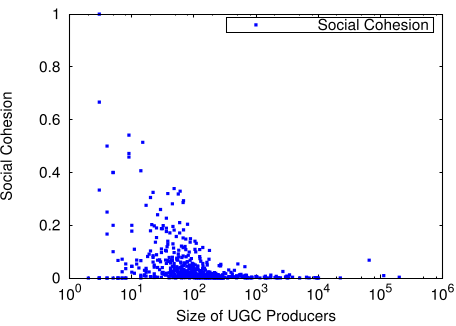 Figure: Measuring the time lag between geographically distant nodes to inform proactive content placement.
Why This Matters
Most replication strategies are Reactive (replicate after the request) or Location-Based (replicate after many requests). Both are too slow for the ephemeral nature of social media trends. By moving to a Social-Predictive model:
- Latency is reduced because the content is already at the edge when the user clicks.
- Bandwidth is saved by avoiding redundant transfers during peak "Flash Crowd" events.
- Storage Efficiency is maximized by only replicating content that shows high social "growth rate" or established periodicity.
Critical Perspective
While the paper provides a strong conceptual framework, the implementation of a real-time "Social-to-CDN" pipeline remains a massive data engineering challenge. Monitoring the Twitter API for every niche topic to update thousands of edge nodes requires a highly scalable metadata plane. Furthermore, as privacy regulations (like GDPR) tighten, accessing granular user location data via social profiles may become a bottleneck for such systems.
Conclusion
This research confirms that the "Social Graph" is not just for marketing—it is a vital component of network infrastructure. By understanding the social cohesion of content producers, we can build a smarter, more "empathetic" internet that anticipates human interest before it manifests as network traffic.