
Scalable Social Distancing: Solving Urban Mobility with Network Science and MCMC
Scalable and distributed strategies for socially distanced human mobility
2021-12-01
Summary
Problem
Method
Results
Takeaways
Abstract
This paper introduces scalable and distributed mobility optimization strategies to mitigate contagion spread in urban spaces. It employs Markov Chain Monte Carlo (MCMC) Gibbs sampling and grid-based spatial parallelization to transform computationally intensive social distancing optimizations into real-time deployable policies, achieving significant speed-up while maintaining SOTA-level infection dampening.
## TL;DR
While social distancing is a proven tool against pandemics, calculating the "optimal" location for every person in a city is a computational nightmare. This paper presents a breakthrough by using **MCMC Gibbs sampling** and **spatial parallelization** to make these calculations scalable. The result is a distributed system that reduces infections nearly as well as the theoretical optimum but runs exponentially faster.
## The Centralization Trap: Why Current Models Fail
The primary challenge in "intelligent" social distancing is the scale of data. Most optimization models assume a "God's eye view," where a central server knows every individual’s location and health status. However, as the population ($n$) grows, the complexity of managing these social ties becomes prohibitive. Furthermore, in the real world, we rarely have a perfect map of the social network.
The authors identify two fatal flaws in prior work:
1. **Computational Complexity**: Linear scaling of parameters prevents real-time updates.
2. **Information Privacy**: Requiring the entire network topology is a massive privacy risk.
## Methodology: Distributed Intelligence via MCMC and Grids
To bypass these hurdles, the researchers introduced three core optimization approaches—**Direct Contact**, **Clustering**, and **Contagion Potential (CP)**—and then applied two scalability "wrappers."
### 1. The Optimization Philosophies
* **Direct Contact**: Purely minimizing $S-I$ (Susceptible-Infected) edges.
* **Clustering**: Breaking up triangles in the social graph that contain infected individuals, leveraging the fact that infectious diseases thrive in "tight-knit" local clusters.
* **Contagion Potential (CP)**: A more nuanced view where "Infected" isn't a binary state but a continuous "spreader likelihood" (CP). The goal is to maximize **Homophily**—keeping people with similar CPs together and apart from those with high CP differences.
### 2. The Scalability Engine
The real innovation lies in the **Sampling and Grid-based strategy**:
* **MCMC Gibbs Sampling**: Instead of moving everyone at once, the system samples one node at a time. It checks: "If everyone else stays put, where is the best place for *this* person?" This reduces a massive global problem into a series of simple local decisions.
* **Spatial Parallelization**: The city is divided into grids with "padding" regions. This allows local processors to handle segments of the population independently.
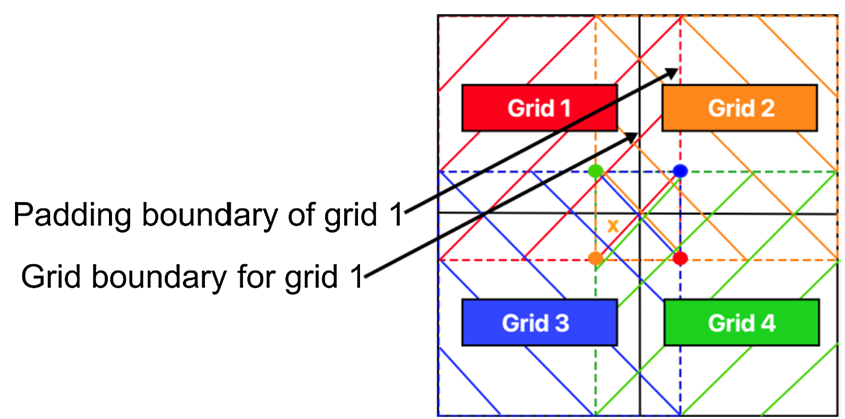
*Fig 1: Spatial partitioning into grids with padding allows for distributed optimization without boundary artifacts.*
## Experimental Evidence: Speed Meets Safety
The authors tested their system using the **SEIRD model** (Susceptible-Exposed-Infected-Recovered-Dead).
The results were striking:
* **Performance**: The sampling version of the "Direct Contact" approach tracked the optimal solution almost perfectly while being significantly faster.
* **Complexity**: As seen in Table 3 of the paper, while traditional optimization time grew quadratically, the sampling strategies remained relatively flat, enabling deployment for thousands of agents.
* **Resilience**: Even when a portion of the population "flouted" the system's recommendations (random mobility), the overall infection curve remained lower than no intervention at all.
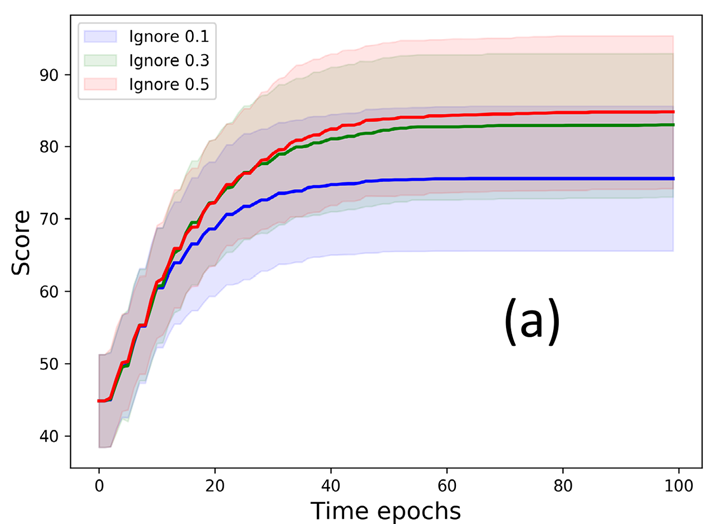
*Fig 2: Comparison of cumulative infection counts; the distributed strategy consistently outperforms random mobility across different population sizes.*
## Deep Insight: Beyond Static Lockdown
The beauty of this approach is its **Inductive Bias** toward local interactions. By focusing on "triad elimination" and "homophily," the authors are targeting the very geometry of contagion.
Most impressively, the **Distributed Strategy** allows each individual's smartphone to make decisions based only on immediate neighbors (Bluetooth/Wi-Fi range). This solves the privacy paradox: you don't need to tell a central server where you are; your phone just needs to negotiate a "safe" path relative to the people around you.
## Critical Analysis & Conclusion
**Limitations**: The model assumes people are willing to move to "recommended" locations. In reality, humans have destinations (work, home). The next frontier for this research is integrating **Utility Functions** that balance "Infection Risk" with "Destination Necessity."
**Final Takeaway**: This work transitions social distancing from a "dumb" blunt instrument (lockdowns) to a "smart" distributed algorithm. It proves that with the right sampling techniques, we can maintain urban mobility without fueling the next wave of a pandemic.