
TLD: Tackling Scalability in Mobile Social Networks with Two-Layer QoS Routing
A scalable gather point based data delivery scheme in mobile social networks
The paper introduces TLD (Two-Layer QoS-aware Delivery), a scalable data delivery scheme for large-scale Mobile Social Networks (MSNs). It utilizes a hierarchical Gather Point (GP) model and Discrete Time Non-homogeneous semi-Markov Processes (DTNHSMP) to predict user mobility and optimize routing for diverse QoS requirements.
TL;DR
In large-scale Mobile Social Networks (MSNs), predicting where a user will be is like finding a needle in a haystack. This paper presents TLD (Two-Layer QoS-aware Delivery), a routing scheme that breaks the network into Macro and Micro layers. By modeling buses as Mobile Gather Points and using semi-Markov processes, TLD achieves high delivery ratios and low latency with a fraction of the computational complexity of previous SOTA methods.
The Scalability Wall in MSNs
Mobile Social Networks are essentially Delay Tolerant Networks (DTNs) where human social patterns—like visiting the same coffee shop daily—are used to predict data "hops." Previous works used Gather Points (GPs) to anchor these predictions.
However, two major flaws existed:
- The Scale Curse: In a small campus, encountering a relay is easy. In a city, if the sender and receiver are miles apart, the probability of a random encounter in a specific GP drops to almost zero.
- Transportation Blindness: Most models assumed "teleportation" between GPs, ignoring that users spend significant time on buses or trains—prime opportunities for data exchange.
Methodology: The Two-Layer Hierarchy
The authors solve the scalability problem by introducing a hierarchical architecture, transforming a flat, high-complexity search space into a manageable two-tier system.
1. The Macro and Micro Layers
- Macro Layer: Focuses on Constant Gather Points (CGPs) like schools or malls and Mobile Gather Points (MGPs) like bus lines.
- Micro Layer: Dives inside a CGP, dividing it into "homes" (e.g., a school is split into dorms, cafeterias, and exits).
2. DTNHSMP Mobility Modeling
Instead of simple Markov chains, the authors use Discrete Time Non-homogeneous semi-Markov Processes (DTNHSMP). This allows the model to account for the fact that transition probabilities change over time (e.g., you go to work in the morning but the park in the evening) and that the time spent in one location (sojourn time) follows specific statistical power laws.
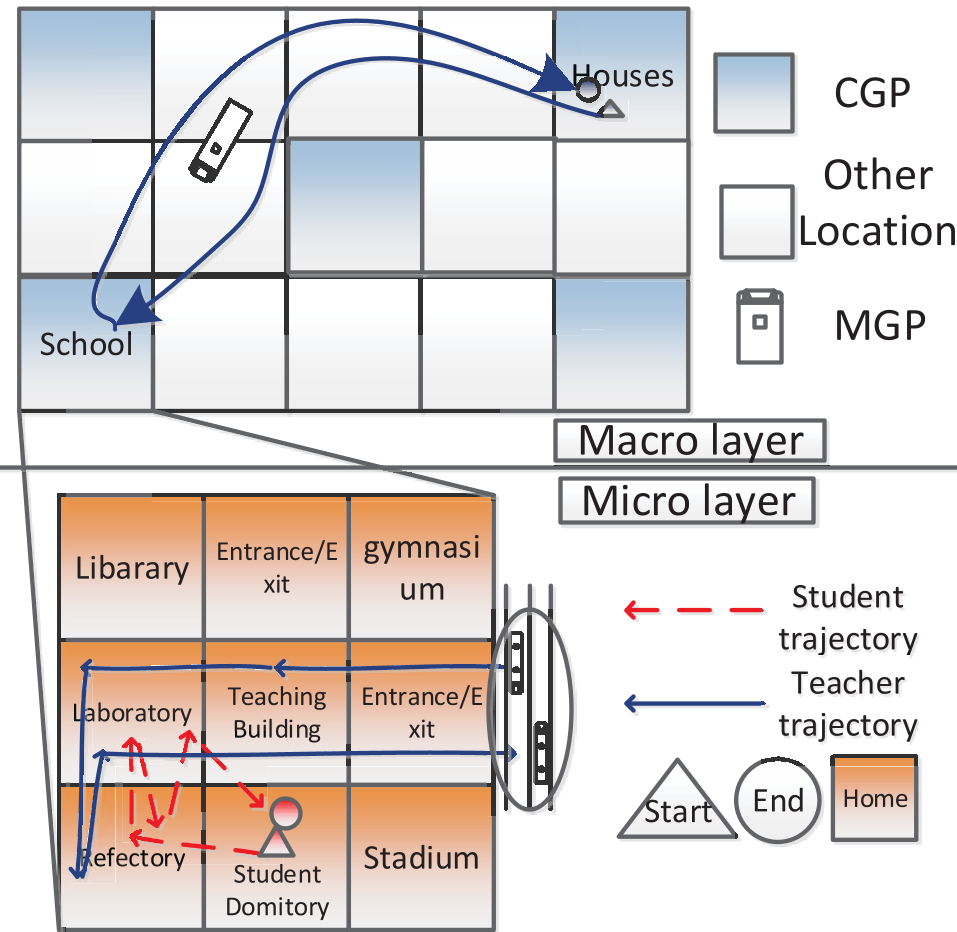 Fig 1: The proposed two-layer model distinguishing between city-wide movement and local clustering.
3. QoS-Aware Routing Logic
The TLD algorithm isn't one-size-fits-all. It selects relays based on three distinct goals:
- Large Files: Optimizes for Contact Duration.
- Urgent Alerts: Optimizes for Minimum Delay.
- Critical Data: Optimizes for Delivery Ratio.
Evidence of Efficiency
The beauty of TLD lies in its math. By splitting the state space, the complexity drops from to (where is the max of or ).
Experimental Performance
In simulations against the popular PER (Predict and Relay) and Epidemic algorithms:
- Reduced Delay: TLD significantly outperformed PER because it accounts for transit time on buses (MGPs).
- Scalability: As the "Community Similarity" decreased (simulating a larger, more sparse network), TLD's delivery ratio remained robust while PER's performance plummeted.
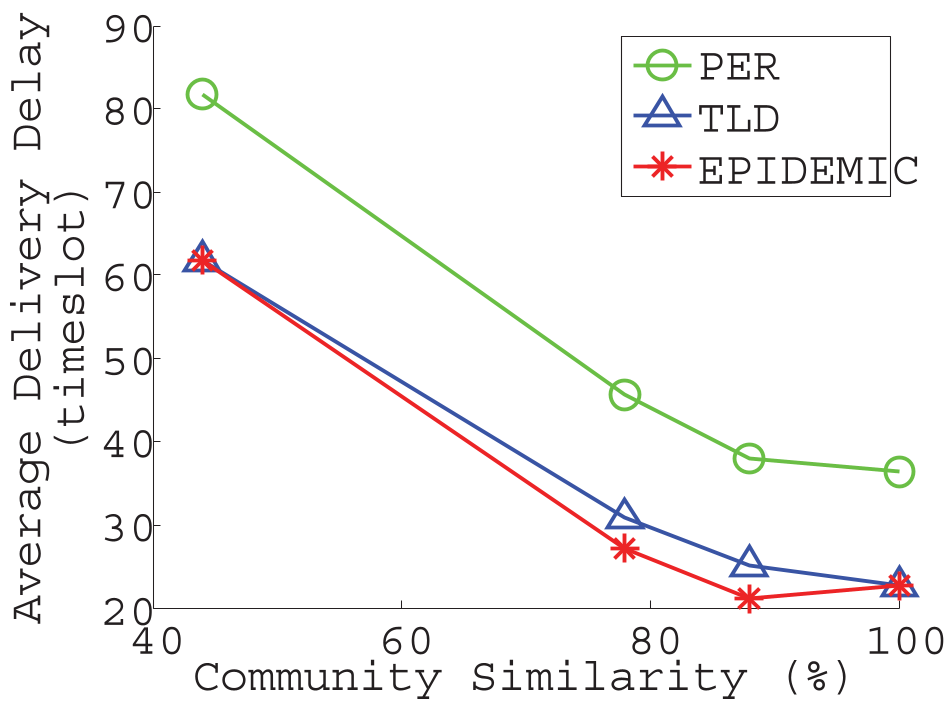 Fig 2: TLD maintains low delivery delay even as geographic distance (network scale) increases.
Critical Insights & Conclusion
TLD proves that "social" routing isn't just about who you know, but where you are in a structured hierarchy. By treating public transport as a moving gather point rather than "dead time," the authors unlocked a massive potential for data relaying in urban environments.
Limitations: The model relies heavily on historical mobility records. In a world where privacy regulations (like GDPR) are tightening, the "History-based" approach may face implementation hurdles, although the authors' "Statistic-based" alternative offers a privacy-preserving (albeit less accurate) fallback.
Future Outlook: As we move toward 6G and smart cities, hierarchical models like TLD will be essential for managing D2D communication without overloading traditional cellular base stations.