
SHNA: Tackling the Combinatorial Explosion in Heterogeneous Social Network Alignment
Scalable Heterogeneous Social Network Alignment through Synergistic Graph Partition
The paper introduces SHNA (Scalable Heterogeneous Network Alignment), a two-stage framework designed to identify shared users (anchor links) across different social networks. By combining synergistic graph partitioning with parallel sub-network alignment, the method achieves state-of-the-art performance in both accuracy and computational efficiency.
TL;DR
The problem of identifying the same user across multiple platforms (e.g., matching a Twitter account to a Foursquare profile) is notoriously difficult due to the search space. SHNA (Scalable Heterogeneous Network Alignment) solves this by first using "Synergistic Partitioning" to break the big networks into small, corresponding sub-groups. This allows for parallel processing and massive pruning of irrelevant links, resulting in a 5000x speedup and significantly higher F1-scores.
The Scalability Wall in Network Alignment
Modern social networks are Heterogeneous Information Networks (HINs), containing complex nodes (users, posts, locations) and attributes (timestamps, check-ins). Identifying "anchor links"—the connections between shared users—is essential for a unified view of user behavior.
However, most existing SOTA models try to align the network as a whole. If you have 10,000 users in Network A and 10,000 in Network B, a simple model must evaluate 100 million potential links. Not only is this computationally expensive, but it also introduces immense noise, as the model "gets lost" in a sea of negative samples.
The Insight: "Synergistic" Graph Partitioning
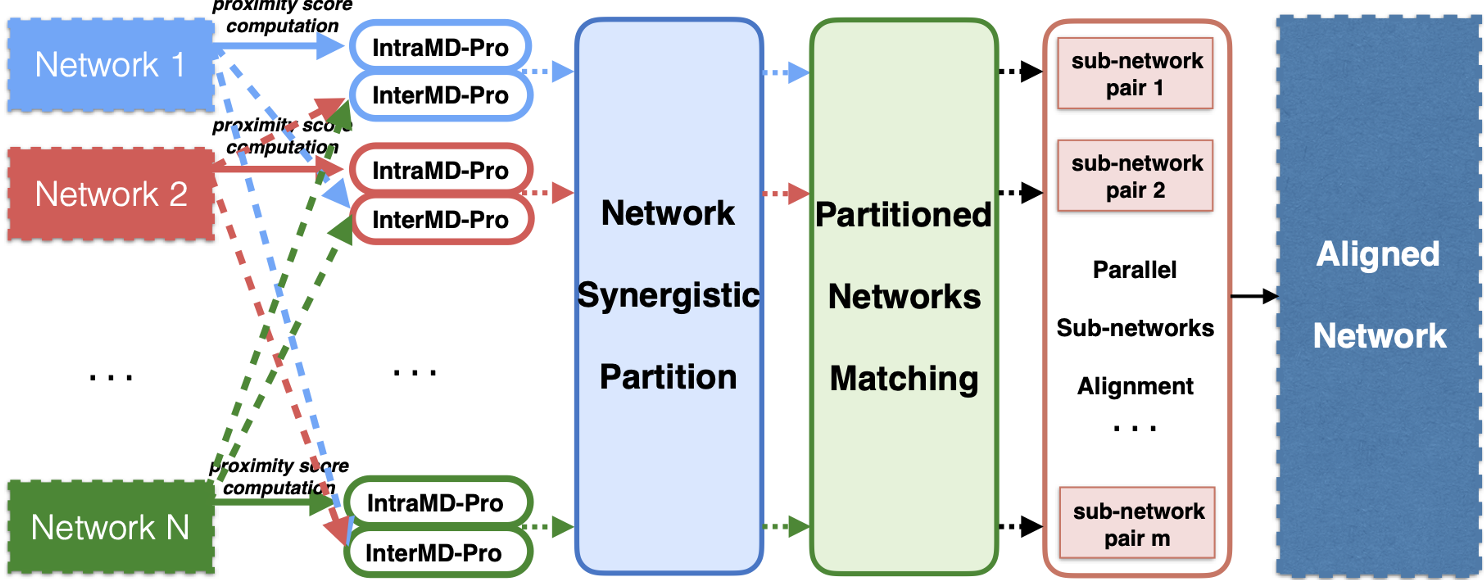
The core innovation of SHNA is that partitioning shouldn't happen in isolation. If you partition Network A based only on its internal structure, and Network B the same way, the resulting clusters may not correspond.
SHNA introduces Synergistic Partitioning, which uses:
- Intra-network proximity: How close users are within the same site.
- Inter-network proximity: Utilizing partially known anchor links (seeds) to ensure that if User A and User B are linked, they end up in corresponding clusters across networks.
Methodology: Meta Diagrams and Dual-Stage Optimization
1. Meta Diagrams: Capturing Rich Semantics
Beyond simple paths, SHNA uses Meta Diagrams (DAG subgraphs) to define user similarity. For example, two users might be considered similar if they both follow the same person who is already known to be the same user in both networks.
2. Discrepancy Minimization
The model minimizes a joint objective function that balances the "Normalized Cut" (standard clustering metric) with a Discrepancy Penalty. This penalty grows if users who are likely to be the same person are assigned to non-corresponding sub-networks.
3. Parallel Alignment
Once the networks are divided into matched pairs , the alignment is performed only within these pairs. This dramatically shrinks the candidate space and allows for the use of more complex, high-accuracy alignment algorithms in parallel.
Experimental Performance
The authors tested SHNA on a real-world dataset of Foursquare and Twitter users.
Effectiveness: Pruning the Noise
By partitioning the network, SHNA successfully pruned the majority of negative links. As shown in the "Top-K Matching" experiments, the synergistic approach ensured that over 92.8% of true positive anchor links were preserved within the matched sub-networks while discarding millions of irrelevant candidates.
Efficiency: From Hours to Seconds
The most striking result is the time complexity. Standard models like IterClip-MD took nearly 14 hours to process the dataset. SHNA completed the same task in under 10 seconds.
Critical Insight & Conclusion
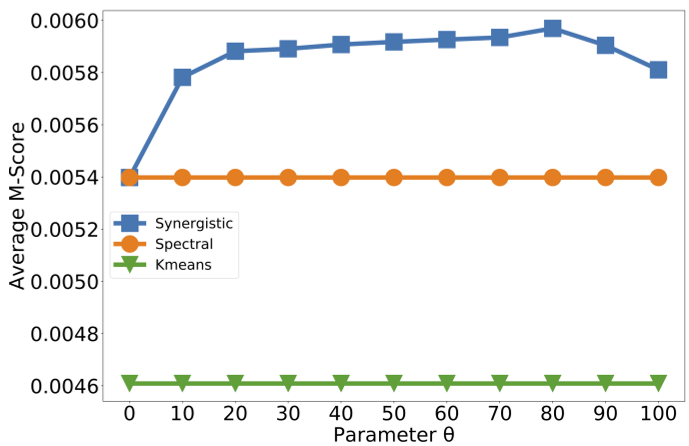
SHNA proves a counter-intuitive point in machine learning: sometimes, looking at less data makes the model smarter. By restricting the alignment search to small, synergistically chosen sub-networks, the model suffers from less "distraction" from negative samples, leading to a higher Recall and Precision.
Limitations: The method relies on "seeds" (partially known anchor links) to guide the synergistic partitioning. In a completely zero-shot scenario where no anchor links are known, the synergistic component would fail, reverting back to independent spectral clustering.
Future Work: Adapting this hierarchical "Partition-then-Align" strategy to larger-scale multi-modal graphs (e.g., aligning social media with academic citation graphs) could be a massive win for the industry.