
CMIA: Scaling Influence Blocking to Guard Massive Social Networks Against Misinformation
Scalable influence blocking maximization in social networks under competitive independent cascade models
This paper introduces CMIA-H and CMIA-O, two scalable heuristic algorithms designed to solve the Influence Blocking Maximization (IBM) problem in social networks. Leveraging Maximum Influence Arborescence (MIA) structures, the methods efficiently counter misinformation propagation under two competitive independent cascade models (MCICM and COICM).
TL;DR
In the era of viral rumors, the "Influence Blocking Maximization" (IBM) problem has become a critical security frontier. This paper presents CMIA-H and CMIA-O, two revolutionary heuristics that replace slow Monte-Carlo simulations with efficient tree-based local structures. The result? A matching success rate in rumor blocking but with a 1,000,000x speedup on large datasets.
Problem & Motivation: The High Cost of Greed
Online Social Networks (OSNs) are double-edged swords. While they facilitate rapid information sharing, they are also prone to the "negative influence" of rumors and misinformation. To combat this, researchers aim to select a small set of "seed" users to spread "good" information (corrections or authoritative announcements) to block the bad.
Prior work relied on Greedy Algorithms. While theoretically sound with a approximation guarantee, they are essentially unusable for real-world applications. Why? Because to calculate the "marginal gain" of each node, you must run tens of thousands of Monte-Carlo simulations. On a network like DBLP, this could take days for a single decision.
Methodology: The Power of Local Arborescence
The authors' core insight is that influence doesn't propagate uniformly; it follows high-probability paths that can be modeled as Maximum Influence Arborescences (MIA).
1. CMIA-H: Exploiting High-Effectiveness
In many scenarios (like official government refutations), "good" information is more trustworthy and propagates more effectively than rumors. The authors model this as MCICM with high-effectiveness property.
- The Logic: If the good information reaches a node faster (fewer hops) than the rumor, it blocks the rumor entirely.
- The Structure: CMIA-H uses a shortest-path logic within the MIA to calculate "Negative Influence Set" (PIIS) to determine which nodes can be protected.
2. CMIA-O: Dynamic Competition
What if the "good" and "bad" information are equally viral (e.g., competing product campaigns)? This is modeled under COICM (Campaign-Oblivious ICM).
- The Logic: Since we can't rely on a simple "shortest path" shortcut, the authors designed a Dynamic Programming method to calculate the probability of a node being negatively activated at any time step .
 Figure 1: Comparison of structural logic between traditional IM and the proposed IBM heuristics.
Experimental Breakthroughs
The performance metrics were gathered across four real-world datasets, ranging from the small EMAIL network to the massive DBLP dataset.
- Consistency: Across all tests (Trivalency and Weighted Cascade models), CMIA matched the blocking effectiveness of the Greedy benchmark.
- Efficiency: On the EMAIL network, while Greedy-O took over 6 hours to finish, CMIA-O completed the task in less than 1 second.
- Scalability: The algorithms show a sublinear relationship with network size because they focus on the "local range" of influence rather than the global graph.
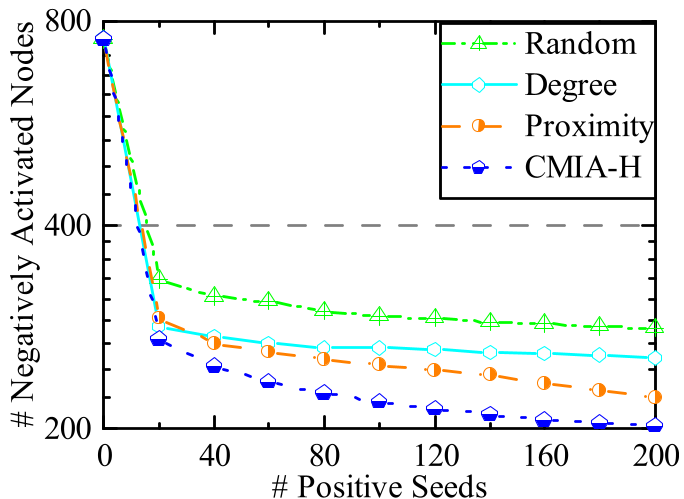 Figure 2: Scalability tests showing the massive gap in execution time between greedy and CMIA methods.
Critical Insight & Conclusion
This paper successfully bridges the gap between academic theory and industry application. By shifting from global simulation to local approximation, the authors prove that we don't need to simulate the entire universe of a social network to stop a localized rumor.
Limitations: While the matching performance is impressive, the heuristics lack a formal theoretical approximation guarantee unlike the greedy method. Future work might involve combining these fast heuristics with "proxy" guarantees to provide both speed and peace of mind for security auditors.
Final Takeaway: For anyone building real-time social monitoring tools, CMIA provides the necessary efficiency to deploy "correction campaigns" the moment a rumor is detected, rather than hours later when the damage is already done.