
Beyond Hubs: Exploiting Community Cores for Scalable Influence Maximization
Scalable Influence Maximization in Social Networks Using the Community Discovery Algorithm
This paper introduces an improved K-means community discovery algorithm for Influence Maximization (IM) in social networks. By identifying "core members" or opinion leaders within communities rather than treating all nodes equally, the method efficiently selects a seed set that maximizes information spread across the network.
TL;DR
The paper "Scalable Influence Maximization in Social Networks using the Community Discovery Algorithm" challenges the "one-size-fits-all" approach to social influence. By leveraging an improved K-means clustering algorithm and a custom Vertex Association Matrix, the authors identify "opinion leaders" within naturally occurring communities. This approach avoids the high computational cost of traditional greedy algorithms while providing a scientifically grounded method to determine the optimal number of seed nodes.
The Motivation: Why Degree Centrality Isn't Enough
In the realm of viral marketing, we've long relied on the Independent Cascade (IC) and Linear Threshold (LT) models. However, these models often treat every node in a network as having equal potential influence if their local connections are similar.
The authors argue that this is a fundamental misunderstanding of social dynamics. In any group, there are core members—opinion leaders whose word carries significantly more weight than their peers. Existing greedy algorithms attempt to find these people by simulating thousands of cascades, which is a scalability nightmare. The research intuition here is simple: Find the communities first, then pinpoint the hearts of those communities.
Methodology: Mapping the Network's Pulse
The authors introduce a structured workflow to transform a raw graph into a set of highly influential seeds.
1. The Vertex Association Matrix
To understand how nodes relate, the authors define the Efficiency of Information Dissemination (EID): Where is the shortest path. This forms the basis of a Vertex Association Matrix, which uses edge centrality and path efficiency to quantify how "similar" or "connected" two individuals truly are in terms of influence potential.
2. Improved K-means & Modularity
Traditional K-means requires you to know (the number of clusters) beforehand. In a social network, you rarely know how many communities exist. The authors solve this by using Modularity (Q) as a stopping criterion.
- If adding a node to a cluster increases , the move is accepted.
- When reaches its peak, the algorithm has found the "natural" number of communities.
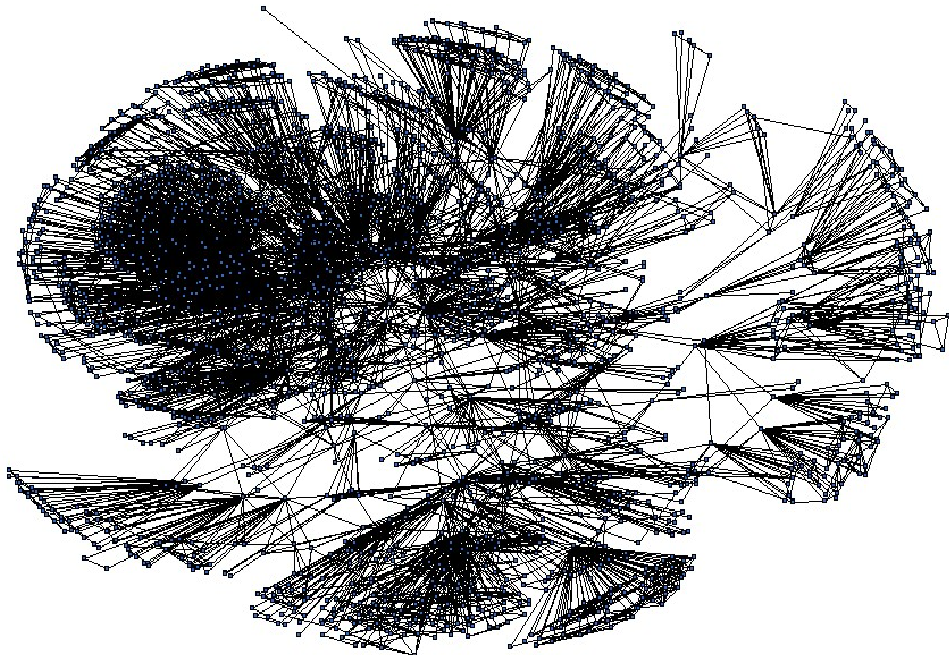 Figure 1: The DBLP dataset visualized as a complex web of author collaborations.
Experiments: Identifying the Core
The authors used the DBLP dataset, a real-world bibliography of computer science authors. By applying their algorithm, they monitored the Modularity curve to find the "sweet spot" of community division.
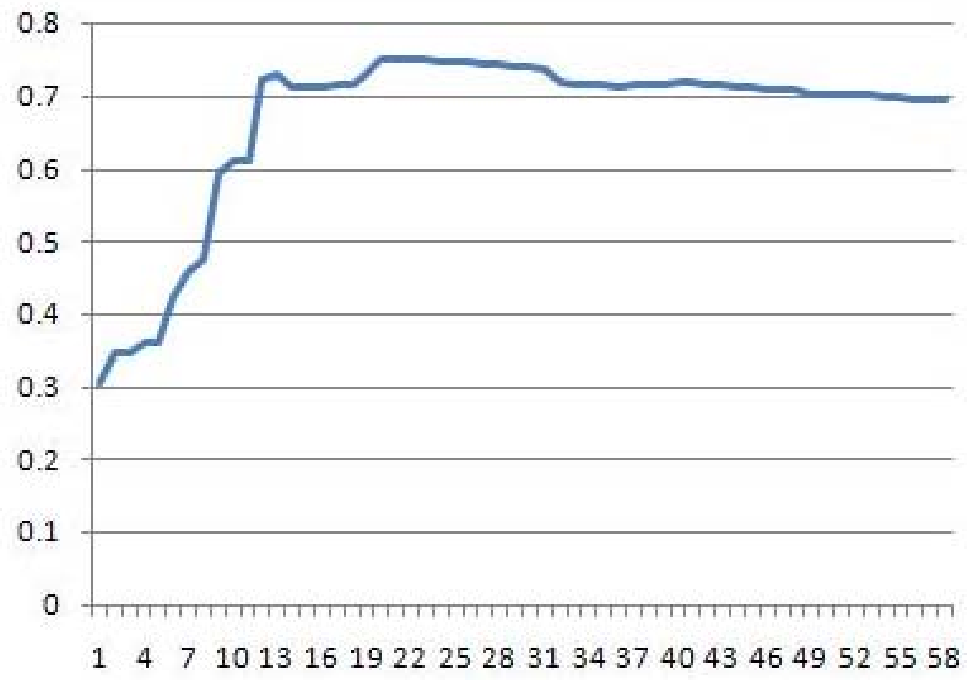 Figure 2: The Modularity (Q) peaks at k=13, indicating the natural community structure of the dataset.
By selecting the core members of these 13 communities, the authors demonstrated that they could achieve a broad spread of influence across the entire 1,814-node network without the massive computational waste of searching the entire graph.
Critical Analysis & Conclusion
The value of this work lies in its scalability. By shifting the problem from "Global Optimization" (which is NP-hard) to "Local Community Identification," it makes Influence Maximization feasible for large-scale production environments.
Key Takeaways:
- Structural Core > High Degree: Being "central" to a community is more influential for information spread than simply having many random connections.
- Dynamic K: Using Modularity to determine the number of seeds () takes the guesswork out of viral marketing budgets.
Limitations:
The paper primarily focuses on static snapshots of networks (DBLP). In the modern era of real-time social media (X, TikTok), influence is temporal. Future work would need to incorporate how these "core members" change over time as topics trend and fade.
Ultimately, this research provides a vital bridge between social science intuition and graph theory, offering a mathematical framework for identifying the true "opinion leaders" in any given network.