
Scalable Adaptive Seeding: Turning the Friendship Paradox into an Influence Engine
Scalable Methods for Adaptively Seeding a Social Network
This paper introduces scalable algorithms for "adaptive seeding" in social networks—a two-stage influence maximization strategy. By targeting neighbors of accessible users rather than the users themselves, the method achieves an optimal (1 - 1/e) approximation ratio for linear influence models.
TL;DR
When your target audience consists of "average joes" with little reach, don't seed them—seed their friends. This paper presents a scalable way to implement Adaptive Seeding, a two-stage strategy that leverages the Friendship Paradox to maximize influence. Using a greedy submodular optimization approach, the authors achieve a theoretical optimal (1 - 1/e) approximation and show massive gains over traditional methods on real-world Facebook data.
The Problem: The "Core Set" Trap
In a perfect world, an advertiser could pick any user on Facebook to start a viral trend. In reality, you are often limited to a Core Set: the people who already like your page or use your app.
The mathematical tragedy of social networks is their heavy-tailed degree distribution. High-degree "influencers" are rare. If you only pick from your existing followers, you are likely picking from the bottom of the influence ladder. Standard Influence Maximization (IM) applied to this restricted set produces mediocre results because these users simply don't have the reach to trigger a massive cascade.
The Insight: The Friendship Paradox
The authors solve this by banking on a sociological phenomenon: Your friends, on average, have more friends than you do.
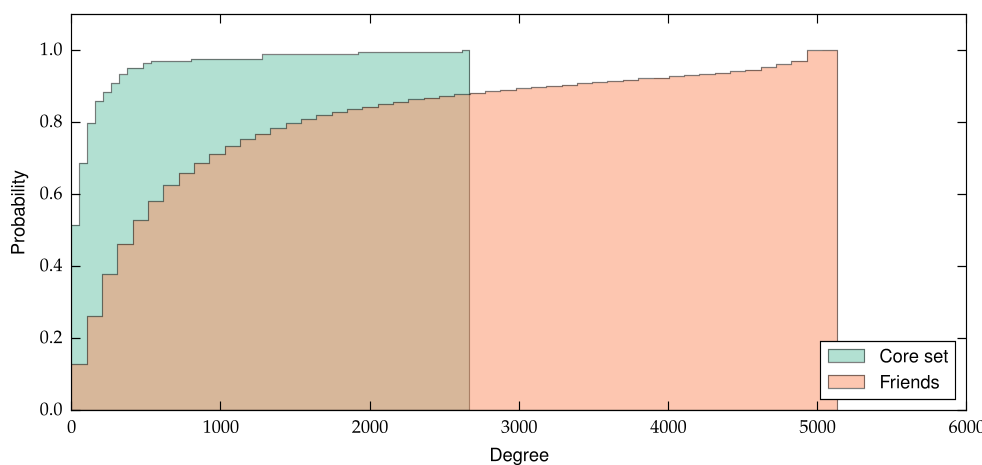 Figure 1: CDF showing that friends of users who liked an organization's post (Kiva) have significantly higher degrees than the users themselves.
By using a portion of the budget to incentivize "Core Set" users to invite their friends, the campaigner gains access to a much more influential pool of potential seeds.
Methodology: From Complexity to Scalability
The optimization challenge is daunting: you must decide which core users to seed now to maximize the expected influence of the neighbors you can seed later. This is inherently an adaptive, two-stage stochastic problem.
1. Mathematical Relaxation
The authors prove a critical Proposition: A "non-adaptive" policy (where you decide probabilities of seeding neighbors ahead of time) can approximate the optimal adaptive solution. This reduces the problem to: subject to budget constraints.
2. The Algorithms
Selection was performed through two primary lenses:
- Pipage Rounding: A framework that relaxes binary choices to fractional ones, then rounds them back, ideal for large budget instances.
- Greedy + Fractional Knapsack: For a fixed set of core users, selecting which neighbors to seed becomes a Fractional Knapsack Problem. The authors show the overall objective is a monotone submodular function, allowing them to use a greedy selection process that is easily parallelizable via MapReduce.
Experimental Results: Dramatic Gains
The researchers tested their methods on Facebook Page data, focusing on "verticals" (specific interest groups). They compared Adaptive Seeding against standard IM.
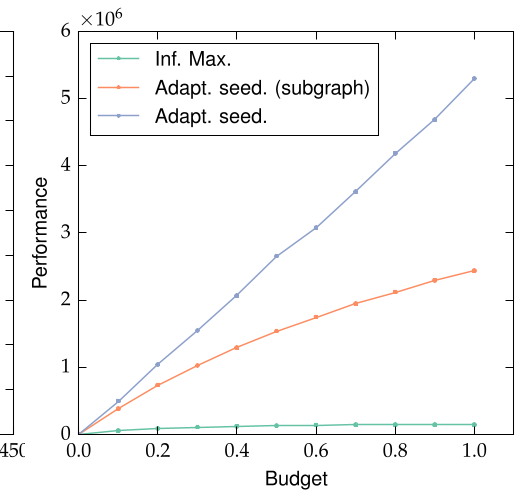 Figure 2: Performance of the adaptive approach vs. standard IM. The gap represents the "Friendship Paradox" dividend.
Key Findings:
- Scalability: The algorithms handled networks of 100,000+ nodes with ease.
- Effectiveness: Even when the probability of a neighbor "realizing" (joining the campaign) is low, adaptive seeding still outperforms standard seeding by reaching higher-quality nodes.
- Robustness: The method works even in "cold start" scenarios where the initial core set has very low inherent influence.
Critical Analysis & Conclusion
This work shifts the focus of Influence Maximization from "who to pick" to "how to navigate." By providing the first scalable, (1 - 1/e)-approximate algorithms for adaptive seeding, Horel and Singer bridge the gap between theoretical sociology and practical data mining.
Limitations: The current framework assumes linear influence models (like the Voter model), which are simpler than the Independent Cascade models often used in industry. Future work will need to address whether these specific approximation guarantees hold under more complex, non-linear diffusion dynamics.
The Takeaway for Product Leaders: Stop looking for influencers within your current user base. Instead, design features that encourage your current users to "open the door" to their more influential friends.