
Scalable Adaptive Seeding: Turning the Friendship Paradox into a Marketing Weapon
Scalable Methods for Adaptively Seeding a Social Network
The paper introduces scalable algorithms for "Adaptive Seeding," an Influence Maximization strategy that targets neighbors of core users to leverage the "Friendship Paradox." It proposes two main algorithms—one based on Pipage Rounding and another on Greedy Submodular Maximization—achieving an optimal (1 - 1/e) approximation ratio for linear influence models.
TL;DR
Influence Maximization (IM) often hits a wall because the people you can reach aren't the people you need to reach. This paper introduces a scalable framework for Adaptive Seeding, which uses a two-stage process to recruit neighbors of your core audience. By exploiting the mathematical certainty that "your friends have more friends than you," the authors achieve an optimal (1 - 1/e) approximation and show massive performance gains in real Facebook datasets.
The Problem: The High-Degree Node Scarcity
In a perfect world, a marketer would seed a product with the most influential people on Earth. In reality, you are usually restricted to a "core set"—people who already liked your page or interacted with a specific post.
The structural problem? Social networks are heavy-tailed. High-degree (highly influential) nodes are extremely rare. If you only pick from the people you can see, you are likely picking "average" users with low reach.
The Insight: The Friendship Paradox
The authors leverage a sociological phenomenon called the Friendship Paradox: on average, your friends have more friends than you do.
Instead of asking "Who is influential in my core set?", the methodology asks: "Which average person in my core set is most likely to know a superstar?"
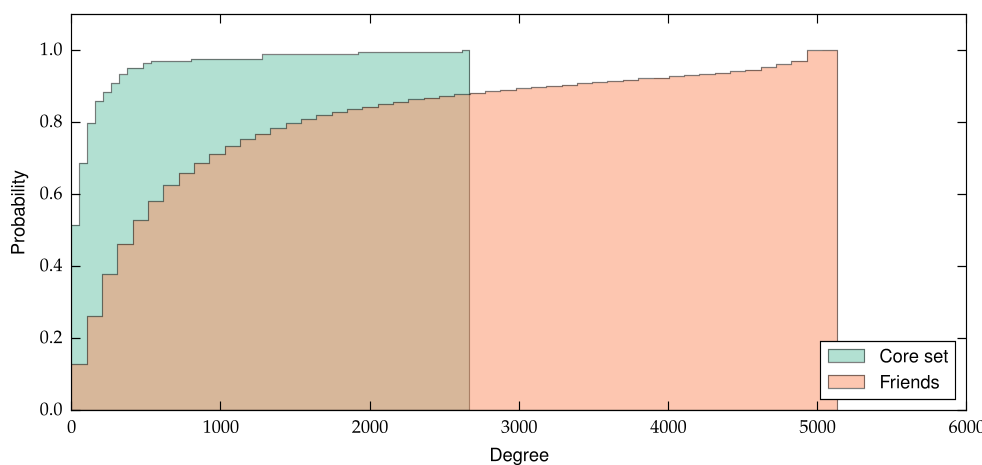 Figure 1: CDF showing the degree distribution. Note how the friends of users who "liked" a post (dashed line) consistently have higher degrees than the users themselves (solid line).
Methodology: How to Scale Strategy
The paper tackles the computational nightmare of two-stage optimization. In stage one, you spend part of your budget seeding core users to "invite" their friends. In stage two, you seed the most influential acquaintances who showed up.
1. Non-adaptive Relaxation
The authors prove a key proposition: a non-adaptive policy (where you select seeds and a recovery probability offline) can approximate the optimal adaptive policy. This simplifies the math significantly.
2. The Algorithms
- Pipage Rounding: Relaxes the discrete choice of nodes into a continuous space, solves it, and rounds it back. This is highly efficient for large budgets.
- Greedy Submodular Approach: Since the objective function is monotone submodular, a greedy algorithm—picking the best "recruiter" one by one—guarantees a (1 - 1/e) optimal solution. This version is MapReduce-friendly and scales to millions of edges.
Experimental Results
The authors tested this on real-world Facebook "Verticals" (commercial pages). They focused on nodes that "Liked" specific posts and then mapped their entire neighborhood (approx. 100,000 nodes).
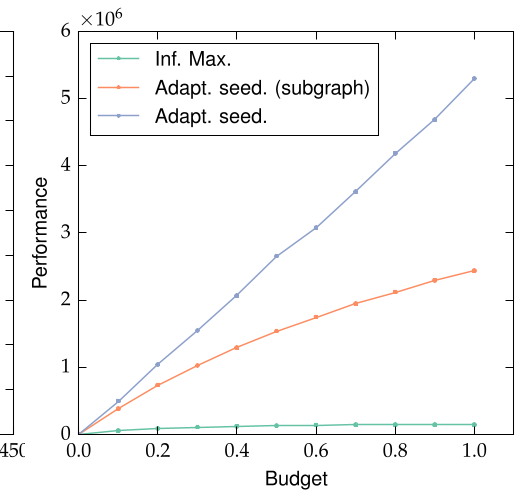 Figure 2: Performance comparison. Adaptive seeding (top curves) significantly outperforms standard Influence Maximization applied only to the core set.
Key Findings:
- Superior Reach: Adaptive Seeding consistently reaches more nodes than standard IM because it "jumps" from the restricted core set into the high-influence regions of the graph.
- Robustness: The method works even when the probability of a friend "realizing" (joining the campaign) is relatively low.
Critical Insight & Conclusion
This paper is a masterclass in turning a sociological "quirk" into a rigorous algorithmic framework. While the model focuses on Linear Influence (like the Voter Model), its implications for digital marketing are profound.
Limitations: The paper assumes we know the probability (how likely a friend is to join). In the real world, estimating these invitation success rates remains a challenge for data scientists.
Takeaway: Stop looking for the "cool kids." Look for the people who know the cool kids. Mathematically, it's a much more scalable way to go viral.