
Sifter: Scaling Online Spam Detection through Topic-Based Decentralization and RNNs
Harnessing the Nature of Spam in Scalable Online Social Spam Detection
This paper introduces Sifter, a scalable online social spam detection system that combines a decentralized DHT-based architecture with Recurrent Neural Networks (RNNs). By clustering social data into topic-specific groups and utilizing LSTM units for sequence modeling, Sifter achieves high-accuracy spam filtering without manual feature engineering.
TL;DR
Sifter is a novel online spam detection system that moves away from labor-intensive, static feature engineering. By leveraging a decentralized DHT-based architecture to group posts by topic and employing LSTM-based Recurrent Neural Networks for temporal analysis, Sifter provides a scalable and adaptive solution to the "drifting" nature of modern social media spam.
Background & Motivation: The Failure of Static Defense
Social media spam is no longer just "junk mail"; it is an evolving threat tied to real-time global events. Traditional detectors often fail because:
- Static Feature Sets: Features trained on old datasets (like N-grams or user credibility) do not transfer well to new platforms or emerging slang.
- Concept Drift: Spammers pivot their tactics based on trending news (e.g., the Boston explosion), causing offline models to become obsolete instantly.
- Processing Latency: Feature engineering takes time—often days—while spam causes damage in minutes.
Methodology: The Sifter Architecture
Sifter solves the scalability and adaptability issues through a three-component architecture:
1. Decentralized Group Management (DHT-based)
Sifter uses a Distributed Hash Table (DHT) overlay to organize nodes. Each social media topic is represented by a groupId. Nodes join specific groups based on the topics they are currently monitoring. This allows the system to focus its computational power where the spam behavior is most concentrated.
2. The Spam Detection Unit (SDU)
At the leaf nodes, Sifter implements Long Short-Term Memory (LSTM) networks.
- Why RNN/LSTM? Social data is inherently sequential. LSTM can "remember" context from previous posts in a stream, which is vital for identifying coordinated group behavior.
- Automatic Feature Extraction: By using
tf * idfvalues as raw inputs to the LSTM, Sifter eliminates the need for manual feature selection.
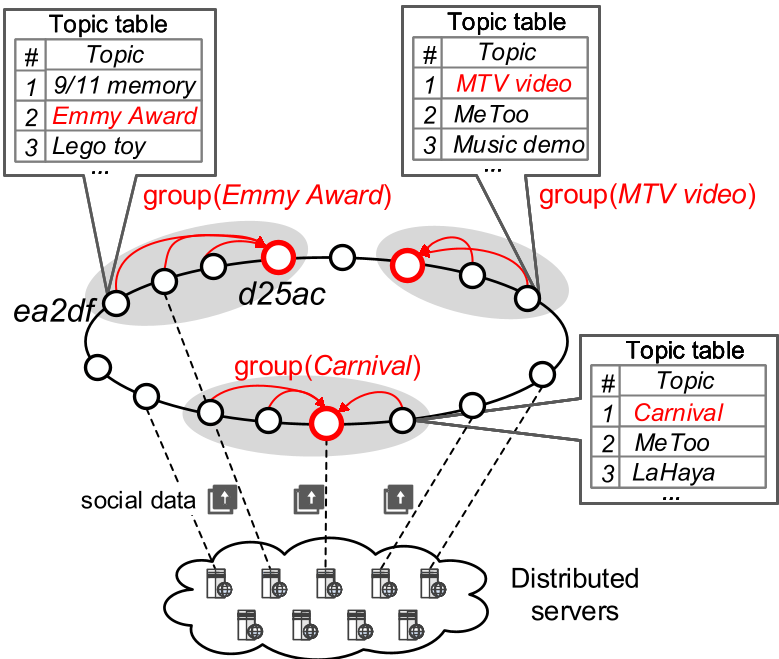 Figure 1: Topic-based group management routing via DHT.
Experimental Insights
The system was tested using a Linux-based testbed of 800 agents processing 1GB of Twitter data.
Performance vs. Time Granularity
As the temporal granularity increases (from 10 to 30 minutes), the system's ability to "catch" the context improves. The F1-score peaked at 89.6%, suggesting that a slightly larger window of sequence data significantly benefits the LSTM's predictive power.
Scalability and Efficiency
One of the most impressive results is the Results Aggregation Time. Because Sifter uses a functional tree structure, the time required to aggregate spam alerts increases linearly with the number of nodes (O(logN)), rather than exponentially. This proves Sifter can handle the massive throughput of modern social networks.
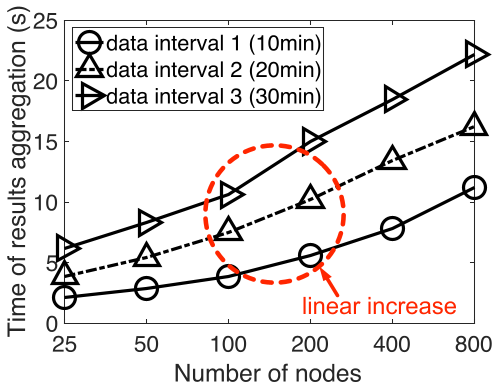 Figure 2: (a) Aggregation latency versus node count; (b) Accuracy growth with training data size.
Critical Analysis & Conclusion
Why it Works
Sifter’s brilliance lies in its Inductive Bias: it assumes spam is a group activity focused on specific events. By partitioning the problem by topic (Decentralization) and time (RNN), it mirrors the way spammers actually operate.
Limitations
- Model Consistency: While the root node synchronizes weights, the overhead of maintaining model consistency across a highly dynamic DHT overlay in a real-world, high-churn environment remains a challenge.
- Adversarial Noise: If spammers learn the topic-clustering mechanism, they may attempt to inject "noise" posts to dilute the
tf * idfimportance.
Final Takeaway
Sifter represents a pivot toward Autonomous Moderation. It proves that by combining decentralized system design with deep learning, we can create defenses that are as agile and scalable as the botnets they aim to defeat.