
Scaling Recommender Systems: A Graph Partitioning Approach for Social Networks
A scalable solution for personalized recommendations in large-scale social networks
This paper introduces a scalable framework for personalized recommendations in large-scale social networks by partitioning the social graph into manageable subgraphs before applying Collaborative Filtering (CF). Using tools like METIS and LensKit on the Epinions and Flixster datasets, the approach achieves significant speedups while maintaining high recommendation quality through parallel execution.
TL;DR
Scaling personalized recommendations to millions of users is often hindered by the quadratic complexity of traditional algorithms. This paper proposes a scalable architecture that leverages Social Graph Partitioning to break down massive datasets into independent subgraphs. By applying Collaborative Filtering (CF) locally within these clusters, the system achieves massive speedups and addresses the Cold-Start problem without sacrificing the precision of SVD or Item-Item models.
The Scalability Wall in Recommender Systems
As Web 2.0 evolved, the data available for recommendations became two-dimensional: Explicit Ratings (what you like) and Social Interactions (who you trust). While this dual information should theoretically improve accuracy, it creates a massive "scalability wall." Traditional CF methods like User-User similarity calculation become exponentially more expensive as the user base grows.
The authors realized that users primarily interact with a small portion of the global network. Why process the entire global graph if a user's preferences are likely influenced by their immediate social neighborhood?
Methodology: Divide and Conquer
The core innovation lies in the two-step partitioning process that aligns social cliques with rating behavior.
1. Social and Bipartite Graph Alignment
The authors define the problem using two types of graphs:
- : An undirected graph representing user friendships or trust.
- : A weighted directed graph representing user-to-item ratings.
2. The Partitioning Algorithm
Using the METIS framework, the social graph is divided into subgraphs. The crucial step is the Rating Partitioning, where each item rating is assigned to the subgraph of the user who provided it.
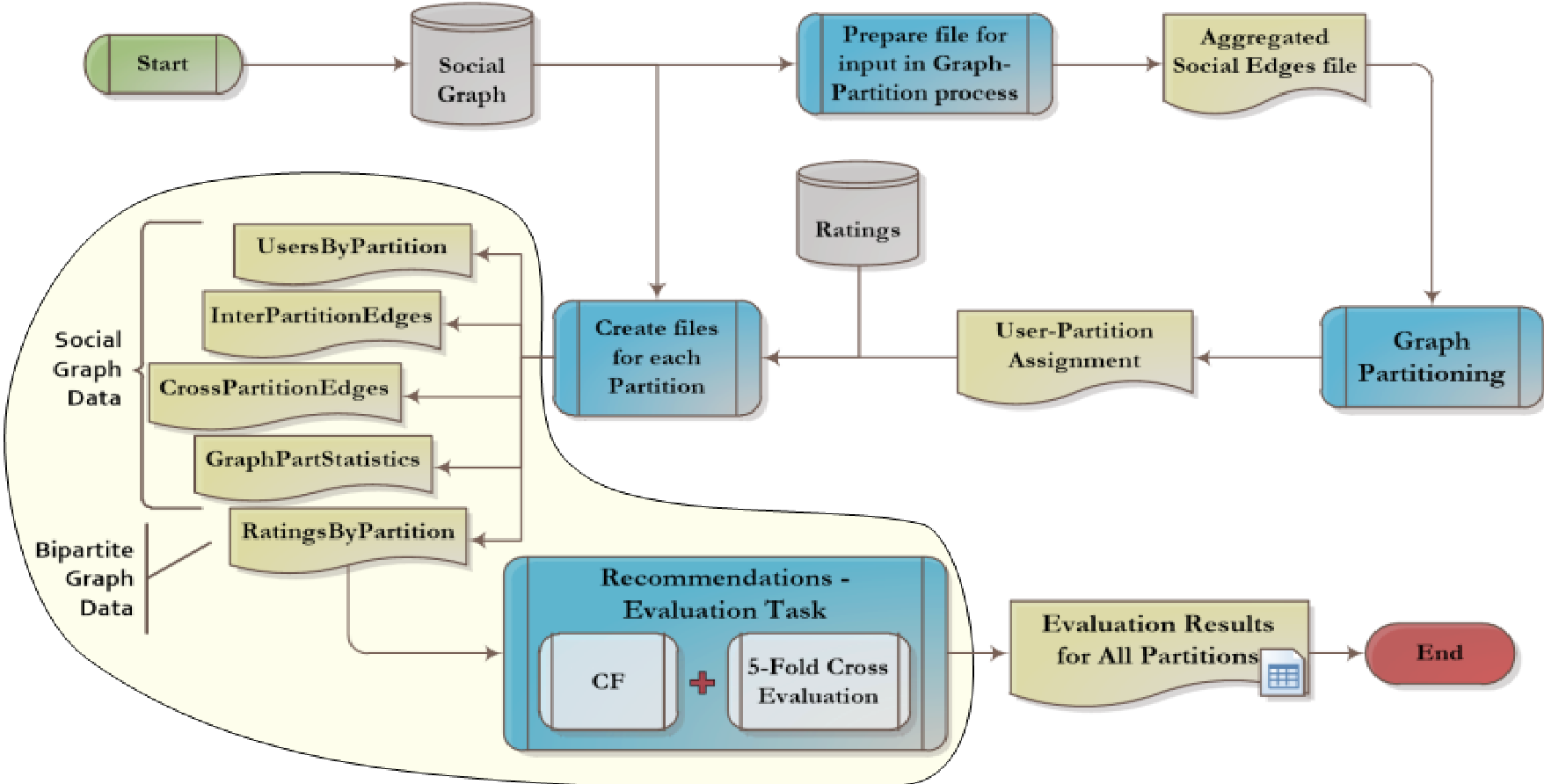
This allows for parallel execution: each partition can be processed by a separate compute node, transforming a monolithic bottleneck into a distributed workload.
Experimental Results: Performance vs. Accuracy
The researchers tested their model on two heavy-weight datasets: Epinions and Flixster.
Execution Time Breakthrough
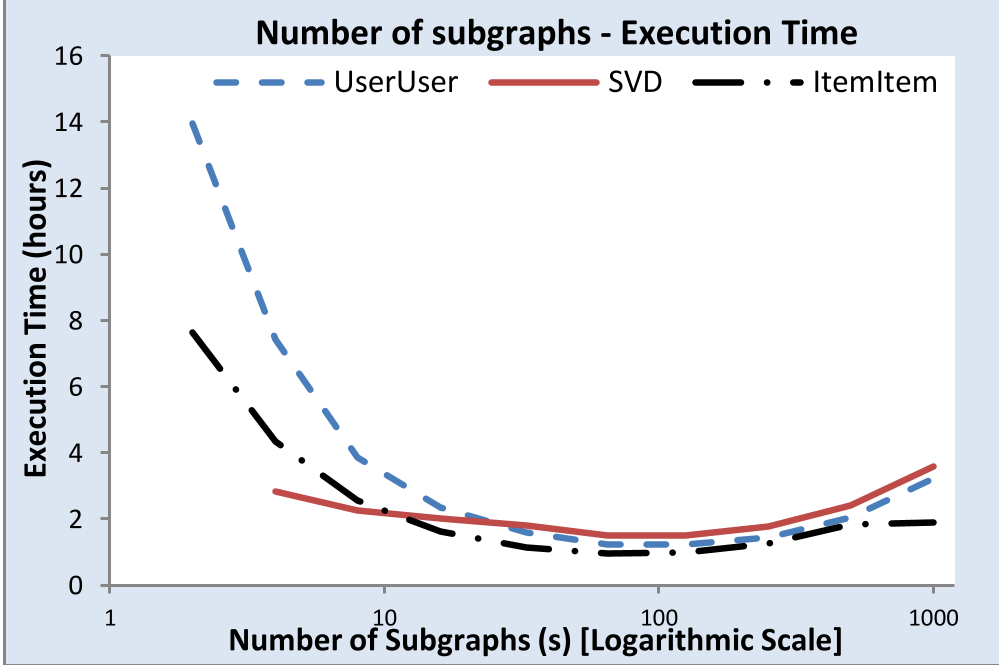
The experiments showed that execution time drops dramatically as the number of partitions increases. For the Epinions dataset, the optimal balance was found around 65 partitions. Beyond a certain point (e.g., 1000 partitions), the overhead of managing too many small subgraphs begins to outweigh the benefits, though Item-Item CF remains remarkably stable.
Accuracy Retention
A common fear with data partitioning is "information loss"—missing a potential neighbor because they were placed in a different cluster. However, the study found that SVD (Singular Value Decomposition) and Item-Item CF were robust against this.
As shown in the figure above, SVD maintains a Top-N nDCG near 1.0 regardless of the number of subgraphs. This suggests that the Latent Space captured by SVD is sufficiently preserved within the socially-linked clusters.
Handling the Cold-Start Problem
One of the most impressive "side effects" of this social-first partitioning is its ability to handle Cold-Start users. Since the partitions are created based on social links, a new user who hasn't rated any items yet is still placed in a cluster of similar peers (socially). The system can then recommend items popular within that specific social subgraph, providing a "warm start" where traditional CF would fail.
Critical Analysis & Conclusion
The paper provides a strong case for Geographic/Social Locality in data processing. By acknowledging that a social network is not a "hairball" but a collection of communities, we can optimize algorithm performance via partitioning.
Limitations:
- User-User Sensitivity: The User-User algorithm performed poorly in highly fragmented subgraphs. This is because it relies on finding specific overlapping neighbors, which becomes statistically harder as you slice the data thinner.
- Cross-Cluster Edges: The current model effectively ignores edges that cross between partitions. Future work investigating "Bridge Users" (those who connect different communities) could further refine the accuracy.
Takeaway: If you are building a recommendation engine for a large-scale social platform, don't try to compute the global matrix. Partition your users by their social "neighborhoods" first; your SVD will likely be just as accurate, and your servers will thank you.