
GeoSocial-GraphX: Bridging the Gap Between Graphs and Space in LBSN
Scalable Processing of Location-Based Social Networking Queries
This paper introduces GeoSocial-GraphX (GSG), a scalable platform built on Apache Spark/GraphX for processing Location-Based Social Network (LBSN) queries. By segregating LBSN data into distinct social, activity, and spatial graphs, the framework achieves SOTA performance, outperforming SpatialHadoop by up to 20x in query efficiency.
TL;DR
The explosion of Location-Based Social Network (LBSN) data (think Foursquare check-ins or geo-tagged Tweets) poses a massive technical challenge: how do you efficiently query data that is both a graph (social connections) and spatial (GPS coordinates)? This paper presents GeoSocial-GraphX (GSG), an Apache Spark-based platform that segregates LBSN data into three optimized graphs and uses a materialized "Spatial Graph" to boost query performance by up to 10,000x compared to traditional approaches.
Problem & Motivation: The "Dual Nature" Dilemma
LBSN data is inherently complex because it joins two worlds:
- The Social World: Recursive relationships (friend-of-a-friend) best handled by graph-parallel frameworks.
- The Physical World: Consecutive, coordinate-based data best handled by spatial indices (R-trees, Quadtrees).
Prior works like SpatialHadoop are excellent for spatial range queries but choke on iterative social traversals. Conversely, standard GraphX or Giraph lack the spatial partitioning necessary to avoid scanning the entire dataset for location-centric results. The authors identified that location-location relationships (e.g., "Which places are visited by the same crowd?") are particularly expensive to compute on-the-fly.
Methodology: The Power of Segregation
The core insight of GSG is the segregation and materialization of relationships. Instead of one giant, messy table, GSG splits the data into:
- Social Graph (): User-to-User connections.
- Activity Graph (): User-to-Location bipartite visits.
- Spatial Graph (): Location-to-Location links (linked via common visitors).
Architecture Overview
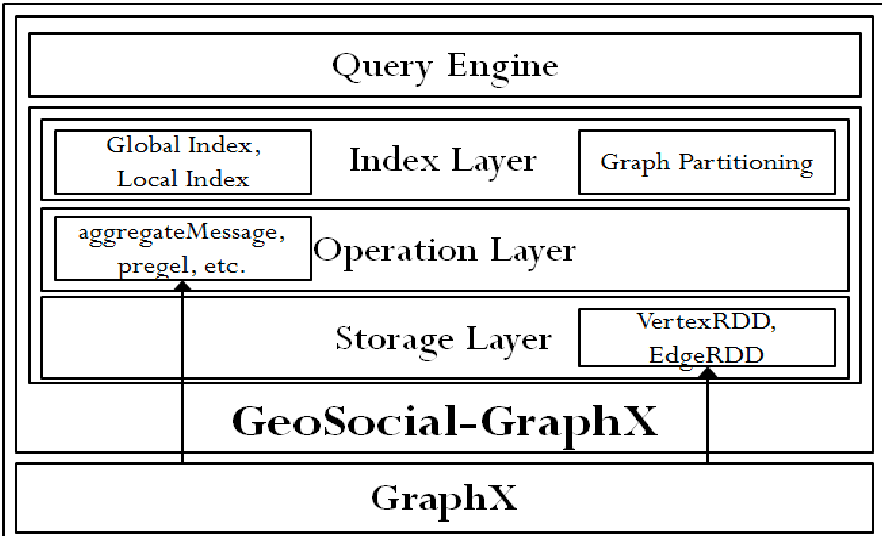
GSG utilizes a four-tier architecture:
- Storage Layer: Uses Spark's RDDs (VertexRDD/EdgeRDD) with vertex-cut partitioning to minimize communication.
- Operation Layer: Leveraging vertex-centric operators like
aggregateMessageandPregelfor efficient local communication. - Index Layer: A two-tier strategy using k-d trees for global partitioning (to keep nearby data on the same node) and Quadtrees/Octrees for local retrieval.
- Query Engine: A programmable API that allows combining "Query Primitives" (Selection, Structural, Aggregate) into complex queries like RangeFriends (Finding friends within 5km of a specific cafe).
Why the Spatial Graph is a Game Changer
The most striking innovation is the materialized Spatial Graph (). Usually, finding locations with common visitors requires joining a massive activity table with itself. GSG pre-computes this. While the construction cost is higher, the query speed-up is staggering.
For a single query like "Find Linked Locations," the Spatial Graph is 13,000x faster than traversing the Activity Graph. This "Materialize Once, Query Often" strategy is the backbone of GSG's efficiency.
Experiments & Results: Sashing the Baselines
The authors compared GSG against SpatialHadoop (SH) across several real-world datasets:
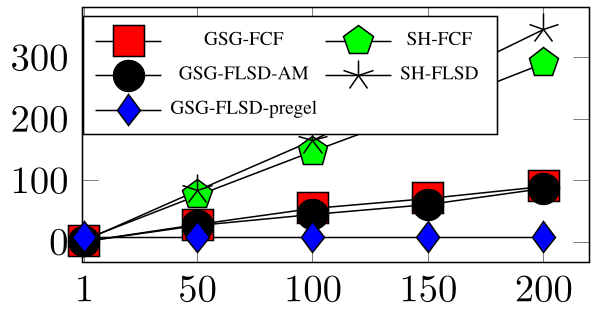
- Efficiency: GSG outperformed SH by up to 20x in spatial range queries () and 2.5x to 4x in social traversals ().
- Scalability: GSG showed near-linear scalability. As the number of cores increased from 1 to 16, the system achieved a speed-up of up to 9.8x.
- Developer Productivity: In a metric often overlooked in academic papers, GSG required 4-13x fewer lines of code (LoC) to implement the same queries as SH, thanks to its high-level API.
Critical Analysis & Conclusion
Takeaway
GSG proves that for hybrid data types (Graph + Spatial), structural segregation is superior to a unified schema. By using Spark's in-memory computation and adding specialized spatial indexes, they bridged the gap between graph analytics and GIS.
Limitations
- Static Nature: The current paper focuses on static snapshots. In real-world LBSNs, check-ins happen in real-time. Integrating streaming updates (as mentioned in future work) is critical for actual production use.
- Materialization Cost: The construction of the Spatial Graph () is computationally expensive. For datasets with massive churn, the cost of re-materializing might outweigh the query benefits.
Future Outlook
As we move toward "Smart Cities" and the "Metaverse," the ability to query complex social-spatial relationships at scale will be the differentiator. GeoSocial-GraphX provides the blueprint for how distributed systems should evolve to handle multi-modal relationships.