
RSD: Identifying Rumor Sources via Structural Network Monitors
Scalable Rumor Source Detection under Independent Cascade Model in Online Social Networks
This paper introduces the RSD (Rumor Source Detection) algorithm, a scalable approach to identify rumor origins in individuals' social networks under the Independent Cascade (IC) model. By deploying monitor nodes that report information reception without requiring textual content, the method uses a "rumor quantifier" score to rank potential sources with high precision in polynomial time.
TL;DR
The spread of misinformation on platforms like Twitter often happens faster than manual fact-checking can keep up with. This paper presents RSD (Rumor Source Detection), an algorithm that identifies the "Patient Zero" of a rumor using only the network's structural topology. By observing which strategic "monitor" nodes have received a piece of information, RSD can pinpoint the source with up to 87% accuracy—even when the actual content of the rumor is unknown or unavailable.
Background & Motivation
In the era of viral misinformation, identifying the source is a race against time. While most researchers focus on what is being said (Sentiment analysis, NLP, Keyword matching), this paper asks a more fundamental question: Can we find the source based only on who heard it?
Current methods face three major hurdles:
- Textual Limitations: Rumors often use evolving slang or emojis that bypass keyword filters.
- Scale: Social networks like Twitter have millions of nodes, making complex simulations computationally prohibitive.
- Dynamic Diffusion: Information doesn't spread linearly; it follows probabilistic paths where each "retweet" is an independent trial.
The authors adopt the Independent Cascade (IC) Model, treating information spread like a forest fire jumping between trees with specific probabilities ().
Methodology: The Rumor Quantifier
The heart of this research is the Rumor Quantifier . The intuition is elegant: if node is the source, it should have a high probability of reaching people who heard the rumor (Positive Monitors) and a low probability of reaching those who didn't (Negative Monitors).
1. Maximum Influence Path (MIP)
Instead of calculating every possible path (which is NP-hard), the authors define the Maximum Influence Path. By transforming edge probabilities using , the problem of finding the most likely path becomes a simple Shortest Path problem.
2. The Algorithm Workflow
- Monitor Deployment: Inject monitors (nodes that report their "infected" status).
- Tree Identification: For every potential source , generate a Maximum Propagation Tree (MPT) that connects to all positive monitors.
- Probability Ranking: Use the formula to calculate the quantifier score.
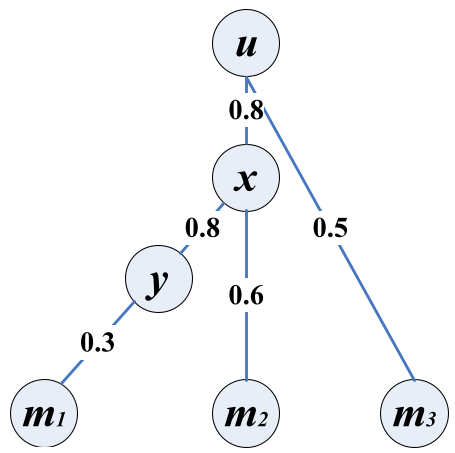 Figure 1: An example of a propagation tree from root node to monitor set .
Experimental Insights: Does it Work?
The authors tested RSD on a real-world Twitter subgraph (38k nodes, 1.3M edges). They compared three monitor deployment strategies: Random, Incoming Degree (ID), and Betweenness Centrality (BC).
Key Findings:
- The "Hop" Accuracy: Even in cases where the algorithm didn't get the exact source, the "top suspect" was almost always within 3 hops of the actual source.
- The Strategy Shift: For small budgets (e.g., 50 monitors), targeting "Influencers" (High Incoming Degree) is best. However, as your monitor budget grows, Random placement actually becomes superior because it covers the "boundary" of the network more effectively.
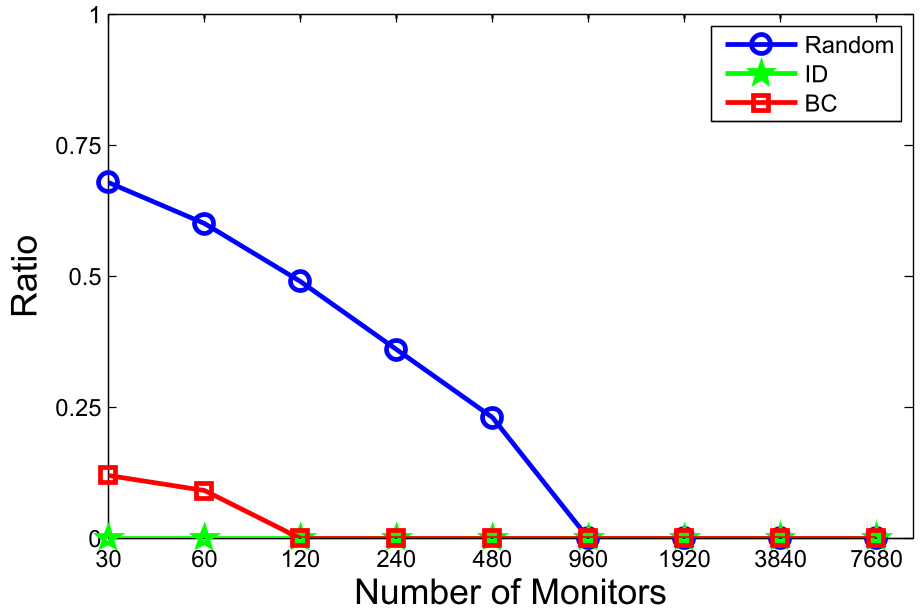 Figure 2: Rank of the actual source in the output. As monitors increase, the rank approaches 1 (Perfect Detection).
Critical Analysis & Professional Perspective
The brilliance of RSD lies in its scalability. By reducing the likelihood calculation to a shortest-path problem on a DAG (Directed Acyclic Graph), the authors moved rumor detection from theoretical sociology into the realm of real-time engineering.
Limitations:
- The model assumes a single source. In modern "astroturfing" campaigns, rumors are often launched by a coordinated botnet (multiple sources), which would require a multi-root MPT approach.
- It assumes we know the (influence probability). In reality, these are estimated from retweet history, which can be noisy.
Conclusion
This paper proves that you don't need to read a user's private messages to know if they started a rumor. Simply by observing the "ripples" in the social pond (via monitors), we can trace the "stone" back to where it hit the water. This structural approach provides a powerful, content-agnostic tool for web security and digital forensics.