
PresenceCloud: Re-architecting Social Networks for the Mobile Era
A Scalable Server Architecture for Mobile Presence Services in Social Network Applications
PresenceCloud is a scalable server-to-server overlay architecture designed for mobile presence services in large-scale social networks. It organizes presence servers into a quorum-based grid system, leveraging a directed search algorithm and one-hop caching to significantly reduce message overhead while maintaining low search latency.
TL;DR
PresenceCloud is a purpose-built server overlay that resolves the scalability bottleneck in mobile social networks—the "Buddy-List Search Problem." By moving away from inefficient Mesh or DHT architectures, it uses a grid-quorum structure and one-hop caching to slash inter-server traffic while keeping search latency fast and constant.
Context & Positioning
In the landscape of modern social infrastructure (Facebook, Twitter, IM), the Presence Service is the unsung hero that tracks who is online, where they are (GPS), and what they are doing. This paper identifies a critical architectural ceiling: as the user base expands to billions, the simple act of notifying "buddies" that a user has logged in creates a "message storm" that can paralyze distributed data centers. PresenceCloud positions itself as the middle ground between the "too-noisy" Mesh systems and the "too-slow" DHT-based structures.
The "Buddy-List Search" Crisis
The authors formalize the Buddy-List Search Problem. In a distributed environment, when user joins, the system must find all friends in and notify them.
- Mesh Architectures: Require every server to know everyone. It's fast (one hop) but replication traffic grows linearly with the number of servers .
- DHT Architectures (like Chord): Search for each buddy individually. This leads to messages, where is the number of buddies. For a user with 200 friends, this is disastrously slow and chatty.
Methodology: The PresenceCloud Innovation
PresenceCloud’s elegance lies in its three-pillar strategy:
1. Grid-Quorum Overlay
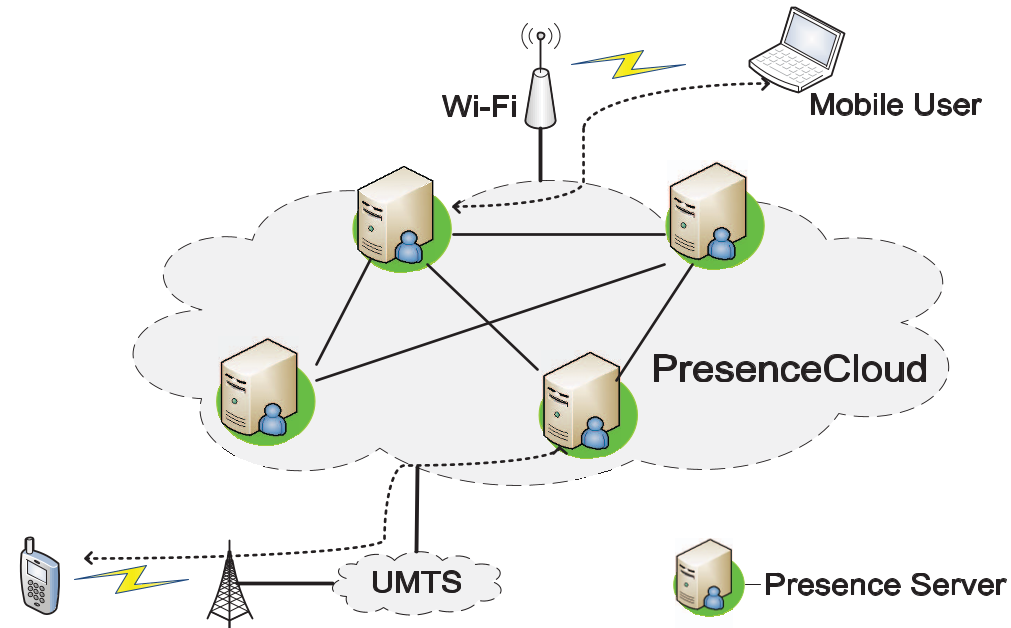
Instead of a chaotic mesh, servers are organized into a logical grid. Each server only maintains connections to nodes in its own row and column. This ensures that:
- Constant Diameter: Any server can reach any other server in exactly two hops.
- Balanced Load: The degree of each node is limited to .
2. One-Hop Caching & Redundancy
Every server caches the user list of its immediate neighbors. This one-hop "lookbehind" gives the search algorithm a massive shortcut: it doesn't just search the target server; it searches the target's entire neighborhood.
3. Directed Buddy Search
When a query arrives, the server hashes the buddy IDs to determine which grid row/column they belong to. It then aggregates these into "multi-buddy" messages.
Experimental Proof
The authors validated PresenceCloud using the King Topology (real-world Internet latency data).
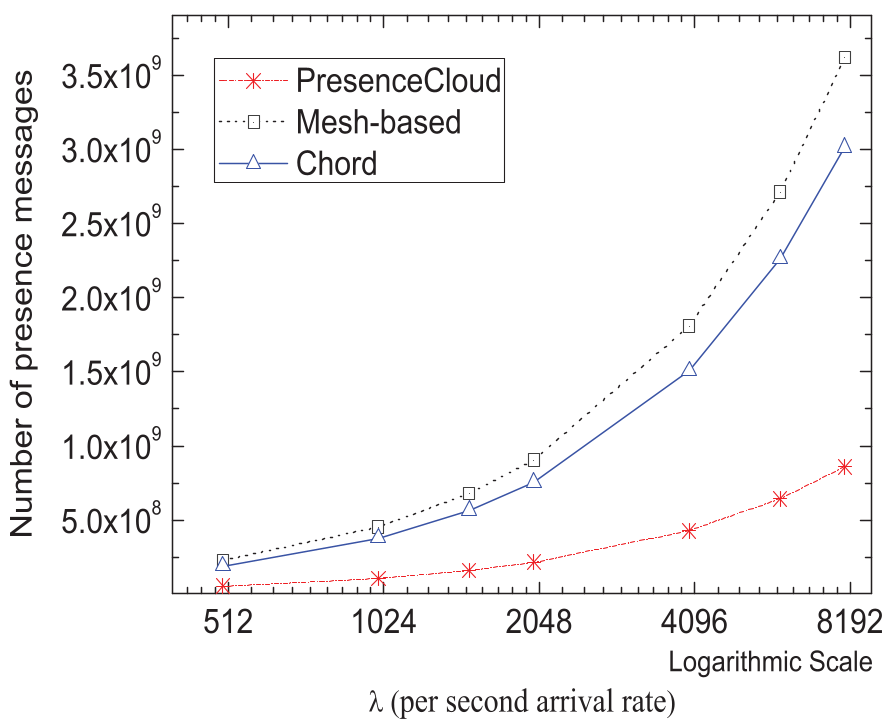
- Scalability: While Mesh systems explode in message volume as arrival rates () increase, PresenceCloud remains significantly more efficient.
- Latency Balance: In terms of "Search Satisfaction" (latency), PresenceCloud outperforms Chord significantly. While it is slightly slower than a pure Mesh (which is a global cache), it offers a sustainable trade-off for real-world deployment.
Critical Insight & Conclusion
PresenceCloud's true value is recognizing that presence information is highly ephemeral. Traditional Peer-to-Peer (P2P) systems like DHT were built for static file sharing. PresenceCloud correctly identifies that in a social context, "neighborhoods" (grid quorums) are more efficient than "global indices" (DHT).
Limitations: The paper assumes symmetric friend relationships for its analysis, though the method works for asymmetric ones. Future work would need to address the impact of highly "non-uniform" distributions (i.e., celebrity users with millions of followers) which might create "hot spots" in the grid.
Takeaway: For architects building the next generation of real-time multi-user systems, the lesson is clear: leverage logical geometric structures (grids) rather than logarithmic trees to keep latency constant and overhead manageable.