
Scalable Spatiotemporal Crowdsourcing: Solving the Smart City Logistics Puzzle
Scalable Spatiotemporal Crowdsourcing for Smart Cities based on Particle Filtering
The paper introduces two scalable algorithms, LCPF and NUD-IC, to solve the Geo-Task Scheduling (GTS) problem in mobile crowdsourcing. By leveraging Particle Filtering and DBSCAN clustering, the methods optimize task execution sequences for workers to maximize completed tasks under strict spatiotemporal constraints.
TL;DR
Mobile crowdsourcing platforms like Uber or Gigwalk often struggle with the "Traveling Salesman-style" complexity of scheduling. This paper introduces two algorithms—LCPF and NUD-IC—that use Particle Filtering and Iterative Clustering to help workers finish more tasks by accounting for how long a task takes to perform, not just how far away it is.
Background: Beyond the Nearest Neighbor
In the world of smart cities, a worker's revenue is tied to the volume of tasks they finish. Most current systems suggest the "closest" task next. However, the authors point out a critical flaw: a nearby task that takes two hours to complete might cause four other nearby tasks to expire in the meantime.
The Geo-Task Scheduling (GTS) problem is inherently NP-hard. As the number of tasks grows, the computation time for an optimal sequence explodes. The authors argue that a truly scalable system must consider:
- Execution Duration: The time spent "on the clock."
- Expiration Time: The "deadline" for the task.
- Spatial Scalability: Handling thousands of points across a city like New York.
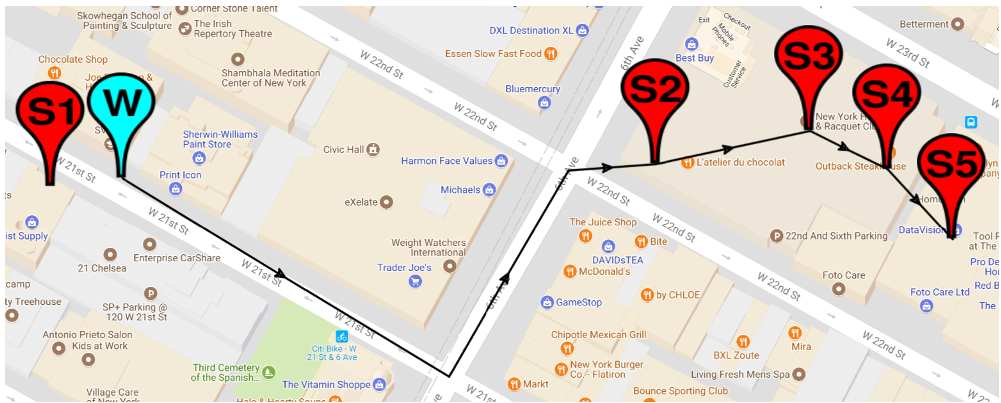 Figure 1: Example showing how a simple distance-based choice can lead to missing multiple deadlines.
Methodology: The Power of Filtering and Clustering
1. LCPF (Least Cost Neighbor with Particle Filtering)
Instead of following a single "greedy" path, LCPF maintains a set of "particles," where each particle represents a possible task sequence. It uses a Least Cost Neighbor heuristic to expand these sequences. By keeping only the most "promising" sequences (those that finish sooner) at each step, it explores the search space much more effectively than a simple greedy search without the overhead of exhaustive computation.
2. NUD-IC (Non-Urgency Degree with Iterative Clustering)
This is the more advanced approach. It introduces a new metric called Non-Urgency Degree (NUD).
- NUD Insight: A task is "non-urgent" if finishing it still leaves plenty of time for remaining tasks.
- Iterative Clustering: Before scheduling, the algorithm uses DBSCAN to group tasks. Crucially, it doesn't just look at distance; it groups tasks with similar execution durations. This prevents a "quick" task from being buried in a cluster of "long" tasks, which could ruin a schedule's efficiency.
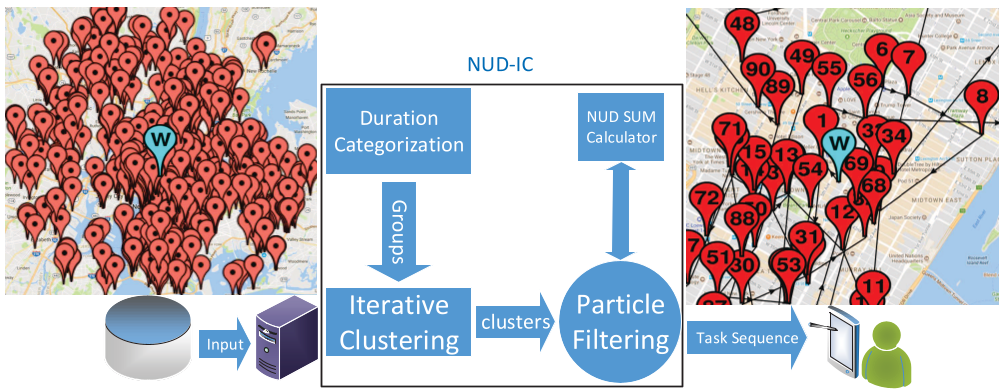 Figure 2: The block diagram of the NUD-IC system, showing the pipeline from task set to final schedule.
Experiments & Scalability
The authors compared their work against a brute-force approach. As shown in the table below, once the task count hits 40, the traditional approach takes over a day to compute, making it useless for real-time mobile apps.
| No. of Tasks | Brute Force Time | LCPF/NUD-IC |
|---|---|---|
| 20 | 24 seconds | Near-instant |
| 35 | 67 minutes | Sub-second |
| 40 | >1 day | Scalable |
The LCPF and NUD-IC algorithms provide near-optimal results while maintaining a response time suitable for mobile users.
Critical Insight: Why Particle Filtering?
The choice of Particle Filtering is brilliant because it treats the "sequence building" as a state-estimation problem. By weighting sequences based on their "completion efficiency" and "non-urgency," the algorithm naturally gravitates toward high-yield paths without getting stuck in local optima that plague simpler greedy algorithms.
Conclusion & Future Outlook
This work highlights that the "spatial" in spatial crowdsourcing is only half the story—the "temporal" (duration) is equally vital.
Future Directions:
- Road Networks: Moving from "Euclidean/Manhattan" distance to real-time traffic data.
- Multi-worker Coordination: Optimizing city-wide revenue rather than just individual worker success.
For developers of gig-economy apps, the takeaway is clear: stop just showing the "nearest" task. Start calculating the "ripple effect" of task duration on the rest of the worker's day.