
Scalable Cyberbullying Detection: How Incremental Computing and Smart Scheduling Save Lives
Scalable and timely detection of cyberbullying in online social networks
The paper introduces a multi-stage cyberbullying detection system featuring an Incremental Classifier and a Dynamic Priority Scheduler (DPS). Tested on Vine data, the system achieves SOTA performance in scalability and responsiveness, detecting incidents in large-scale social networks with minimal computational overhead.
TL;DR
Cyberbullying moves fast, but social media data moves faster. This paper presents a breakthrough in scalable and timely detection by moving away from "heavy" batch classifiers towards an Incremental Logistic Regression model paired with a Dynamic Priority Scheduler. The result? A system that can monitor tens of millions of sessions (like Vine or Instagram) on just a handful of cheap cloud instances, raising alerts 7 times faster than traditional methods.
Context: Beyond Accuracy
While academic research has spent a decade perfecting the "accuracy" of cyberbullying classifiers, the industry faces a different beast: The Scale/Time Paradox.
- Scale: Platforms like Instagram host over 40 billion media sessions.
- Time: Cyberbullying is a repetitive, evolving process. A late alert is often useless for victim protection.
Current SOTA models (like AdaBoost or Deep Neural Networks) are "static." Every time a user adds a new comment to a post with 500 existing comments, these models re-read all 501 comments. This is computationally suicidal at scale.
The "Work Smarter" Methodology
The authors provide a two-stage solution to kill the computational bottleneck.
1. Incremental Classifier: Only Process the "Delta"
Instead of re-evaluating an entire media session, the team designed an Incremental Feature Extraction algorithm. By selecting "incrementally linear" features (like total negative words or average sentiment), the system only needs to calculate the score for the new comments and add them to the saved state of the previous comments.
 Note: The system transitions from expensive AdaBoost to a highly optimized Logistic Regression that processes updates in constant time O(1) relative to total history size.
2. Dynamic Priority Scheduler (DPS): Focus on the Fire
Not all social media posts are equally likely to turn toxic. The DPS categorizes sessions into High and Low priority:
- High Priority: New posts or those showing increasing "toxic confidence" scores.
- Low Priority: Established posts that have remained civil.
Unlike a static filter, the DPS is "Dynamic." It uses a sliding average of confidence scores. If a civil post suddenly turns sour, its priority is elevated. If a toxic thread dies down, it's deprioritized, saving CPU cycles for more urgent threats.
Experimental Results: Radical Speedups
The performance gains are staggering. When compared to the previous baseline (Standard AdaBoost):
- Speed: The incremental approach was 223x faster for 50,000 sessions.
- Scalability: While a standard round-robin scheduler needed 40 AWS instances to monitor Vine, this system needed only 8.
- Alert Latency: The system achieved a 7x speedup in raising alerts for actual bullying incidents.
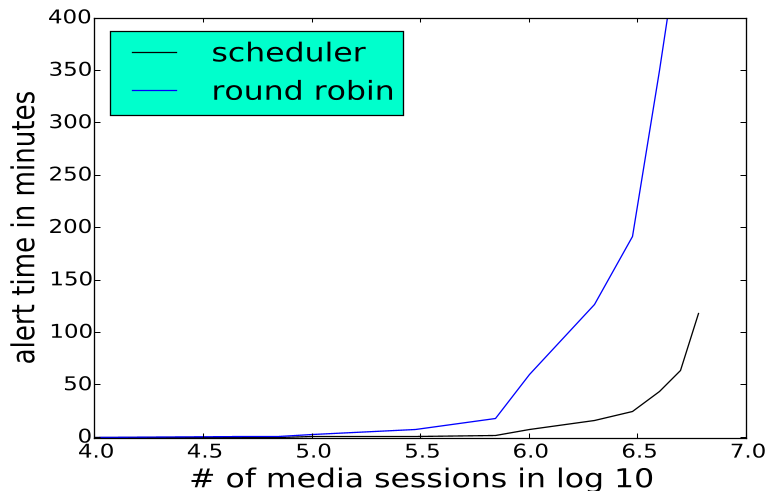 The graph shows that as the number of media sessions increases, the 'Gain Time Ratio' of the Dynamic Scheduler grows significantly, proving its value at "Internet scale".
Critical Insight: The Memory Plateau
An interesting find in the paper is the Memory Plateau. The authors noticed that increasing instance RAM beyond 32GB yielded no further performance gains. This suggests that in the world of real-time moderation, CPU/Computation, not raw Memory, is the ultimate bottleneck. This insight allows DevOps teams to cost-optimize their moderation clusters by choosing medium-memory, high-compute instances.
Conclusion & Takeaways
The paper proves that we don't always need the "most complex" model (like a 100-layer Transformer) to solve social problems. By combining a lightweight linear model with clever systems engineering (incremental logic + priority scheduling), we can build safety tools that are actually deployable in the real world.
Key Takeaways for Engineers:
- State Matters: In streaming data, don't re-calculate; update your state.
- Prioritization is Optimization: Monitoring everything equally is a waste of resources.
- Timeliness is a Metric: High accuracy is irrelevant if the alert arrives after the harm is done.